Tag

fundraising

Local nonprofits implement different strategies for annual fundraisers in wake of COVID-19

By Feature

by Shari L. Finnell, editor/writer, Charitable Advisors

For School on Wheels, an Indianapolis nonprofit that provides tutoring for children facing homelessness, the potential loss of funds from its annual fundraiser in 2020 would have been devastating — a significant blow to its ability to carry out its mission in the midst of the COVID-19 pandemic.

Education Celebration generates 25 percent of School on Wheel’s annual budget, according to Amber Ewing Kostoff, CFRE, vice president of development. In 2019, it brought in more than $270,000 from sponsorships, live and silent auctions, ticket sales and a matching gift opportunity for about 400 attendees.

“It’s a big deal for us,” Ewing Kostoff said.

When Indiana started reporting its first cases of COVID19, School on Wheels event organizers immediately started considering alternative options for their 2020 Education Celebration. It was originally slated for April, just weeks after Indiana Governor Eric Holcomb started issuing statewide restrictions, including a shelter in place order, effective March 25.

“When all the news about the pandemic and the restrictions coming to fruition, we didn’t feel comfortable about having an event with more than 400 people in a room,” Ewing Kostoff said. At the time, we weren’t sure how things were going to look like going forward.”

As with hundreds of other nonprofits in Indiana, School on Wheels had invested a significant amount of time and resources into event planning because of multiple benefits. A successful fundraiser not only provides an avenue for generating funds, it gives nonprofits the opportunity to meet donors and volunteers face to face, showcase the mission, and recognize sponsors, volunteers and supporters.

While inclement weather always has posed a threat to plans for galas, 5Ks, parties and other event fundraisers in Indiana, COVID-19 has had an unprecedented impact — disrupting plans for nonprofit organizations of all sizes throughout the year.

Zoobilation, one of the most widely anticipated black-tie fundraising events in Indiana, was canceled for the first time in its 34-year history. Organizers originally had postponed the date, moving it from June 12 to August 14, in the hopes that it could be hosted in a safer environment for its 5,000 guests by that time. The fundraiser supports general operating expenses for the Indianapolis Zoo.

With COVID19 undergoing a resurgence, Zoobilation organizers last week announced its decision to cancel the event. “It was painful to cancel it but not difficult considering what was in the best interests of our guests and partners,” said Julie McDearmon, CFRE, director of Institutional Advancement at the Indianapolis Zoological Society.

Organizers of Rev Indy, an IU Health Foundation fundraiser that supports statewide trauma and critical care programs, also decided to forego its 2020 celebration because of the potential health risks, said Carol A. Howard, executive director of Rev.

“We spent months weighing all the options to safely hosting Rev this year,” Howard said. “Our number one goal as a leading healthcare organization is to safeguard the health, safety and well-being of all of our guests, vendors, chefs, entertainers and volunteers.”

The cancellation of these major fundraisers followed extensive research and planning, according to their organizers. Some of the questions that emerged included: Do you approach sponsors and ticket holders about maintaining their financial contribution — even in the face of their own potential economic hardships? What about investing in the logistics of planning an alternative virtual event? And, with cases of COVID19 resurging in Indiana, how do you plan for future events?

“There’s not a one-size-fits-all solution,” said Zoobilation’s McDearmon, who noted that she has previously worked at nonprofits of varying sizes and resources. “Ultimately, you have to do what’s best to protect your brand and reputation as well as those of your sponsors and partners. If you can’t host your event safely, then you need to weigh different options.”

McDearmon said it’s also important to include committee members in conversations about how to move forward.

Howard stressed the importance of being fluid with planning in the midst of a changing environment.. “We are in a time that ‘new’ event concepts can be born and executed safely during this time, which ultimately can create new opportunities for non-profits in the long term.”

As part of its planning in the wake of COVID-19 and social justice protests locally and nationally, Rev organizers announced that some of the proceeds from its canceled 2020 event would be directed to the Iu Health Foundation’s Racial Equity in Healthcare Fund.

Ewing Kostoff pointed out that virtual events may be a possibility. School on Wheels hosted an online option and, as a result of that event and the generosity of its donors, reached its fundraising goal. “Focus on what makes sense for your individual organization,” Ewing Kostoff said. “It has to make sense for what you’re trying to accomplish. Who is your audience? How do you get them engaged? What can your staff do in a short amount of time? Those are critical questions to ask.”

School on Wheels Hosts a Virtual Event

When event organizers for School on Wheels’ Education Celebration first understood the initial impact of COVID-19, they made plans to postpone the April event to June 25. “We hoped things were looking different by then,” said Ewing Kostoff. “We also wanted to try to get the event in before the end of our fiscal year..”

With uncertainty increasing about the viability of hosting the June 25 event, the team started exploring another Plan B, an option that would take them into unchartered territory. The Education Celebration committee members researched online for tutorials on how to host a virtual event. They also contacted other nonprofits that had switched to virtual events, including Second Helpings and St. Mary’s Child Center.

After making the decision to host a virtual event, the planning committee focused on several critical areas, including how to deliver value to sponsors. “By the time we got to March, we had already secured all of our sponsors,” Ewing Kostoff said. “We felt we had to deliver the benefits that we promised them from an in-person event, something creative and equitable.”

While the organization wasn’t able to offer sponsors tangible items like a table with dinner, they realized they could adhere to the idea of highlighting their brands in a program. In addition to featuring the sponsors on the homepage of the Education Celebration site, they featured them in an ad in the Indianapolis Business Journal, social media posts and other platforms. “We tagged them at every opportunity,” Ewing Kostoff said.

Another critical focus was the event’s auction, which relied on the donations of local businesses. Typically, organizers would approach businesses for gifts to sporting events, concerts, hotel stays and restaurants. “We felt we couldn’t go to those people and ask for those things,” Ewing Kostoff said. “We didn’t want to ask restaurants for donations at a time when they’re closing their doors. We never want anyone to feel pressured”

However, Ewing Kostoff said she did heed the advice of some of her fundraising peers:“It never hurts to ask. Give them an option.”

While the donated items were smaller in scale than in previous years, bidders paid more than they had anticipated. “They wanted to support what we’re doing,” Ewing Kostoff said. “We have the most amazing sponsors. They stuck with us and showed us, ‘We’re with you.’”

Promotion also was a key consideration as part of the event planning, Ewing Kostoff said. With an in-person event, organizers were focused on a limited number of people. That focus shifted significantly with an online event.

“We could widen the scope of our audience,” Ewing Kostoff said. “With an in-person event, you’re limited to the number of people you can put in the room. We reached out to all the supporters, sponsors and people who attended any of our events in the past. We let them know that we’re doing a virtual event and invited them to sign up to receive text messages.”

They also included online event details in newsletters and all of their social media channels, and encouraged their supporters to invite their friends to the online event.

When planning an online event for the first time, Ewing Kostoff said, it’s important to keep the right focus. “Focus on what makes sense for your individual organization, what you’re trying to accomplish and how to get your audience engaged,” she said. “And focus on it being the best virtual event you’ve ever done. Don’t try to compare it to what we’ve done in the past.

“That took the pressure off our team,” Ewing Kostoff added. “We’re really proud of what we were able to pull together. It was wonderful to see how many people came through that day and the next day.”

Another key takeaway from Ewing Kostoff was the importance of conveying the message of the nonprofit’s mission in the midst of the pandemic.

“We provide tutoring for children facing homelessness. We typically provide that tutoring onsite, in schools and in shelters,” she explained. “When things started to shift in March, we really did have to pivot. We had to figure out how to reach those students. One of the barriers for a lot of kids we work with is technology. We started having conversations with our partners about ways to get students the tools they need so they don’t fall behind.”

School on Wheels consistently explores different ways to convey the message behind its mission, Ewing Kostoff said. “Our mission doesn’t go away. The need for education never stops, We try to stay focused on the importance of what we’re doing and how to embrace new ways to talk about what we’re doing.”

Zoobilation Looks Ahead

While Zoobilation has an enviable reputation, selling out all of its 2019 tickets in less than 10 minutes, organizers don’t take its popularity for granted.

“We pretty much plan the next year before we even finish the current year,” said Julie McDearmon. “Before we decided to postpone, we were already planning Zoobilation 2021. We’re constantly having to look forward — even strategically looking five years out to determine how to keep it exciting. It’s a constant cycle.”

Before its cancellation, Zoobilation 2020 was projected to raise $2.5 million in support of the zoo’s mission of empowering people and communities, both locally and globally, to advance animal conservation. That amount represented approximately 8 percent of the Indianapolis Zoo’s annual operating revenue.

When making the decision to cancel Zoobilation, organizers prioritized the health of its supporters as well as the long-term reputation of Zoobilation and its partners, according to McDearmon.

They also considered the economic fallout caused by COVID-19. “Our restaurant partners and many sponsors have been hit hard this year and are struggling. That was another strong consideration in canceling Zoobilation,” she said.

McDearmon also said it was important to offer ticket holders various options in response to the cancellation of the event. They were given the opportunity to donate the cost of the tickets, ranging from $300 (general admission) to $600 (Premium Experience), as a charitable gift; repurpose the ticket for Zoobilation 2021 or request a refund.

“We know many people are struggling right now. All of us at the Indianapolis Zoo are grateful that people are being very generous and letting us keep their Zoobilation ticket fee or sponsorship as a full donation,” she said. “We also realize that there are some who aren’t able to do that.”

Early on, as Zoobilation committee members discussed options for the 2020 event, they considered the possibility of hosting a virtual event, McDearmon said. Their research included observing virtual events hosted by other zoos and aquariums.

At the end, they decided it was not a viable alternative for Zoobilation. “When you have a production that’s this big, you have to pay a lot to execute it well. You need to consider if you can give your guests the same experience they expect and pay for normally,” McDearmon said. “Virtual events may work for some nonprofits, but the Indianapolis Zoo decided the event execution wasn’t there for us.”

As in previous years, McDearmon, her events team, and other Zoobilation committee members are already looking ahead. Plans for Zoobilation 2021 are underway, including logo and other creative development and corporate partnerships.

With COVID-19 impacting all nonprofits in some way, it’s important to explore many options to determine the best path forward, McDearmon said.

“Every nonprofit organization has varying degrees of resources,” she said. “There isn’t a one-size-fits-all solution for every nonprofit as they navigate the special events landscape during this challenging time. My advice would be to protect your brand, image and reputation, and that of your sponsors and partners, when you determine how to proceed.”

Rev Indy navigates a new path

For the past six years, Rev Indy has played a vital role in supporting IU Health’s mission.

“Our funding goals have been focused and deliberate to ensure no matter where you are injured in Indiana, you can access IU Health Trauma Care,” Howard said.

Funds raised from Rev 2019 were specifically directed to support 911 access trauma ESO integration, a new mobile critical care ambulance and trauma education.

Like other nonprofits, the discussions about what to do with Rev 2020 started early in the year, as COVID-19 cases were being reported in Indiana. The decision-making process involved several factors, Howard said.

“If we took a ‘show must go on’ perspective during a public health crisis, it may make our guests feel we are being irresponsible or inconsiderate of their health,” Howard said. “The long-term impact could be a significant loss in giving. Since we are a healthcare organization, our decision will be under a microscope.”

Also, since the serving of food and beverages is a significant part of Rev, many of the biggest contributors to Rev are facing economic challenges caused by the pandemic, she said. “Many restaurant partners have been facing months of lost revenue.”

“Another consideration was the safety of staff members and volunteers working during the event,” Howard said. “We had to ask ourselves, ‘How will this outbreak impact the safety of our team? Are we risking their well-being?’ These are questions we had to consider.”

After outlining their concerns, the Rev committee consulted with its legal team to navigate options as COVID-19 updates emerged. “They were extremely helpful in looking into all of our concerns,” Howard said.

With Rev attracting a large crowd of guests intermingling over food and drinks, the risks were clear, Howard said. “With large events, it is difficult to enforce social distancing and occasional bottlenecking of people in certain areas, such as entrances, egresses, and restrooms.”

While the Rev committee eventually decided to cancel the event, they also used it as an opportunity to expand its impact.

“Over the last year, we have been looking to expand Rev’s funding opportunities,” Howard said. “In the wake of the Black Lives Matter movement, a donor asked how he could help IU Health do something about the stark differences in health among racial and ethnic groups, which were brought to the forefront during the COVID-19 pandemic.”

Howard said that IU Health had already been addressing these differences on many fronts, needed a focused fund through which donors could support a broad range of initiatives.

“The IU Health Foundation created the Racial Equity in Healthcare Fund to support IU Health’s work in advancing equitable care for all and we felt it was a perfect time to expand our funding opportunities,” she said. “This fund will support creative and effective initiatives addressing health inequities among Hoosiers.”

Rev ticket holders and sponsors were given the option to donate funds to the IU Health Foundation to reduce racial equity in healthcare or statewide trauma and critical care programs, or to transfer their tickets to Rev 2021.

Top sponsors who chose to donate their funds were invited to “Taste of Rev,” an Aug. 1 event that allows up to four cars from each company to drive around the Indianapolis Motor Speedway, stopping at pit stop locations along the way for pre-packaged food and beverages and photo opportunities.

“We also accommodated everyone who requested a refund for this year’s event if either options did not work for them,” Howard said.

Discovering the power of the podcast

By Technology

By Lynn Sygiel, editor, Charitable Advisors

Just four short years ago, few people would have recognized the name – or the voice – of Sarah Koenig. Today, Koenig, an investigative journalist, engages millions of people and is among the world’s most-listened-to storytellers.

Koenig’s medium? The podcast, a once-humble and somewhat experimental method of delivering content to the general public.

Koenig is the host of “Serial,” a podcast that tells a nonfiction story over multiple episodes. Earlier this month, Koenig was in Indianapolis as part of WFYI’s Listen Up speakers’ series.

According to Slate magazine, the word “podcast” first appeared in a news story in 2005. But for years, podcasts remained on the fringes, unable to gain traction until smartphones and apps made information easily accessible and a lot more portable.

Matt Shafer Powell, WFYI’s chief content officer, produced his first podcast in 2005. He was working in Knoxville, Tennessee, and a university IT staff person read about podcasts and suggested using this platform to distribute content.

According to Powell, there was an initial flush of podcasting, and then growth seemed to die.

“We were actually kind of talking about it in terms of ‘Yeah, remember when podcasting was such an interesting idea. Boy, those days are gone.’

“And then all of a sudden, there came this wholesale embrace of podcasting from so many of the big players, like “This American Life,” and groups like that. It just exploded and then “Serial” came along.”

And just how has the medium grown? Earlier this year, Chartable, a company that provides podcast analytics and attribution tools, reported that there were 700,000 available podcasts, and that number is growing. Each month, 32 percent of Americans listen to a podcast.

But does that mean that nonprofits have embraced the format?

Bill Stanczykiewicz, the Fund Raising School’s director, knows firsthand what it takes to regularly produce a podcast. In late January 2018, the school launched “First Day,” a weekly 10-minute podcast to provide organizations with the latest information on fundraising and philanthropy.

“I would speculate that the format probably works best for intermediary-type nonprofit organizations. Many of our nonprofits are literally first responders who are meeting needs and making the world a better place as they serve children and victims of domestic violence, promote the arts, clean the environment, endorse animal welfare, all these things. That’s a lot of hard work on a day-to-day basis and to think about setting aside time for podcasts could be a challenge.”

So that’s why Stanczykiewicz’s team has kept the format short, and before the launch of “First Day,” identified its three strategic reasons.

“One is that we believe strongly that podcasts are the medium of now and definitely the medium of the future. More and more people are turning to podcasts for information. I think of college students who tell me they never read the New York Times, but they listen to the NYT podcast every day.”

The Fund Raising School had a multichannel marketing strategy, and a podcast was a seamless fit. It also ensured that the school’s information is accessible, including internationally, for fundraising and nonprofit professionals.

“We know you’re making the world a better place, so it’s 10 minutes in, out, done. Get practical information that you need and get back to work is another reason why we chose that format,” Stanczykiewicz said. In the year and a half of production, there have been only two occasions when the format deviated from the interview format. Typically, Stanczykiewicz said, he is the objective host, and there is a featured guest.

“We tell the guests in advance, this needs to be translated for practical application for frontline fundraisers. We cannot have our very talented faculty and researchers talking about research; it has to be what does this research means for practical fundraising. We wanted it to be quick, right to the point. If you want more information, you can go to our website. We know that fundraisers are busy people, we wanted to summarize, three big points, and then be done.”

And while WFYI’s Powell said he’s not an expert on podcasting, public radio had an early upper hand. In 2005, NPR emerged as a major player with a ready supply of content when it put out shows like “Fresh Air,” “Planet Money” and “Ted Radio Hour” online.

“We were on the air already doing in-depth reporting, and that kind of storytelling, so it was an easier fit to move it over to the podcast realm than maybe some other media entities. In a lot of ways, we’re learning right along with everybody else.

“I think it’s a really exciting time. It’s scary, but being in media has always been scary because it’s in a constant state of change. I think when it comes down to it, people still love, and will always love a good story,” said Powell.

He, like Stanczykiewicz, believes that audio-only content isn’t going away, because it allows the listener to engage in other activities, like jogging or cooking. He said the case for radio over 100 years ago was that it allowed an individual’s imagination to fill in the gaps, and that hasn’t changed.

“I believe that about audio-only content despite the fact that we are going through changes in how it’s delivered. We’ll continue to go through changes, but there’s always going to be a place for good content, good stories and the human voice,” said Powell.

Stanczykiewicz said the format of the school’s podcasts works for them, and urges nonprofits or individuals to have a plan before launching any type of podcasts.

While he has a background in radio, he earned a leadership certificate on social media from the Owen Graduate School of Management at Vanderbilt University. One point that was stressed in that training was to release it on the same time and day or days of the week. So, because “First Day” is released on Mondays, it is aptly named, and while some people have suggested they produce a daily podcast, currently the school doesn’t have that capacity or a plan to increase production.

Powell urged potential podcasters to be realistic about whom you want to reach.

“There’s nothing wrong with doing a podcast that only reaches a small, but selective group of people. Be realistic about who your audience is and what you want from them: Do you want to entertain them, do you want to educate them, do you want to inspire them?” he said.

While the Fund Raising School does not have exact audience listeners, typically the week a podcast is released, Stanczykiewicz said there are 500 listeners. Each podcast is archived, and anecdotally, the school learned that people use the 10-minute segments at staff and board meetings. Over time, podcasts, which Stanczykiewicz said cost virtually nothing to produce, have achieved up to 1,000 listeners.

Powell recommends identifying resources as part of the initial planning, but said that equipment and hosting are not expensive. He cautions that it depends on the final product. From his experience, though, he said it takes 10 times longer than initial projections.

“If you’re talking about the kind of podcast where you’re going out and getting stories and editing these stories and getting music and doing all this other stuff, there’s going to be a pretty financial obligation there unless you got all the equipment and all the time in the world and can do it yourself,” said Powell.

And while podcast audiences are growing, some genres are more appealing. A 2018 report from Nielson examined the broadest popularity types for avid listeners.

The Fund Raising School’s format, for example, requires little editing. Guests are told it’s live to tape with just one take. Liz Jackson, the school’s associate director, manages the program, and this past school year, there was a graduate assistant who did the day-to-day work of scheduling, preparing the guests, uploading the podcasts and tracking usage data. Unlike most nonprofits, the school’s advantage is access to IUPUI’s facilities, which include a video- and audio-recording studio that is staffed. Topic ideas are a standing agenda item at bimonthly team meetings.

“We brainstorm what’s some of the latest research that has come from our faculty or research team, or as we teach, is there a predominate line of questioning that we’re hearing about, a topic that we’re hearing about, or is there something out in the news. For example, we might say there’s been some natural disasters, maybe we need to have something on natural disasters or how does that affect charitable giving or some change in tax policy,” he said.

Podcasts are recorded two to three months prior to air time to make sure there’s always enough in the pipeline, and typically the interviewees are solicited from the two-dozen faculty,10 researchers or external guests speaking at the school.

For WFYI, podcasts have typically been local radio shows that are available on-demand. That was until “The WorkAround” from “Side Effects.” Funding from the Corporation of Public Broadcasting provided the initial funding for “Side Effects,” and in the grant was a deliverable — a podcast. After extensive brainstorming, the team decided to produce 20- to-25-minute podcasts about the difficult and sometimes shocking things that people would do to work around the American health care system. Seven episodes were produced last year.

“It was a learning experience. We totally underestimated how much time and energy it would take. You’d think that that would be a great lesson for us, but we actually have another podcast in production right now called “Sick” that’s going to launch in September,” said Powell.

Some support for this new podcast is provided by Boston-based PRX.

“PRX had this program called “Catapult.” It was designed specifically to (support) public radio stations that had some ideas and some resources available for podcasts, but really didn’t know what they’re doing. I’m happy with “The WorkAround.” It’s good journalism, and I think it came out sounding good, but we had no clue what we were doing, we were totally flying without instruments. We also didn’t know how to market something like this or how do you get listeners?

“And then along comes PRX with its RFP saying, ‘Hey, if you have a podcast idea, we’d love to help you with it.’” WFYI was one of five stations named around the country to be part of the “Catapult” cohort. PRX provided some funding to help with the costs, but it is providing something more valuable.

“The important part is they’re putting us through extensive training on everything from the best way to produce a podcast, to the best way to write one, to the best way to market one. Really more than anything, it’s the intense training that we’re getting out of  ‘Catapult,’” said Powell, who’s been with the station for two years.

The reporting and production team are Jake Harper and Lauren Bavis, and they have traveled to Boston several times for boot camp training weeks. PRX has also been a constant editorial presence, offering suggestions to hone the product.

“I’m anxious to see what the output will be in terms of lessons for us going forward,” said Powell.

So if a nonprofit is thinking about tackling a podcast, Powell shared advice that Koenig provided her audience earlier this month — be your true self.

“If you’re just trying to create this podcast, and it’s not something that engages you, people are going to recognize that. It’s a heavy, heavy lift. Koenig, for example, had 42 hours of tape with Adnan Syed that had to be gone through. There’s a long process of editing and reediting and questioning and re-questioning. In that kind of storytelling podcast, you better be prepared to really work long and hard,” he said. “People say, ‘That sounds easy, I can do that.’ But they don’t know what’s involved.”

Stanczykiewicz said that if the philanthropic sector isn’t there yet, it needs to be.

“As more and more people are consuming information through their phones and other technological devices, they’re looking to podcasts now for information more than ever before. And that’s a trend in our opinion that’s only going to continue to increase. This is where the world is going,” he said.

“It will be very interesting to see this moving forward. You know when you write this story three years from now, I think they’ll be even much more extensive than what you’re finding now,” said the assistant dean for external relations.

Editor’s note: After this article ran, the Girl Scouts of Central Indiana shared news of its podcast. Since February, it has partnered with Veteran Strategies, a local public relations firm, to interview Hoosier community leaders. The inaugural “Leaders and Legends” podcast featured former Mayor of Indianapolis Greg Ballard. https://leadersandlegends.fireside.fm/ 

Brackets For Good, Research for All

By Sponsor Insight

By Leslie Wells, Assistant Director of Communications, SPEA at IUPUI

Huddled around a kitchen table, Cali Curley, Jamie Levine Daniel and Marlene Walk discuss their latest research project. They’re focused on the innovative concept of competitive philanthropy.

“We typically don’t talk about nonprofits in terms of competition, despite the fact that they are competing for resources,” Levine Daniel says. “While nonprofits often have a negative view of competition, we wanted to explore its true impact.”

A SPEA research team now has its chance, thanks to the charitable organization Brackets For Good. Each March, the nonprofit hosts March Madness bracket-style online fundraising tournaments in cities around the country.

Since its inception, Brackets For Good has helped nonprofits raise more than $6 million. The Indianapolis-based nonprofit got its start in 2011 and has now expanded to 13 cities and states. Participating organizations try to out-fundraise the others. Each nonprofit keeps its donations, while each tournament’s winner receives an additional $10,000.

With so much on the line, organizers at Brackets For Good wanted to ensure their program was setting up participants to succeed. In 2015, Matt Duncan, co-founder and deputy director of Brackets For Good, and his team turned to the School for Public and Environmental Affairs at IUPUI for help in designing evaluation questions that would create a more balanced bracket.

“We really needed an academic-research approach,” Duncan says.  “We knew SPEA could help us design questions that would help us better evaluate which organizations would be best suited for this tournament. That’s why we turned to SPEA.”

“The academic perspective allows them to say their process has been vetted through research scholars at a university, increasing credibility and notoriety in both the nonprofit and academic sectors,” Curley says. “This collaboration also allows Brackets For Good and SPEA to be on the leading edge of what’s happening in the nonprofit world with competitive philanthropy.”

Curley began reviewing the application survey for the tournament three years ago. She soon brought Levine Daniel and Walk on board, relying on their nonprofit research expertise to advance the project.

“We saw this as an excellent opportunity for research,” Walk recalls. “Current nonprofit literature already tells us how individual characteristics – such as gender, race, or religion – impact philanthropic giving. What we want to know now is whether there are softer forms of identity, such as a sports-identity or being competitive, that could drive or promote giving as well.”

The team began analyzing data and developing new application surveys. They examined features such as a nonprofit’s mission awareness, its number of employees and volunteers, how much the organization had in its unrestricted fundraising budget, as well as the nonprofit’s social media habits.

IUPUI students were also able to take advantage of this unique research and evaluation opportunity. Curley and Walk use the project in their classrooms as a learning tool for students spanning several majors, including Sustainable Management and Policy, Media and Public Affairs, Policy Studies, and Civic Leadership. Levine Daniel discusses the research in her courses, as well.

“This project provides students with an opportunity for experiential learning,” Curley adds. She points to the fact that students not only get hands-on experience in data and evaluation, they also learn about local nonprofits. “We approach it from this dynamic space of teaching students to learn about their community and be more engaged and involved, while also doing an evaluation for Brackets For Good in a meaningful way.”

The research team led by example, showcasing SPEA’s commitment to community partnerships. The team says this project allows them to keep their finger on the pulse of the nonprofit sector in Indianapolis, while getting a better sense of what makes it tick. The selection paper only used data from Indianapolis, allowing the research team to model selection statistically and provided a model that Brackets For Good could ‘scale up’ to other communities. BFG applies the survey and evaluation tool to all participating organizations.

While the research is still in the peer-review process, the initial findings from their research show commonalities among organizations that made the cut into the tournament. They rated higher on being tech savvy and were more active on social media. They had a higher amount of unrestricted funds and larger volunteer bases. In addition, organizations that had more community awareness of their mission were more likely to make it into the tournament.

These findings have allowed Brackets For Good to revamp its application survey, ensuring that divisions, rankings and match-ups are more evenly paired.

“SPEA took the competition to the next level,” Duncan says. “They created a much more fair and robust bracketology than what we had developed on our own.”

But can that bracketology predict which organizations will make it all the way to the end?

“If we can provide Brackets For Good with data and studies on topics such as effective messaging and risk mitigation, that will allow them to improve the guidance they provide to organizations, which hopefully enhances the experience for everyone,” Levine Daniel adds.

“We have not yet found out what actually makes organizations successful in the tournament. That’s the next step,” Walk says.

The team is currently combing through the latest data and piecing together the characteristics of winning organizations that will allow Brackets For Good to develop a toolkit for nonprofits. At the same time, Curley, Levine Daniel and Walk also are using this project to boost opportunities for students and SPEA.

“We’re building expertise and laying the groundwork for future research,” Levine Daniel adds. “Now, when people think about competitive philanthropy, they will think about SPEA.”

[content_box box_type=”normal”]Brackets For Good runs from March 2 through April 6. To learn more about organizations in the competition, build your own bracket or donate, click here.[/content_box]


Leslie Wells joined SPEA as its assistant director of communications in 2018. She previously spent more than a decade in broadcast news and three years as media relations manager at the Indiana Youth Institute.


The state of storytelling in the nonprofit sector

By Feature, Fundraising, Leadership

By Vanessa Chase, founder, Storytelling Non-Profit and Network for Good

Stories have been a huge trend in the nonprofit sector in the past five years, but our sector has been telling stories for much longer. Year after year, we are committed to telling people about our work, progress, and needs. Each time we communicate these things, we are communicating pieces of the larger narrative about our organization.

But things are changing, and storytelling is becoming a much more intentional act. Across the for-profit and nonprofit sectors, storytelling is a buzzword and communicators are consumed with telling stories that will engage their target audience. In the nonprofit sector, donors make up that audience. Our challenge is getting our current donors to give more and acquiring new donors who care about the cause. This is not a new or small task for our sector.

“The State of Storytelling” is a project that came to life out of an interest to know how the nonprofit sector is actually using stories and what results organizations are getting. Stories are constantly talked about as a tactic, but are they really helping nonprofits get better fundraising results?

Button Text

Three key fundraising opportunities for Indiana nonprofits

By Sponsor Insight

By Jen Pendleton, CFRE, vice president-Indiana, Aly Sterling Philanthropy

In my new role as vice president with Aly Sterling Philanthropy, I’ve been meeting with nonprofit leaders like you, all over Indiana.

While you and your fellow leaders represent a diverse group of organizations dedicated to a range of causes, I’ve discovered that, regardless of your organization’s size or type, you share many of the same challenges.

Can you relate to any of the following?

  • Is your nonprofit struggling to increase annual fund giving and also bring in major gifts?
  • Do you feel alone and unsupported within your organization when it comes to fundraising?
  • Do you struggle to engage your board members fully?

Now, I choose to be optimistic and refer to these challenges as opportunities – because that’s ultimately what they are! Every one of these issues is solvable with some planning and careful thought to address the issue at its root cause.

Consider the areas of OPPORTUNITY below and how they apply to your organization.

  1. Leadership

Many of you shared your struggle to find board and staff leaders who are great at what they do, willing to work hard and, most importantly, able to stick around longer than a year or two.

Consider these points:

  • Plan ahead for succession and dedicate time to strategically recruit and onboard your leadership. It’s one of the most important things you can do all year.
  • Look in your current donor and constituent pool and proactively recruit people who already love your organization and care about your mission.
  • Take time to get to know each board member individually. Meet with each of them (or at least call) once or twice a year to talk, catch up and see how they think things are going. You’ll be amazed what an impact it can have on you and your board member!
  • Make sure you and your fundraising staff have support from organizational staff and board by encouraging intentional collaboration.
  • Take time to celebrate your successes and say thank you! It makes everyone feel good and keeps staff and board energized and committed.
  1. Time and resources

Every organization says resources – people, money and time – are the biggest challenges to their mission. The “overhead myth” seems to be alive and well, and most of you are still trying to do more with less.

Consider these points:

  • Assess where you, your staff and board are spending your time. Is it on the most important things?
  • Determine what you can stop doing, what you should start doing and where you need to invest to accomplish your most strategic goals.
  • Ask your board for the resources needed to meet your mission. Show them a plan for reaching your goals and ask for their investment.
  1. Building a culture of philanthropy

In most organizations, only one or two people focus on stewardship and/or fundraising. At least one organization I spoke with doesn’t have any fundraising staff.

Why does this matter? Because best practices show the most successful organizations are those that create a “culture of philanthropy.” This means they involve everyone in every department at every level in raising money and stewarding donors. If you think your development director is your #1 fundraising tool, think again. That grumpy, uninformed person answering your phone or working the front desk can undo months of cultivation in one conversation.

Consider these points:

  • Assess how many people are focused on fundraising and stewardship in your organization.
  • Consider what would happen if you leveraged all staff and board to be evangelists, “thankers” and cultivators of your donors and mission.
  • Start small. Determine what your culture of philanthropy looks like and build a pilot culture with a few key people… then refine and launch to board and staff when you have some wins!
  • Don’t be afraid to try new things. To grow to the next level, change is required. Assess what you can stop doing and create the time to start doing more meaningful work that matters and helps bring more revenue and resources in the door!

It’s true that collaboration, resources and culture – mixed with planning and careful thought – are the keys to solving organizational challenges as well as the larger issues impacting our community and world. You’re immersed in the work of both, and I’d like to help.

Let’s get started! I’m happy to meet with you and your team to brainstorm soon. It’s how we do business – build relationships first – at no cost to your mission.


jen-pendleton Jen Pendleton, CFRE, is vice president of Aly Sterling Philanthropy, leading the firm’s work in Indiana. Before coming to ASP, Jen served as president and CEO of the Community Foundation of Boone County (Indiana), where she led a campaign to raise $1 million in matching funds from the Lilly Endowment for the county’s Community Impact Fund.

Giving is up: What does that mean for fundraising?

By Sponsor Insight

By Una Osili, director of research, Indiana University Lilly Family School of Philanthropy at IUPUI |

Last year charitable giving from individuals, estates, foundations and corporations hit a record $373 billion, according to Giving USA 2016: The Annual Report on Philanthropy for the Year 2015.

The years 2014 and 2015 represent the highest and second-highest totals for giving in the past 10 years, adjusted for inflation. But total giving grew more slowly in 2015 — increasing by 4.0 percent adjusted for inflation — compared to the 6.1 percent increase we saw in 2014. The slower rate of growth in 2015 reflected changes in several of the economic factors that influence giving: while most were still positive, their growth was not as robust as in the preceding year.

Still, contributions from all four sources of giving and to all but one of the nine categories of nonprofits receiving those gifts (the exception was giving to foundations) went up in 2015. This suggests that while the giving climate was not quite as strong in 2015, the overall environment for giving remains favorable.

Individuals were responsible for the largest share of giving last year, providing 71 percent of the total, while foundations saw the largest year-over-year percentage growth among the sources of giving, increasing the amount they collectively gave by 6.5 percent.

The longest-running and most comprehensive report of its kind in America, Giving USA is published by Giving USA Foundation, a public-service initiative of The Giving Institute. It is researched and written by the Indiana University Lilly Family School of Philanthropy.

Here’s a closer look:

2015 Charitable Giving by source

  • Individual giving, $264.58 billion, increased 3.8 percent in current dollars over 2014.
  • Foundation giving, $58.46 billion, was 6.5 percent higher.
  • Charitable bequests, $31.76 billion, increased 2.1 percent.
  • Corporate giving, $18.45 billion, grew 3.9 percent.

Highlights of 2015 gifts to selected categories of nonprofits

Five charitable subsectors saw large increases in 2015:

  • Education: giving increased to $57.48 billion, growing 8.9 percent.
  • Public-Society Benefit: the $26.95 billion given in 2015 was an increase of 6.0 percent
  • Arts/Culture/Humanities: at $17.07 billion, growth in current dollars was 7.0 percent
  • International Affairs: $15.75 billion, a jump of 17.5 percent.
  • Environment/Animals: the $10.68 billion estimate for 2015 was up 6.2 percent

While these results are encouraging, though, it’s what nonprofit leaders and fundraisers do with that information that counts. Here are some points to ponder:

  • Put the majority of your effort where the majority of the giving for your type of organization is. The new Giving USA report estimates that 87 percent of giving comes from or is directed by individuals, their bequests and family foundations where family members play a role. Some nonprofits’ missions may be more conducive to corporate or foundation support, but it’s important to have the right mix of funding sources for your organization. Adjust your outreach as necessary.
  • Review historical trends to inform your planning. While, as they say, past performance does not predict future results, what informed assumptions can you make about growth in giving over the next few years after reviewing patterns and trends over time? What might those trends mean for your organization? Do you have a plan to address them? Be sure to look at the trends for your type of organization, as well as for giving overall.
  • Develop a more focused and compelling case for support. Incorporate data and takeaways from Giving USA and other reputable research into your nonprofit’s proposals and communications.
  • Increase your volunteer leaders’ understanding of philanthropy. Show them how your organization’s funding patterns and potential compare to the national picture. Give them additional insight into the latest developments in philanthropy, how those might affect your nonprofit, and what steps you are taking as a result. Sharing this type of information will provide assurance that recommendations and decisions are based on the most accurate data available.

Explore Giving USA products and resources, including free highlights of each annual report, and find key tools to share with your board and donors at our online store. Select the full report, available in both digital and paperback formats, a PowerPoint slide deck, data tables and more.


una Una Osili, Ph.D., is director of research for the Indiana University Lilly Family School of Philanthropy at IUPUI.


Living the dream

By Sponsor Insight

By Patrick M. Rooney, associate dean for academic affairs and research, IU Lilly Family School of Philanthropy at IUPUI |

In sports terms, Wes Boone is lighting ‘em up.

The Indiana University Lilly Family School of Philanthropy sophomore won a $100,000 scholarship in the Dr. Pepper Tuition Giveaway last month. The 19-year-old won the award during halftime of the ACC Football Championship game last month.

His win is also a victory for sports-minded youth around the world who lack the most basic athletic equipment. To date, the nonprofit Boone founded in 2013 and leads, Gear Going Global, has provided sports gear to impoverished and orphaned kids in 15 countries around the globe, including Cameroon, Haiti, Nicaragua, Nigeria and the Philippines.

“For many of them, the ability to play some semblance of sports is food for their souls,” he said.

When Boone was a high school junior at North Montgomery High School, his mother showed the family a documentary, “Power to the People”, about life in Guatemala and Hoosier REMC linemen who brought electricity to three remote villages in Guatemala. Beyond the overall poor standard of living for many Guatemalans, what stood out to this teen was video of kids playing soccer with an empty water bottle — playing with trash because they didn’t have a ball.

[content_box box_type=”normal”]

Wes Boone, a sophomore at the IU Lilly Family School of Philanthropy, has already racked up an impressive list of accomplishments, including:

  • Creating a nonprofit organization, Gear Going Global, while still a high school junior.
  • Providing sports gear to impoverished kids in 15 countries around the world.
  • Receiving a $5,000 national scholarship from org.
  • Earning the Jefferson Award for Public Service.
  • Won the 2015 Outstanding Young Adult Indiana Philanthropy Award from the Association of Fundraising Professionals-Indiana Chapter.
  • Is half way to a goal of collecting 500,000 pieces of sports gear in partnership with the Jefferson Awards’ Lead 360
  • Won a $100,000 scholarship in the Dr. Pepper Tuition Giveaway in December 2015.

[/content_box]

“I’d been playing soccer since I was four or five years old, and I’d always had easy access to sports equipment,” Boone said. “I was awestruck that other kids didn’t have that. I asked my parents what I could do, and they told me I could make a difference.”

Boone set out to do just that. Beginning by asking family and friends to donate sports gear, he soon created a 501(c)3 organization. Three years later, it’s a global enterprise. “It’s just amazing how fast this has all gotten so big. I’ve been able to travel, speak and raise awareness for the needs Gear Going Global is working to meet.”

The Dr. Pepper award, which Boone won on live-national television during the Atlantic Coast Conference’s football championship game, follows other impressive accolades. In recent months he’s received a $5,000 national scholarship from DoSomething.org (an organization encouraging youth to engage in social change), the Jefferson Award for Public Service and the 2015 Outstanding Young Adult Indiana Philanthropy Award from the Association of Fundraising Professionals-Indiana Chapter.

The Jefferson Awards’ Lead 360 program has now partnered with Gear Going Global to help the nonprofit reach a goal of 500,000 pieces of donated equipment. In the first nine months, the organization is halfway to the goal. The tally is tracked publicly online.

Many of the youth international organizations, which receive this sports equipment, send back photos of these local children using the donated gear.

“The most rewarding part of what we do is the look on the kids’ faces in those pictures. They work so hard just to try to have what they need to play sports. In some places, the coolest kid is the one who has a long-sleeved shirt they can stuff with newspaper and tie into a ball so they can play soccer,” Boone said.

This past fall, Boone got to see that look first hand, making his first international trip to deliver gear to kids at the Minmahaw School in Thailand.

“It’s a small school and the kids travel hours to get there. They’re creating a soccer team and this new equipment will help a lot. I even got to play a game of soccer with them, which was really fun.”

His experiences have inspired him to make leading the nonprofit, based in Darlington, Ind., his full-time job after commencement.

“Winning the $100,000 will allow me to graduate with a philanthropic studies degree from the Lilly Family School of Philanthropy without any debt, which will help me grow Gear Going Global faster, and ultimately give the gift of play to more children in developing countries around the world,” Boone said.


patrick-rooneyPatrick M. Rooney, Ph.D., is associate dean for academic affairs and research at the Indiana University Lilly Family School of Philanthropy at IUPUI.

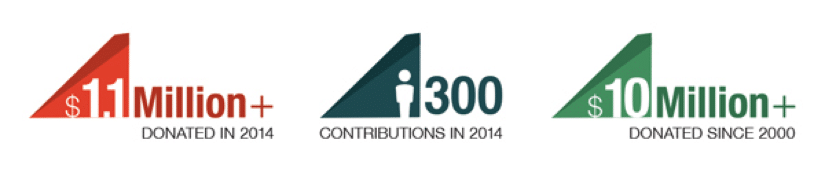
BKD Foundation’s 2014 charitable giving surpasses $10 million

By Fundraising, Sponsor Insight

The BKD Foundation is the firm’s charitable arm. The BKD Foundation is solely funded by BKD partners’ and employees’ monetary contributions. It aims to enrich the communities BDK serves through financial donations and volunteerism. The foundation supports not-for-profit organizations of all types and sizes, including employees serving in volunteer roles.

bkd-numbers

Supporting youth organizations

While the BKD Foundation provided support to a number of Indiana organizations, it made significant contributions to causes that serve the state’s youth. Junior Achievement of Central Indiana, The Villages, Big Brother Big Sisters of Northeast Indiana and Boys & Girls Club of Evansville are just a few of the organizations that benefited from foundation dollars. But the support went beyond monetary, numerous employees also regularly volunteered.

Outside of youth-specific charities, the Indianapolis and Bloomington BKD offices continued its five-year donation commitment to the Eskenazi Health Foundation for its violence intervention program and to the Community Foundation of Bloomington and Monroe County, a nonprofit that supports local charities.

Indiana BKD employees personally went above and beyond with charity efforts by donating both money and time — to Habitat for Humanity homebuilding efforts, the Salvation Army Toy Town toy drive, the March of Dime and many more.

Surrounding communities

The Fort Wayne and Merrillville offices sponsored The Carriage House Dancing with the Fort Wayne Stars event. Several BKDers also volunteered to tabulate votes and help with event-related activities throughout the year.

In Evansville, the team chose to support Community One, a local nonprofit dedicated to housing restoration and community development needs.

To learn more about the foundation’s support, browse the digital version of the 2014 foundation report.