By Annmarie
Novotney, audit and accounting senior manager, Blue & Co.
Your organization exists for a reason. You
have a mission to accomplish, and you’re driving hard every day to meet that
challenge.
Nonprofit organizations face unique
obstacles like identifying the best use of available resources, growing to
support increased services and remaining financially viable while maintaining a
strong focus on efficiency.
At Blue & Co., we understand the
challenges you face, and work – not only as your service provider but also as your
business partner – to help you navigate and overcome these challenges.
Our growing list of nonprofit clients (over
900 individual organizations) is proof of the abilities our experts demonstrate
in areas that are relevant to you as a nonprofit organization. Some of our
largest categories served include healthcare organizations, collegiate
membership organizations, higher education entities, community foundations,
social services groups, trade organizations and other membership organizations,
and private and corporate foundations.
Our titles may include accountants and
consultants, but we do much more than that. We are able to accurately identify
day-to-day management issues and operational concerns, such as internal
controls, segregation of duties, management effectiveness, and board
development. We offer practical solutions that add value and help ensure you
understand all aspects of compliance in your sector.
It is
our mission to support your mission. We want to stand with you as an invaluable
resource to advance your services in the community. We believe in our nonprofit
clients and are dedicated to helping them carry out their vision. Let us be a
partner to you as you drive your organization to succeed.
Here is a brief overview of our top
nonprofit services:
Annmarie Novotney is an audit and accounting senior manager at Blue & Co. Carmel’s office. She specializes in providing
assurance and consulting services to nonprofit organizations and is active
in the nonprofit community, recently completing a six-year term as treasurer
for the Susan G. Komen Central Indiana Affiliate. She is a member of the
Indiana CPA Society, the American Institute of Certified Public Accountants and
Executive Women in Finance.
Research repeatedly confirms that employee engagement drives organizational success. We know it’s important,but have trouble with misunderstanding of expectations and turn-over.
At last month’s HR peer group, Tony Dill, owner of HR Partnerships, discussed employee engagement with HR professionals at the HR peer group. With several decades of both HR experience and working for nonprofits, he has the perfect blend to understand nonprofit HR challenges. During Dill’s one-hour presentation, he clarified what engagement is and isn’t and how to develop your leadership team. If you missed the session, here are some highlights of his presentation.
When you hear the term ‘employee engagement’ what comes to mind?
A common misperception is thinking your staff is satisfied, happy and motivated. You’ve garnered from organization satisfaction surveys that your staff is pleased with the benefits offered and with the work environment. While those are important, they don’t measure the emotional commitment an employee has to the organization and its goals. In part that may explain why a seemingly happy team member jumps ship when a competitor’s offer comes along.
In contrast, Dill sees employee engagement defined by emotional commitment and discretionary effort.
Typically, emotional commitment is tied to people whom we are closest with — parents, spouse or our children. But according to theHarvard Business Review, workplace relationships are important to create a sense of purpose and ownership. Close work friendships boost employee satisfaction by 50 percent and companies with satisfied employees outperforming the competition by 20 percent.
It follows then if engaged employees have meaningful relationships at work, as a leader, you also need to invest in your staff and get to know them and invest in building relationships. This starts on day one. In fact, Dill recommends employee onboarding should last 6, 12, maybe even 18 months and includes socializing the employee into your culture. Some examples of what this would look like:
Ongoing, regular meetings with the new hire at least every 30 days to help with defining performance standards and meeting company expectations.
Solicit monthly feedback about the employee’s experiences, what would help him or her and how the work experience could be better.
Have socializing activities during work hours with new hires and current staff. A group lunch is an easy way to accomplish this.
The other component of engagement is discretionary effort. This is when an employee perseveres beyond what is expected and goes the extra mile. For example, those employees who are willing to complete a project under a deadline versus asking for an extension. Another way to look at discretionary effort is someone who looks for innovative ways to do things. Discretionary effort is motivated by a passion and is often linked to the mission or the well-being of team members, or both.
8 leadership traits
If your organization wants to foster engagement where does it begin? Right at the top of the organizational chart. Organizations with a culture of engagement demonstrate eight characteristics in their teams. The leadership traits are: self-aware, authentic, humble, trust, innovation, vision, passion and confidence.
During Dill’s presentation, the audience elaborated on the top
three characteristics; their ideas are worth sharing.
Self-aware leaders continue to develop
themselves professionally and personally.
Authentic leaders interact with their staff
and get to know them as a person.
Humble leaders are servants. Putting others
first.
The management team needs to take ownership of these leadership
traits and demonstrate them first. Dill reassured that your staff does not need
to exhibit all eight traits. Yet, often, they will pick them up from the
“trickle-down” effect. Driving employee engagement and developing a company
culture often happens in tandem.
It all begins
with trust
Dill explained, as leaders embody the eight leadership
characteristics, they become more trust worthy and authentic. In return, staff will feel comfortable to
share. As staff gains trust, it builds a two-way commitment between the manager
and employee. When an employee feels safe enough to open up and share, a
feedback loop is created. Open communication allows the manager more
opportunities to clarify what the employee needs to focus on and this in turn accelerates
the organization’s productivity.
Dill offered advice to embrace this change in culture. First, help each team
member, even the hired hand in the warehouse, understand how their contribution
is linked to the organization’s strategic plan, and ultimately, its mission. Additionally, but equally important, have a conversation
about how staff’s goals play into the overall plan. In the nonprofit sector,
this is where things get a bit dicey.
As a leader, you’ll probably learn your staff’s goals revolve
around learning a new skill, getting a promotion and increasing compensation —
things that while commonplace in the for-profit community, are often a luxury
for many nonprofits. If your
organization is on a shoe-string budget, the attendees offered creative ways
your organization can help its staff achieve their goals. Such as, If the employee foots the bill for a
training, he or she can be rewarded with extra PTO time. Bring in an expert in
your industry for an employee lunch and offer a free lunch-and-learn. Create an
internal training program.
Remember, engagement discussions are not one-time conversations. Most people need to hear something eight times before they own it. Be creative and communicate your organization’s message in a variety of ways.
Julie Struble is
the marketing and sponsorship director at Charitable Advisors. With the company since 2002 and with five
years as a HR generalist, one of her responsibilities is to coordinate
educational opportunities for the CA’s affinity HR peer group, and secure speakers
with expertise to discuss the challenges in the nonprofit HR department.
By Kevin Kidwell vice president national tax exempt sales, OneAmerica®
It’s well documented that
Americans aren’t saving enough to fund their retirement. So the drumbeat in the
industry has been to remind participants in employer-sponsored retirement plans
of the importance to “defer, defer, defer” and set aside a portion of their
take-home pay.
Meanwhile, companies that
administer 401(k) and 403(b) plans have endeavored to provide clients with relatable
uncomplicated guidance, make enrolling and plan access simple, and provide
resources to keep everything on track. For example, some plans are designed for
automatic investment in a target date fund so that some employee participants
don’t have to lift a finger.
Broadly speaking, this
evolution to making things easy has
been borne out by studies in behavioral finance that have shown that these plan
designs work.
While we all agree that
saving for retirement is a good
thing, there’s a financial commitment from the employer that should be acknowledged
and also applauded. The retirement plan industry is focused on helping the
participant put aside enough money; but just as important, is a focus on
assisting the employers in creating the best structure for the organization’s
financial goals.
No employer wants to
experience hardship when it’s trying to do right by its employees in funding
retirement contributions. But some
cookie-cutter approaches, which may seem easy in design and implementation, may
not take into account the diverse needs of differently paid staff or worse yet,
create cash flow issues that endanger the organizational mission.
The value in saving for retirement
The National Institute on
Retirement Security[1] (NIRS) warned recently
that American workers fortunate enough to have a retirement account offered
through their employer still face a deep retirement savings shortfall.
Ultimately, the inability of
older Americans to be self-sufficient after a lifetime of work will have
negative impacts on the U.S. economy, government budgets and families, according
to NIRS.
How retirement plans work
Contributions made by an
employer to an employee’s retirement plan ─ whether the plan provides for
elective deferrals or not – is regulated by the Internal Revenue Service (IRS),[2] and
it’s those complex IRS rules that outline the guardrails for a tax-exempt
retirement plan. (If you work for a nonprofit, that’s a common savings approach
at your organization.)
The IRS allows an employee
to defer his or her pay and allows the employer to also then make a tax-deferred
contribution. The plans have strict rules in order to maintain their
tax-deferred status. (The Employee
Retirement Income Security Act requires several tests each year to prove a plan
does not discriminate in favor of employees with higher incomes.[3]
These rules don’t apply to government plans.)
While it’s not given, over
time these contributions accumulate through the act of continuous employee/employer
contributions and compounding.
A match, where the employer
contributes an identical amount to what the participant invests, is not
mandatory, but is the most common type of contribution.
I would argue that there are
also other ways for employers to make contributions for the benefit of the entire
company.
Here’s what could make a
difference and is worth consideration:
Look at the usefulness of creating three separate
retirement plan pools — one that matches automatically for everyone who opts
into in the retirement plan, one that is reserved for specific groups of
employees with high-demand jobs, and a third that’s targeted to profit-sharing
based on performance.[4]
Consider a formula that factors in the Social Security
Replacement Ratio. Not many people realize Social Security’s payout structure
provides benefits progressively, so that people who earned the lowest wages at
a company upon retirement receive a higher replacement rate than did the higher
earners. As a result of this Social Security policy, the law allows employers
to make contributions to offset the Social Security deficit for middle and
higher income workers – compensating them for what Social Security is not going
to pay out when they are eligible to draw it, in other words.
Consider unique retirement plans at companies or
organizations with specialty occupations, such as the medical field,
acknowledging that the retirement-saving needs of “late entrants” into the
workforce (attorneys, physicians, accountants and other professionals of
occupations that require years of schooling) are different than other members
of staff. Adults who left their careers to raise their children missed out, so
they could be eligible for unique retirement plan designs that helps them catch
up.
Employers may also look at
the possibility of contributing more to the retirement account during a great
year for the organization’s bottom line, but also possibly contribute less in a
down business year.
Ultimately, the retirement
plan of any tax-exempt organization needs to mirror their mission. The plan
should be of optimal plan design and be one where the employer isn’t painted
into a corner by funding obligations.
We’ve found through our
experience that there are all kind of things we can do that makes sense. But
ultimately, if the system in place is not good for the employer, it won’t be
good in the long term for their employees.
In Kevin
Kidwell’s role as vice president of national tax-exempt sales, he
works to provide ideas, knowledge, information – both technical and practical –
in an effort to facilitate improved plan and participant outcomes. Since
joining OneAmerica in 1988, Kevin has held various positions within the
Retirement Services division. Beginning in 2000, his exclusive focus has been on
healthcare and tax exempt organizations.
Indianapolis-based
OneAmerica®, an organization that can trace its roots back to 1877,
has been helping organizations with their tax-exempt retirement plans since
1964. We believe a retirement plan should do more than help someone retire – it
can help organizations recruit, retain and reward employees.
OneAmerica® is
the marketing name for the companies of OneAmerica. Products issued and
underwritten by American United Life Insurance Company® (AUL), a OneAmerica
company. Administrative and recordkeeping services provided by McCready and
Keene, Inc. or OneAmerica Retirement Services LLC, companies of OneAmerica
which are not broker/dealers or investment advisors.
The
views and opinions expressed in this material are solely those of the author
and do not necessarily reflect the views and opinions of any of the companies
of OneAmerica. Provided content is for overview and informational purposes only
and is not intended and should not be relied upon as individualized tax, legal,
fiduciary, or investment advice. Investing involves risk including potential
loss of principal.
Editor’s note: Since this story was published, 900 Girl Scouts selected the Shoe that Grows as their reward, donating a total of 523 pairs to this Kenyan school and far surpassing the chapter’s 120 pair goal.
Samoas and
shoes. What do they have in common? Very little, actually, but a group of
ambitious and forward-thinking Girl Scouts in Central Indiana are out to change
that.
Since early
January, as they do every year, the Girl Scouts have been selling cookies. Lots
of them. In Central Indiana, about 29,000 Scouts in 45 counties have been peddling
their snacks and fulfilling our guilty pleasures. On average last year, each girl sold 184 boxes.
As the cookie
season winds down, however, a first-of-its-kind project by the local council,
the Girl Scouts of Central Indiana, is about to ramp up.
Traditionally, the girls and their troops earn group and individual
rewards for being top cookie-sellers. By the end of this month, girls can select prizes, such as stuffed animals, sleeping
bags, theme park tickets or trips with other scouts.
This year, however, the girls can earn shoes. Not pairs
of splashy tennies or the latest Doc Martens. These shoes they earn aren’t for
them, but for kids in Kenya.
Local Scouts will have the opportunity to forgo personal
prizes and do something altruistic. Each Scout who sells at least 125 boxes may
donate her “prize” to the cause. The reward for 125 boxes is equivalent to a
half shoe to a Kenyan elementary student. As the number
of boxes increases, so does the number of donated shoes.
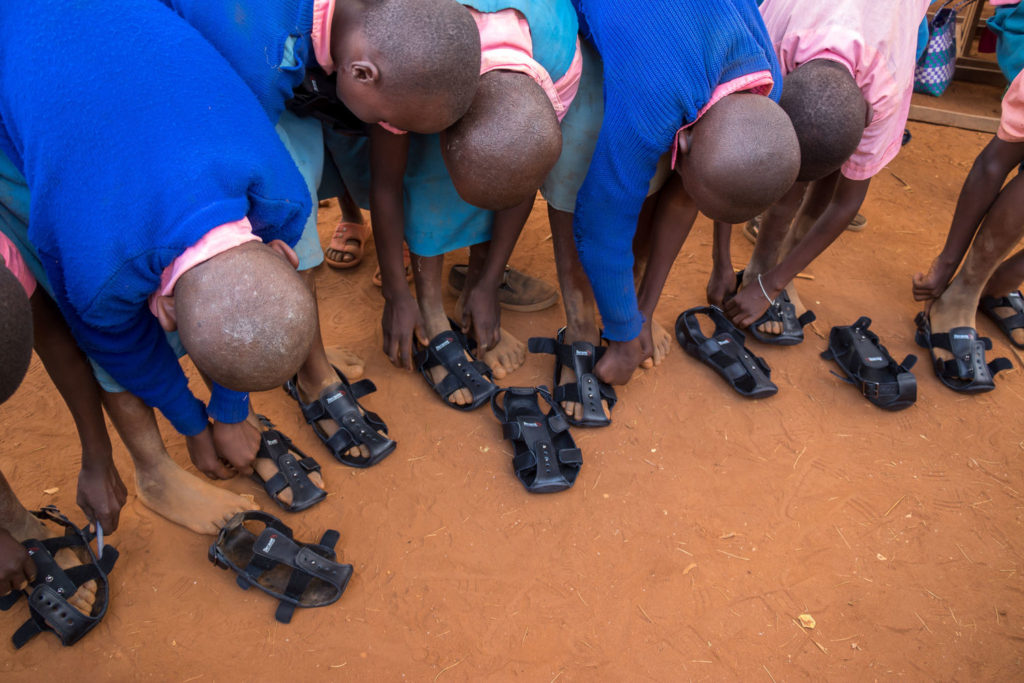
These are, however, not ordinary shoes. These are Shoes that Grow, the brainchild of the nonprofit organization Because International. The shoes are adjustable and can accommodate five size changes. The shoes will be given to students at the Hope School, which is outside several small villages in northern Kenya. For kids in this African country, having shoes that fit — or even shoes at all — is not a given.
Ellen Winking, the vice president of membership and
“cookie manager” at Girl Scouts of Central Indiana, heard about the program on
a national news program and spent last summer conversing with local girls about
this as a rewards option.
To help Girl Scouts understand how this unique footwear
works, Winking used both an actual pair and a video to demonstrate. Both were
supplied by Idaho-based Because International, which distributes
simple, innovative products to help make daily life easier for people living in
poverty.
The video shared the story of a 12-year-old girl in Haiti
who could not attend school simply because she had no shoes. For local girls, it was an opportunity to
learn that schooling could be denied for not having shoes.
Buoyed by the girls’ interest, Winking contacted Kenton
Lee, founder of Because International, to discuss the possibility of offering
the shoes as a reward, and the nonprofit staff agreed to give it a try.
“I was excited
when they approached us with this idea, and we kind of brainstormed to see if
it could fit. The partnership with the council is really unique, and I’m really
looking forward to see what transpires. If it works, it definitely is something
that I would encourage other similar groups to think about doing,” said Lee
from his office in Nampa, Idaho.
This Central Indiana Girl Scout council’s goal for this
year’s annual cookie program is to provide 120 pairs of shoes for students at a
particular elementary school in Kenya. A part of the Girl Scouts’ training
model is for each girl to self-identify a personal and troop goal for cookie
sales.
“Adding the
shoe is a slightly different twist because girls are forgoing a prize to do
this good for others,” said Danielle Shockey, Central Indiana Girl Scouts’ CEO.
According to Lee, 400 kids attend the school in Kenya, but
those are just the kids who have the ability to go to school.
“There are even poorer kids, who live out in the rural
areas surrounding the school. I would also like to give to local leaders extra
pairs of shoes so as they identify more kids that don’t go to the school that
they’d be able to help them by providing shoes if that’s a need that they
have,” he said.
The Girl Scouts’ national office said while other troops
have provided funds for causes like saving sea turtles, Central Indiana’s council
is the first to offer this type of philanthropic reward option.
“I’m really
excited about this opportunity with them,” said Lee. “This is a first. We’ve had other kids do more
classic fundraising — lemonade stands, yard sales, mowing lawns or using their
birthday — as fundraisers.”
Proper footwear, according to Lee, is a critical way of reducing
the risk of injury, parasitic diseases and foot infections in Third World
countries. For many, it is a necessary part of a school uniform. But, he knows,
it doesn’t solve every problem.
“It is a very simple thing. But even a small thing, even
something that doesn’t solve the entire situation, still makes a big difference,”
he said. Lee estimates there are over 300
million children who do not have shoes, and countless more with shoes that do
not fit. Sometimes they receive shoe donations, but children’s feet grow and
they quickly outgrow donated shoes.
After attending Northwest Nazarene University, Lee thought he was destined to be a
missionary. But since his religion requires a three-year commitment in the
field, he traveled for a year, ultimately working in an orphanage in Kenya for
six months in 2007 as a way to test his future path.
During a walk with children at the orphanage, he noticed
one girl whose shoes didn’t fit, which sparked an idea that he jotted in his journal.
Homesick, he returned to Idaho, but his idea percolated.
“It
really was just kind of a random idea that popped into my head just based on
the situation, based on the context,” Lee said. “You know the orphanage
couldn’t afford to buy the kids any new shoes, and yet their feet were always
growing. And then from that point, I had an idea for a growing shoe, but I had
no idea how to make it happen. That’s what took the six years.”
First he tried
and failed at designing a prototype. He tried to give the idea away, but after
multiple rejections from shoe companies, he found a small shoe-design company
in Portland, Oregon.
“They loved what we were trying to do and took us through
about a yearlong design process. Then we made about 100 prototype pairs that my
wife and I took back to Kenya and put in four different schools,” Lee said. “We
had kids try them out for about a year, got some really good feedback, and then
we made our first official batch of the Shoe that Grows. It was essentially
just a hobby at that point. I had a few thousand pairs in my guest bedroom, and
I tried to get them out to people I knew working with kids. It was just kind of
a small part of my life at that point.”
Now, the shoe
is in 100 countries, mainly near the equator including parts of Central
America, through sub-Saharan Africa, East Africa, and a bit of Asia. Overall,
the nonprofit has distributed almost 250,000 pairs in the last four years and
has worked with over 1,500 partner groups or distribution partners to deliver
those shoes.
To simplify distribution, the Because International has begun
to identify factories
closer to the need. Right now a Kenyan factory is working to produce a sample.
If all goes according to plan in 2019, the shoes for the Kenyan school will be
made at that factory in Mombasa and shipped to Nairobi. Haiti and Ethiopia also
have manufacturing plants.
Lee said his organization
doesn’t attach any strings to the shoes for either the recipients or the
donors. Recipients are not required to send thank yous or Skype with the
donors.
“Above all else what we want
is for the local people — the leaders and the kids receiving the shoes — is
for the shoes to be a benefit to them and be a valuable resource. But if the
Girl Scouts want to make contact with the school and vice versa, we’re happy to
make the connection.”
Besides sending shoes to Kenya, girls who select the shoe
reward will receive a patch, which includes the Shoe that Grows logo, a heart
designed from a footprint. For Girl Scouts earning patches and badges for
successfully completing requirements is something of honor.
For the Girl Scouts, philanthropy certainly is not new.
CEO Danielle Shockey, herself a Girl Scout alumna, said it’s embedded in everything
the organization does.
“Philanthropy is really just part of our DNA, and the
whole idea of making the world better place is our mission statement. I’ve
never met a troop who doesn’t think about some kind of community service
project,” and the cookie program provides troops with annual funds to be able
to do this. At the younger levels, girls think about how to give back to the
local community, and as they get older, they begin to think about the world
around them.
According
to a study at Arizona State University, altruistic children do grow up to be
altruistic adults.
Since 2009,
the Girl Scouts in Central Indiana have been involved in Operation:
Cookie Drop. Customers are asked if they would like to purchase
additional boxes to be distributed to soldiers stationed at military bases
across Central Indiana, to military veterans and for the first time this year, to
local first responders. Last year, the scouts delivered 96,000 boxes to Stout
Field to military families.
“They are really glad to meet the girls and physically
move the boxes together. We are purposefully making sure that they’re seeing
the effort and the result. I think we do some very deliberate things, as much
as it is a part of the things that they earn and their badges and the gold
awards, we also want it to be intrinsic too,” said Shockey, who became CEO in
January 2018.
Both Lee’s nonprofit, Because International, and Girl
Scouts working to earn a Gold Award have a goal of solving societal problems.
In the case of Because International, they have expanded
efforts and now have a mosquito net called Net Buddy for distribution in
countries where malaria is a health concern. Lee, the founder, is also working
with a colleague on a new program, the Pursuit Incubator, to help other
entrepreneurs pursue ideas for products. The group’s efforts revolve around
using small innovative products to fight poverty.
And as Girl
Scouts stay with the organization and reach their teens, they have the option
to earn a Gold Award, the
organization’s highest award. Last year, locally about 30 girls achieved the Gold
Award.
“To earn the
Gold Award, a girl must find a community challenge where she thinks she can
make a difference. So when we say it’s part of our DNA, girls are constantly
thinking about the world around and how they can make it a better place and it
manifests itself differently. Troops think about it, girls think about it and
also if they want to have our highest award, they have to think about it in a
very big way.”
Shockey shared
the example of a Zionsville sophomore’s project. She saw the documentary about Holocaust
survivor Eva Kor; and her message of forgiveness touched this 15-year-old teen.
“Soon after
there was the school shooting in Noblesville and she thought my community
really needs this message of forgiveness,” said Shockey. “And they needed to
hear it directly from Kor.”
So working with
her school superintendent, she planned two programs. At one, Kor would speak to
middle- and high-school students, and offer a similar program in the evening at
a local church. The proceeds from the 500 tickets sold were donated to
Zionsville’s Lunch Angel Fund, a program that pays off student lunch deficits
and provides needy students with extras they cannot afford.
The teen didn’t
stop there, Shockey said, because she wanted a sustainable program.
“So she worked
with WFYI to build education kits about the Holocaust. Now every history
teacher in Zionsville has a Holocaust kit to use with future students,” said
Shockey.
The leaders really walk the talk of girls leading the way,
and so they will wait to see how successful and how popular it is before making
additional plans and connections.
“Did girls make it part of their goals? I think at the
end of this year, it will be pretty telling. Take Operation Cookie Drop that started
over 10 years ago. It’s now 96,000 packages,” said Deana Potterf, the chief
communications officer. Who could have imagined.
Nonprofit leaders often
worry about organizational sustainability, demonstrating impact and planning
for their next chapter.
At Hedges, we get it. We’ve
been there too! That’s why our team of experienced consultants is passionate
about empowering nonprofit leaders to confidently
and effectively address the challenges that come their way. By investing in our
services, nonprofit leaders can stay focused on solving the most important
issues facing our community.
Since 2002, Hedges has been
a trusted partner to more than 100 leading nonprofits, foundations and public
entities in Central Indiana. We have worked
with them to maximize their impact, produce
measurable results and attract larger community investments. From helping a single nonprofit to
strategically plan and secure funding to helping a foundation to measure and
communicate its impact of a community-wide initiative, Hedges has provided an
array of services to support the success of our nonprofit community.
Drawing on our team’s deep
understanding of the local nonprofit landscape, topical expertise, and
extensive knowledge of nonprofit best practices, we specialize in helping
leaders address complex challenges. Through strategic planning, grant services,
program development and evaluation, and board development, we assist in building
a nonprofit’s capacity allowing them to further their mission in a sustainable
way.
If you’re a nonprofit leader
who is ready to make transformational change, our team is ready to help.
Contact me at erin@hellohedges.com or learn more about our
measured approach to social change at www.hellohedges.com.
Erin Hedges is the president of Hedges and has worked in the nonprofit sector for over 20 years.