Laura S. Quinn, executive director Idealware for Tech Soup |
What tools can help you raise money and rally support for your cause through an online auction? We take a look at the software tools that are widely used in the nonprofit sector.
An online charity auction can be a good way to raise money, rally support for your cause, and hopefully, to have some fun. Like any special event, an online auction requires solid planning and a fair amount of staff time. What it won’t require, however, is substantial technical expertise. Several good online platforms will host and help you manage your online auction.
What should you be thinking about as you consider an online auction? What tools might work well? We asked a number of nonprofit professionals with experience in auctions for their software recommendations and condensed their advice here.
The American Cancer Society, which held nearly 5,000 Relay for Life events in 2014, raised $335 million during that time to lead the way in the annual Peer-to-Peer Fundraising Top 30 listing.
The charities on the list, compiled by the Peer-to-Peer Fundraising Forum, raised more than $1.6 million and featured more than 8.3 million participants.
The total revenue raised, however, is a 2.47 percent decline from 2013.
Second on the list is the American Heart Association’s Heart Walk, which raised $110 million, an increase of 4.92 percent.
Among the charities making a significant gain was the Alzheimer’s Association. It held 650 walks across the country and raised $67 million, an increase of 18.6 percent.
By Stefanie Krievins, coach and founder, Radiancy Coaching Partners |
Nonprofit employees are a mission-driven bunch and sometimes help until it hurts, often doing this work at the expense of our families, health and mental wellbeing.
In a 2011 study, Opportunity Knocks, a national nonprofit job and career services group, found that over 50 percent of the nonprofit employees they surveyed were burned out or were in danger of becoming burned out. In part, the survey found that when an individual leaves a nonprofit, the organization often redistributes the duties.
As positions are eliminated or people leave, according to this study, the nonprofit sector is extremely unlikely to refill those positions, even with temporary help or consultants. We simply spread the work out among the existing employees. The cliché, “Do more with less” is a truism in our work.
Burnout is most often related to how organizations are staffed. The marketing manager is a one-person department in charge of social media, print material, public relations, appeals, volunteer projects, working with the Board’s marketing committee, website technology, planning special events, and marketing for new clients, volunteers, and donors. This is done in the name of those the mission serves. In other sectors, this would be at least four people’s jobs (minus the volunteer management, of course).
It’s time that these practices stop.
We need (and deserve) a resource to avoid burnout, to teach those of us serving the hungry, homeless, refugees and abandoned children how to also take care of ourselves. As the studies show, and we’ve experienced, we can’t be great professionals and continue to serve otherwise.
Radiancy Coaching Partners is that resource. Coaching and group workshops are available for nonprofit staff, boards and volunteers. These services can help with advancing the mission through one-on-one consultations, team trainings, and retreats:
Managing time and productivity: saying “No” more often and “Yes” to the right things that advance the plan
Understanding communication and work styles individually and as a team
Training staff to implement strategic plans
Managing for accountability and follow thru
Reducing stress
An Indianapolis nonprofit program director and client shared the power of coaching. She said: “I’d always assumed that coaching was for high-powered executives, not regular people. Boy, was I wrong. I began working with Stefanie at a time when I was facing some daunting personal and professional challenges.
“I felt overwhelmed by the choices, and was becoming increasingly unhappy. She derailed my path of unhappiness, helping me to stop and look at things in a new way. I came away from the experience feeling more relaxed and much more flexible about my life. The challenges didn’t go away. It’s just that I have more tools available to meet them.”
I faced this same burnout on more than one occasion in the 10+ years I worked for charities. This is how I found coaching and a new way to contribute to organizations’ missions. Radiancy Coaching Partners provides coaching and consulting exclusively for nonprofits. Learn more about how this resource can help you and your organization at radiancycoaching.com.
Stefanie Krievins is the founder, coach and trainer at Radiancy Coaching Partners. She has a master’s degree in nonprofit management from SPEA at Indiana University, completed credentialed coaching training from Erickson International, and has more than a decade of employment and volunteering in the charitable sector in Central and Southern Indiana and nationwide. She lives in a low-income neighborhood in Indianapolis as a way to stay connected to the causes she’s most passionate about: homelessness, food insecurity and helping each person get the resources he/she needs to be their best self.
Bob Karnak isn’t the type to back down from a challenge or a chance to get in a little exercise. The retired quality assurance consultant at Elanco recently made a trip from Indianapolis to Cleveland to visit family. For some, that would mean flying; for most, it would be a five-hour car trip. For Karnak, it was just an extra-long bicycle ride.
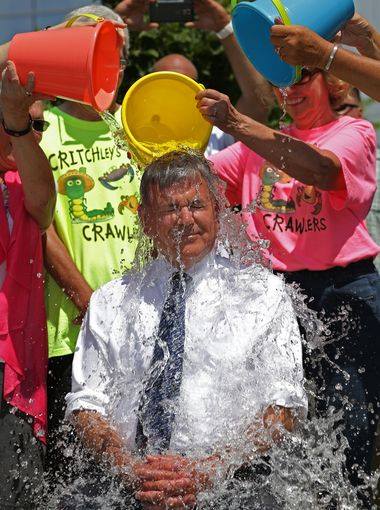
Dr. Robert Pascuzzi, a physician in the department of Neurology, kicks off the Ice Bucket Challenge at the I.U. Neuro Science Center in August. The ALS Certified Center is at the I.U. Neuro Science Center and where patients go to be diagnosed and evaluated using a multi-disciplinary approach for their ALS journey.
The 68-year-old Indianapolis man doesn’t make a habit out of going out for 300-mile spins, but it is in his fabric to stay active. Karnak averages about 3,000 miles a year on his bike, mostly for pleasure, but there’s often a deeper, more important goal.
Karnak’s two-wheeler isn’t just a vehicle to get from Point A to Point B. It’s a vehicle to raise money for charity – for causes that are important to him. Causes that can make the world a better place.
“Is altruism the right word?” Karnak asked. “It’s really doing something for somebody else. I’m healthy, my kids are healthy, my wife for the most part is healthy. I don’t have any life threatening diseases. I think it’s incumbent upon those who are healthy to help others.”
In many respects, Karnak, and others like him, are a charities’ best friends. They do the heavy lifting. They ask and the charity receives. In the nonprofit world, it’s called peer-to-peer fundraising, and while the concept has always been around in one form or another, it has grown to new heights over the past decade.
Over the years, Karnak has raised money locally through various biking events for charities such as Habitat for Humanity, the Multiple Sclerosis Society, the Juvenile Diabetes Research Foundation (JDRF) and most recently, the Leukemia and Lymphoma Society. The total is north of $160,000 and still rising.
Ways to get up, get involved
Looking for an event to participate in to raise money for a charity dear to you? There are many opportunities in Indiana, in the Midwest and nationally.
Most organizations have already held their 2015 events, but will be setting dates soon for 2016.
“If I’m out on a training ride, and somebody says, ‘Hey, what are you doing?’ and I get a chance to talk to them for more than five minutes, they are probably gonna get a letter from me asking for a donation,” Karnak said. “If you can bend someone’s ear, you’ll find everybody has a connection. Everybody. There’s not one person on this green earth anymore that doesn’t know someone who’s afflicted with something.”
Nonprofits rely on contributions to stay afloat, and under the peer-to-peer philosophy, rely on their supporters to play major roles. Who hasn’t been asked by your neighborhood Girl Scout or their parent to buy cookies? Or candy bars, wrapping paper, or poinsettias? We buy these things because someone we know asked us.
In today’s world, nonprofits that ignore the power of peer-to-peer fundraising do so at their own risk.
“It’s actually very simple in its core,” said Taylor Shanklin, the director of marketing and “peer-to-peer boss lady” at raisemore.com, a fundraising consulting firm in the Dallas-Fort Worth area. “It’s just people asking people to support them in what they are doing and support a cause they care about.”
In most cases, peer-to-peer fundraising revolves around an event: a run, a walk, a bike ride, a triathlon, a swim-a-thon. Participants sign up, agree to raise money and ask their friends and family to donate.
The Indiana chapter of the Leukemia and Lymphoma Society receives 88 percent of its funding through events such as its Man and Woman of the Year programs, its Light the Night walk and Team in Training, said Executive Director Amy Kwas. The challenging TNT program, where participants are trained to run marathons, compete in triathlons or 100-mile bike rides, was among the pioneers in this respect, having started in 1988.
“There’s the old adage – that people give to people, and that’s why it works in our case,” said Kwas. “Most people are affected directly, and it’s a way of showing support, perhaps for someone who’s going through treatment.”
Today, just about every nonprofit has gotten into the act. If you have a favorite charity, chances are there’s a specific event lined up to raise money for it. The figures may vary slightly, but there’s no doubt that the response rate from one donor asking another far exceeds that of traditional email or snail-mail solicitations from the charity itself.
Kimbia, a Texas-based fundraising consulting firm, estimates that 1 in 4 peer-to-peer emails will result in a donation, as compared to 1 in 1,250 appeals directly from a charity.
“In peer-to-peer, it’s a friend asking a friend,” said Shanklin. “I’m more inclined to give to my friend than some random organization. Peer-to-peer is always going to win in terms of (return on investment).”
Despite its effectiveness, not all charities have jumped on the bandwagon with both feet. In Indianapolis, Gleaners, which operates multiple local food banks, sends out solicitations frequently and still gets the majority – as much as 60 percent – of its donations from individuals. The charity has a donor database of more than 60,000, said Debbie Russell, the director of donor engagement.
“We’ve talked about it, but we’re not doing a lot in that regard,” said Russell, of peer-to-peer.
Gleaners did have a recent golf outing, however, that raised $7,500, and is putting in place a Building Hope initiative that is moving in the peer-to-peer direction, Russell said.
Gleaners is looking for key donors to become “ambassadors.” Russell said the ambassadors will spread the Gleaners’ message and bring others into the circle with the hope of creating a steady revenue stream.
For those charities wanting to enter the peer-to-peer world, there are no shortage of advisers. A simple Google search turns up page after page of companies marketing their services. Fundraising professionals can attend national conferences on the subject and there are numerous blogs devoted to the topic, mostly focused on the power of social media.
There are some red flags, however. According to the Peer-to-Peer Professional Forum, the top 30 peer-to-peer fundraising events in the country raised more than $1.6 billion in 2014, but that is a 2.47 percent decline from the previous year. The biggest player, the American Cancer Society’s ubiquitous Relay for Life program, brought in $335 million, but was down nearly 12 percent, or $45 million from 2013. The traditional Susan B. Komen Race for the Cure was down 10.78 percent, and its sister event, the Komen 3-Day walk, was down 38 percent or about $16 million.
Other events, such as LLS’ Team in Training program and the JDRF One Walk also took major hits.
Shanklin, of raisemore.com, thinks part of the decline is because the market is simply overcrowded.
“There are so many events now. Sometimes I feel that everybody is doing a walk,” Shanklin said. “I think that donors and participants are looking for something more interesting. Quite frankly, walks don’t bring in a lot of money, and they can be kind of boring. Although the walk thing is something everybody can do.”
Shanklin says charities must be more innovative, and many are, she said.
“Some organizations are trying different things, like animal shelters doing a dog walk,” she said.
The Alzheimer’s Association, which has a traditional walk that raised nearly $68 million across the country last year, has branched out with an event called the Longest Day. The initiative is on June 21, the summer solstice. On that day, participants pick an activity to take part in from sunrise to sunset, a reminder of the daily challenge facing those with Alzheimer’s.
“One of my friends had a daylong karaoke party,” Shanklin said. “They are doing a lot of do-it-yourself campaigns.”
Another popular event is the Movember movement where men grow mustaches in November and raise awareness (and money) for prostate cancer research.
“Movember is something that’s new. It’s fun, it’s quirky, it’s interesting. I think people are shifting their giving around because there are so many options out there,” Shanklin said.
The target for most charities is to catch lightning in a bottle similar to the ALS Ice Bucket Challenge that swept the nation a year ago. The ALS Association, which works to fight Lou Gehrig’s Disease, raised $115 million in 2014 after donations of just $23 million in 2013. In contrast, the movement has brought in barely a half million dollars in 2015.
“The Ice Bucket Challenge took off in the peer-to-peer world like nothing else,” Shanklin said. “I don’t know if we’ll ever see something like that again. It wasn’t even a fundraising campaign, just a way to raise awareness, but people got involved and interested, and it became a fun thing.”
“We broke the glass ceiling when it comes to awareness,” said Cindy Wise, executive director of the Indiana chapter of the ALS Associated. “Now if I mention “Ice Bucket Challenge,” everybody knows what I’m talking about.”
Shanklin doesn’t believe traditional fundraising is dead, but charities that continue to send out solicitations must be mindful of their audiences. While older donors may still like letters, younger people may prefer emails or to be contacted strictly through social media.
“Knowing the analytics of your audience is really important, and that’s something charities can really, really mess up,” Shanklin said. “When I feel they aren’t listening, and they bombard me – like if they send something to my 4-year-old son and me – I’m thinking, ‘If you are misusing your resources, I actually don’t want to give you my money. I might want to give it to someone else.’
“I want to see organizations do a better job of tailoring their communications,” Shanklin continued. “Nonprofits must look at generations and generational-giving trends and reports and how they are connecting to those generations.”
Knowing your audience carries over to the peer-to-peer world. Much attention has been focused on the innovative fundraising techniques of Charity: Water, which provides wells and drinking water for Third World countries. The 8-year-old nonprofit has become overwhelmingly popular with millennials and has drawn raves for its videos, vivid graphics, compelling stories, its social media presence and its revenue model in which 100 percent of all donations go to its programming. Charity: Water’s operating costs are paid for privately.
Charity: Water’s September campaign asked that people born in that month forgo any birthday gifts and ask friends to donate to the charity instead.
Even Charity: Water’s approach, however, goes back to the core of peer-to-peer fundraising. Friends asking friends. Neighbors asking neighbors.
Karnak, the bicycle veteran who has been raising funds this way for more than two decades, is a believer.
“I think a lot of people give because I’m coming out with a request and a valid reason,” he said. “And I make a case for it. I’m not doing it for myself. People are willing to give if you ask.”
By Kathleen Kelly Janus for Stanford Social Innovation Review |
For many nonprofit organizations, getting young people to support their work seems an insurmountable challenge. Millennials are a mystery to them. As the stereotype goes, what is the use of involving the lazy, unemployed, social media-addicted generation, anyway? Even so, it’s widely understood that millennial engagement is vital to cultivating a pipeline of support for the years to come.
The good news is that engaging millennials does not have to be such mystery. In fact millennial supporters can become an organization’s most avid champions. At Spark, an organization I co-founded, which is now the largest network of millennial donors in the world, we’ve proven that while they may not have as much to give, collectively their impact can be powerful. In nearly 10 years, we have raised more than $1.5 million to support women’s issues, mostly in contributions of less than $100, and probably even more importantly, we have inspired a large group of young people to support gender equality issues who will likely continue to contribute to women’s organizations for decades.
The journey started in the gym at West Springfield High School in 2004. The rookie coach of the girls volleyball team wept as he told his players he was struggling not only with teaching the sport but also with his mother’s recent diagnosis of Stage 4 breast cancer, the deadliest stage. The girls were speechless, stunned by Rick Dunetz’s raw display of emotion.
But they rallied around the coach in an electrifying run to the district championship, galvanized by his mother’s first appearance at the title game. Dunetz was struck by how the players and the patient fed off each other: The team’s underdog winning streak, he said, seemingly inspired his mother to keep fighting cancer.
In the years since Barack Obama’s crowdfunded presidential campaign put this alternative form of fundraising on the map, crowdfunding has diversified dramatically. In the UK, digital innovation, particularly across social platforms and the financial tech (fintech) industry, has engendered a flourishing sharing economy, disrupting the natural ebb and flow of traditional finance streams. Peer-to-peer models are thriving, with the crowdfunding sector showing substantial growth.
Crowdfunding can neatly be described as the practice of financing a project or venture via small amounts of money from a large number of people. It’s most commonly understood as a means to fund grassroots businesses, with “backers” recouping financial rewards. But, driven by uncertain economic times, a new crop of donation-based crowdfunding sites for personal causes is booming.
Performance reviews feel as though they have been around since the beginning of time. No matter how many organizations say they are going to blow up performance reviews, they still remain. They are the things that wouldn’t leave. They are inevitable and universal, just like those family and friends who can’t or won’t take a hint that it’s time to go.
More feedback, more often is the future of the dreaded performance review. Meeting with your employees once or twice a year to assess their past, present and future is beginning to seem quite quaint. Some organizations, like Instacart, are moving to a hybrid system that bridges the old and the new. Others have decided to ditch the annual process entirely.
Performance reviews have come to be seen as more trouble than they’re worth. Just ask Adobe, who nixed their annual review process earlier this year. Or startup Zugata, who aims to make that frustrating process less time-consuming and more productive.
How do you know it’s time to say goodbye and eliminate your performance reviews? Here are four ways to tell it’s time to let them go:
You’re trying to justify pay. That is, you’re just trying to defend the salary of your employees. Your process links pay to outcomes, so the performance conversation becomes a mechanism to be compliant. If employees did better than you expected, congrats; you can give them a pay raise!
You don’t even mention the word employee development. Managers are too focused on ensuring outcomes were met. Focusing the process on outcomes sometimes achieves the desired results, but more often than not, it doesn’t move the needle.[i]
You’re trying to treat everyone the same. Treating everyone the same is not the same as treating everyone fairly. To treat people the same means you are fitting them into one system, rather than building a system to support the people. It means you walk your successful employees through the same process as your bottom performers. Compare this to a dinner at a nice steakhouse. You wouldn’t expect the chef to cook everyone’s steak medium, when one person likes it medium rare and another likes it well done.
You feel like this is something you have to do. Talking about the goals an employee should focus on and how they’re doing towards meeting those goals shouldn’t be something you have to do. This conversation should be something you want to do. As a leader, you want to be able to deliver feedback to your employees. You want to ensure they know the right things to prioritize and accomplish. Employees also want clarity in their role and to know the progress they are making toward those goals.
If not performance reviews, then what? Entrepreneurs such as Srinivas Krishnamurti of VMware or Philippe Van Nuijs from Jive Software, are pioneering software to evolve the performance review, promising to provide employees regular and varied feedback on their iPhones in a less intrusive and time-consuming manner.
Pinterest, which uses performance and engagement tool Reflektive, is in the midst of completely moving away from what they like to call “traditional reviews and performance ratings.” The best thing for workers, argued Mike Joyner, the People Operations Manager at Pinterest, “is to get aligned on goals and ensure everyone is consistently getting feedback.”
Mike Bensi, a FirstPerson advisor, works alongside nonprofits and small business owners to design strategic plans that enhance the employee experience. His goal is to align an organization’s culture with human resources, benefits and wellness. He has an MBA from IU Kelley School of Business and more than 10 years in progressive human resources management, including serving as the BMV’s HR director.
Unsure how to tell your process to take a hike? I suggest seeking an advisor to help you have that conversation so you can build a more meaningful conversation with your employees.
Business incubators have been around since the late 1950s. Their goal: to lend a helping hand to start-up companies through a variety of services that may include a working space, seed money, management assistance and networking capability. Incubators were especially busy in the past decade due to resurgence in the tech industry in Boston and the Silicon Valley in California.
With the downturn of the tech economy, there has been a rise in non-tech incubators and an adapted model for nonprofits. Unlike most for-profit incubators or accelerators, which exchange space and services for equity share in their clients’ companies, most nonprofits are charged fees.
While there are several business incubators in the Indianapolis area, this year two sites emerged that are primarily focused on nonprofits and social entrepreneurs.
The Hub for Innovation, Vision and Entrepreneurship (HIVE) opened in January at Christian Theological Seminary on the Northwestside. Launch Cause was announced by Bloomerang this year and will occupy 6,800 square feet of the company’s new building near Fort Harrison State Park in early 2016.
Brenda Freije is director of networking and recruitment at Christian Theological Seminary and Steve Shattuck is marketing vice president at Bloomerang and Launch Cause’s executive director.
While both have used the word incubator to describe their spaces, both think it overstates the mission, but simply calling it a co-working space sells it short.
“We don’t want to just call ourselves a co-working space because that is very passive. We don’t want to be a space that is described as ‘Come in, and good luck to you. We’ll keep the lights on.’
“We’re sort of in this in-between, where we want to offer some guidance, coaching and services and things like that, but we don’t want to put someone through some sort of rigid programming. We also don’t see ourselves as an equity stakeholder as an incubator would,” said Shattuck.
Neither site provides grant or seed funding or has a competitive process to become a member.
“From a nonprofit standpoint, we didn’t want to be that rigid but also didn’t necessarily have the resources yet to incubate fully,” said Shattuck.
“We’ve not gone down that path because that will be a big fundraising initiative. We’re not going to close the door to that, but right now we’re not there,” said Freije. “We’re not going to jump in the deep end before we really figure out what we can offer.”
There are, however, some values that a nonprofit has to agree to in order to be housed at CTS. “We are a Christian institution. If that offends you, this is not the place to be. It doesn’t mean that everybody has to be a Christian or the organization has to be, but that can be a deal breaker.”
Both locations offer open working spaces and different levels of service targeted to new nonprofits.
After outgrowing its current space, and working with the Fort Harrison Reuse Authority, Bloomerang will complete its own building next month, but will not occupy the entire 20,000 square feet. The extra space, Shattuck said, is a way to use a company asset for something “cool.” The space, still a shell, has potential for build-out specifics for nonprofits.
Modeled after the Nonprofit Hub in Lincoln, Neb., the center will have three types of work areas – 30 open spaces, 21 cubicles that are semi-private, 14 offices and two conference rooms. Tenants may pay daily ($10) for short-term use or enter into longer-term agreements with prices ranging from $75 to $650 a month depending on the office services and type of space provided.
In 2007, Freije was pastor at Lockerbie Central United Methodist Church, which started the Earth House Collective for nonprofit ministries. When it closed in 2012, she began a conversation with CTS’s president. The HIVE has made seminary unused space available for external members.
“Basically, we had a boardroom that was not being used. It was a large space that we could be using as a gift or a blessing to others if we just set it up,” she said.
Everything in the space is movable, and fees, listed on the HIVE’s website begin at $75 a month, and include a desk, access to the building, WiFi, a mailbox and other basic services like cleaning. The space, which officially opened in January, has five tenants. A CTS student who has started a nonprofit is the most recent member. This week, when Henry Timms the founder of Giving Tuesday is in Indianapolis for several public events, CTS will host a smaller lunch to which HIVE members are invited.
“The next step is to start helping emerging ministries and nonprofits become better at what they’re doing. Are there things we can do as an educational institution? So slowly, we are adding programming that HIVE members get discounted rates to attend,” said Freije.
CTS students are also working with the center. One student is researching best practices for social entrepreneurship centers around the country. Seminarians can also see nonprofits in action, see alternatives ways of ministering or volunteer with the nonprofits.
When Shattuck and Bloomerang’s co-founder Jay Love started talking about their idea, they met Jacob Schpok, the executive director of Indiana’s Office of Small Business and Entrepreneurship. The state established the office in 2013. Schpok told them that there are 100 co-working spaces in Indiana, but none exclusively for nonprofits.
Launch Cause will have business members who may or may not be tenants. Shattuck said his board of directors will help screen this group and possibly recommend them to the nonprofits as vendors.
Both sites welcome social entrepreneurs. This summer HIVE, together with Butler University’s business school, hosted a community think-tank discussion about social enterprise. In part, they wanted to learn with community partners how to empower those who are taking pretty big risks.
At CTS, Freije said entrepreneurship is now a gateway class for entering students, recognizing that an effective pastor or community leader has to understand entrepreneurship and how to run nonprofit organizations.
‘We’ve just reinvented our master’s of divinity program and one of the five gateway classes that all new students take is entrepreneurship. We’re starting to see that at other seminaries,” she said.
“Our students need to know is there’s no guarantee of a job when they graduate. You can pursue ministry in a lot of different ways and there’s all kinds of opportunities, but it won’t always look like you stepped into a salaried position in a church. If it does, that’s really good.”
By Tracy Kaufman, engagement specialist, Foundation Center |
If you’re in the early stages of forming a nonprofit and struggling to find your footing, you may be in search of people or organizations to help you along the way. One option that some new nonprofits pursue is the assistance of a nonprofit incubator, which helps to guide you at the time when you need support most.
What is a nonprofit incubator? A nonprofit incubator is an organization that helps to nurture and facilitate the development of a young nonprofit through the provision of resources, services, and seed funding. The use of an incubator improves the chances that a new organization will be able to remain sustainable over time, and also provides strong opportunities to build relationships with other organizations in the sector.