Category

Programming

Parkinson’s patients fight back

By Feature, Programming

By Lynn Sygiel, editor, Charitable Advisors

Six years ago Joyce Johnson was hired by Rock Steady Boxing’s board and charged with the task of figuring out a way to expand its program.

“We were getting calls from all over the world where people would hear about it, and they would call and say, ‘Where’s Rock Steady Boxing in Colorado Springs?’ And I would have to say, ‘I’m sorry, there’s only one Rock Steady Boxing, and it’s here in Indianapolis,’” said Johnson.

There was no long-range plan in place in 2006 when Scott Newman — at the time Marion County’s prosecutor and public safety director – started boxing. Newman had been diagnosed with early onset Parkinson’s disease, and his friend, Vince Perez, an attorney and former boxer, wanted to help. His intention was just to keep Newman active.

feature-for-web And so they started boxing in Newman’s basement. Newman started getting better. His tremors lessened, his balance improved, and he got stronger. He had lost his ability to type on his computer, and he got that back, and had a lot more confidence when he was in court.

“I often describe it as being serendipitous. He had no idea it was going to work when he started boxing. He and his bud were just trying to keep him active,” said Johnson.

By the time Johnson entered the picture, Newman and Perez had moved from the basement to a friend’s gym, and then opened the first-of-its-kind Rock Steady facility. Originally, Rock Steady’s board thought that Kristy Follmar, a former world champion boxer and one of the founders of the program, was going to be the Jane Fonda of home DVDs.

The board envisioned growth to be simple — sell DVDs to people with Parkinson’s who could then exercise in their living rooms. But it wasn’t too long before they realized that it wasn’t just the exercise.


[content_box box_type=”normal”]

Rock Steady Boxing training camp

“At our training camp, we teach people about Parkinson’s and the symptoms, we give them some boxing information and then we teach them why boxing is the most effective way to combat Parkinson’s,” said Johnson.

Training Camp (the boxing term for “seminar”) provides an overview of Parkinson’s disease, beginning boxing techniques and adaptations of our fitness program designed to combat 23 common symptoms of PD. The course includes classroom instruction, hands-on training and a workout in the gym with Rock Steady boxers.

Coaches should be at least 18 years of age and must attend the entire two-day seminar to be eligible for coaching certification, with an optional Saturday morning. This year’s camps are sold out until August.

Training fee: $699 first attendee; $500 each additional attendee from same location.

[/content_box]


“I think we all realized that the camaraderie in the gym, people all with Parkinson’s working together fighting back, there was just something to that. Plus it isn’t really safe to be in your living room doing a lot of strenuous exercises,” said Johnson.

When Johnson was hired in 2011, she read lots of articles about scaling nonprofits. She quickly realized it wasn’t a franchise operation they were hoping to establish. Rather it was a nonprofit helping people fight back against Parkinson’s, and they needed a diverse approach.

Subsequently, she and her team tackled a new design for expansion, beginning with writing a manual to replicate the program. Follmer had learned about Parkinson’s, had been a boxer and had developed a system, so sharing that experience was critical, and potential coaches needed to see the program in action. Soon the idea for a two-day training camp in Indianapolis was born.

Johnson emailed people who made those early phone calls looking for the Rock Steady program in their communities, and told them Rock Steady was launching a training program. That was in 2012, and it resulted in three affiliates.

“The biggest question the board has had, and probably all of us have had from the beginning is ‘Can you really replicate this?’” Johnson said.

“In the first six years, everybody thought that this whole program was Kristy and her enthusiasm and her boxing knowledge. She’s really special, and she’s got this big wonderful heart, and it just really embraces everybody. Everybody loved her and that’s why we kept growing (locally), and I think people thought that you couldn’t bottle that, that you couldn’t take her personality and replicate it.

“But it turns out that that you can,” said Johnson, who says the proof is in the videos posted by affiliates.

People who come, they have discovered, want to do this.

feature-for-web2 “They are fighting Parkinson’s, and that’s real different. This isn’t a random thing where somebody graduates with an exercise science degree and just decides to come take our training. That isn’t the way that it happens. They have some connection to Parkinson’s,” said Johnson.

In the first couple of years growth was steady. By 2015, there were 83 affiliates in 23 states and three international programs.

One of those affiliates was in New York City, and one of the participants was Aaron Latham, husband of CBS’ Lesley Stahl. Stahl pitched the story idea, and that November, a 10-minute piece aired on “Sunday Morning.” The rest is history. The phones started ringing and the website crashed, according to Johnson.

“It turns out that Lesley Stahl and CBS can do more for you in 10 minutes than you can do in 10 years. Sometimes, we just walk down that path already laid out. And so Rock Steady has been growing since then and will continue to grow,” she said.

And grow it has. Today there are 356 affiliates in 46 states, and 20 affiliates in seven countries.

The Indianapolis gym, the only stand-alone gym, has over 200 participants with two fulltime and four part-time coaches. The gym is open six days a week, and offers 19 classes for four different levels, which is based on the person’s physical condition and how advanced their symptoms are.

Membership at the Indianapolis gym is $60 a month for unlimited classes, with most people coming between 10 and 12 times a month. In LA where the cost of living is higher, Rock Steady charges $150 a month.

The affiliates’ programs are typically housed at another facility, like YMCAs, rehab hospitals and boxing gyms.

“Boxing gyms have added a Rock steady program during the daytime, when they’re normally empty. Most of the people who do Rock Steady are retired, come in the middle of the day when most of these buildings are empty of adults,” said Johnson.

One lesson the nonprofit has learned is that one Rock Steady program in a metropolitan area is not enough. In Central Indiana, for example, there are programs in Anderson, Bloomington, Brownsburg, Greenwood, two in Hancock County, one at the Westside Garden Plaza and the JCC.

People with Parkinson’s have difficulty driving more than 15 or 20 minutes, and many lose their ability to drive at later stages. The driving time added to a 90-minute class for many is their limit.

“So that’s why we keep saying there needs to be a Rock Steady in every community in the country. That’s the goal,” said Johnson.

Affiliates have to agree to do the Rock Steady method the way it’s prescribed and sign a contract with an agreement that classes will be group class only, adhere to the methods learned in Indianapolis and pay a yearly fee of $800. As an affiliate, sites can access online the coaches’ management system, which includes everything Rock Steady has developed over its 11 years.

“Every document, every waiver, even videos of how to put on gloves. Everything that we’ve developed once they’ve become an affiliate they have access to. We don’t want them to reinvent the wheel. We want them to do it the way that we have taught them to do it,” said Johnson.

The best way to access how affiliates are doing is through social media.

“All of our affiliates post videos of themselves with their classes,” said Johnson.

Johnson said that what happens in the gym hasn’t changed dramatically because over the first six years, the Indianapolis coaches had seen hundreds of people and developed the program at all levels. They were confident that the program works.

What has changed, though, is that Indianapolis is now a home office that manages 356 affiliates. It has the responsibility for making sure instructors are trained properly, executing the program effectively and answering all their questions.

As an organization, it is still learning how important its brand is.

“When we very first started, we had questions like the guy in Australia who wanted to replace the Statue of Liberty in our logo with a kangaroo,” Johnson said.

“We’ve had to learn what it means to worry about branding and to trademark our logo and our bylines. We’ve got a couple – Fighting back against Parkinson’s, In this corner hope — are both trademarked taglines.

“We’ve had to safeguard that, and as we’re moving along, now we have manufacturers that want to put the Rock Steady logo on stuff, and so now we’re learning about royalties.

“We started out as a local nonprofit, hand-to-mouth, having barbecues, to pay the coach. There’s a lot more business end to what we do than there used to be.

What does the organization have planned?

Recently Rock Steady launched a free quarterly 32-page magazine, “In Your Corner.” It is one way to connect the affiliates, and make them aware that they are a part of something bigger – fighting Parkinson’s.

It is also developing an online certification program, which for the next year, it will be available only to affiliates.

But most importantly, it continues to stay focused on its mission.

“We are experts in Parkinson’s, you have to have a Parkinson’s diagnosis to be here, and so we just feel like that’s the strength of the program. We haven’t tried to develop any other programs for other diseases. This is what we do. There are 10 million people in the world with Parkinson’s. There are people everywhere with Parkinson’s that need this,” said Johnson.

Rock Steady Boxing

By Feature, Programming
  • Rock Steady Boxing was founded in Indianapolis in 2006.
  • Forced, intense exercise has been scientifically proven to reduce, delay and even reverse, some of the symptoms of Parkinson’s disease.
  • At its flagship Indianapolis location, 19 classes are offered each week, serving more than 200 people.
  • Sixteen “Training Camps” are presented each year to replicate and establish Rock Steady affiliate programs throughout the world.
  • As of April 2016, there were 356 affiliates in 46 states, and 20 affiliates in seven countries.

feature2-for-web The effect of boxing

While participants have reported success, Stephanie Combs-Miller, associate professor and director of research at Krannert School of Physical Therapy at the University of Indianapolis, has been studying Rock Steady for the past nine years. Learn more about the longitudinal study.

Parkinson’s disease

  • Parkinson’s disease is neurological disorder that many include symptoms such as muscle rigidity, tremors and changes in speech and gait.
  • As many as one million Americans live with Parkinson’s disease, which is more than the combined number of people diagnosed with multiple sclerosis, muscular dystrophy and Lou Gehrig’s disease.
  • Approximately 60,000 Americans are diagnosed with Parkinson’s disease each year, and this number does not reflect the thousands of cases that go undetected.
  • More than 10 million people worldwide are living with Parkinson’s disease.
  • Incidence of Parkinson’s increases with age, but an estimated four percent of people with PD are diagnosed before the age of 50.
  • Men are one and a half times more likely to have Parkinson’s than women.

Parkinson’s Disease Foundation, National Parkinson’s Foundation


After the Leslie Stahl CBS’s Sunday Morning segment aired in 2015, Rock Steady had an increased demand for its training camps. This spring number of affiliates has grown to 356 from three in 2012.

feature-3-boxing-video

Groundwork Indy’s roots

By Feature, Programming

By Lynn Sygiel, editor, Charitable Advisors

In the 1980s, Liverpool, England started an experiment. The city worked with young people to improve areas that had been neglected. After seeing some success, Groundwork UK was established by Prime Minister Margaret Thatcher to promote local partnerships that could rebuild Britain’s bypassed urban communities through community-led strategies.

Its success led U.S. National Park Service staff to travel to the U.K. to learn more. Impressed, the Park Service launched Groundwork USA in 1996, recognizing its potential to build upon the human and environmental assets found in every community.

It was joined by the U.S. Environmental Protection Agency Brownfields Program to establish pilot programs in three communities — Bridgeport, Conn., Lawrence, Mass., and Providence, RI. Based on success in those cities, additional programs were established in Concord, N.H., Somerville, Mass., and Yonkers, N.Y.

In 1999, the New York’s metropolitan Regional Plan Association joined the partnership to help establish the Groundwork USA national office to support the growing network. The organization has a home base in Yonkers and just had a recent deadline for potential site applications.

Today there are 23 chapters, which based on the U.K. program are called trusts, in the U.S., including one in Indianapolis. The U.S. program is designed to help local stakeholders in communities struggling with environmental, economic and social decline.

“The National Park Service was looking at it as a way to get some work done in the urban core, and at the same time engage urban youth, kids of color. They wanted these kids to become future advocates and future visitors of the parks. They realized that these young people are not visitors, don’t feel welcome and have barriers. So Groundwork was started as a means to build that urban constituency and also to get some work done,” said Phyllis Boyd, Groundwork Indy’s executive director.

Each trust, while independent, works with other trusts and shares resources. Each tailors their approach to the unique needs of small- to medium-sized cities, neighborhoods, and rural communities, working hand-in-hand with local residents, government officials and business owners.

The national office assists with everything from national grant access to the nuts and bolts of daily operations. Indianapolis received a three-year grant to get started.

Sample projects of Groundwork Indy

RECLAIM

In 2016, Groundwork Indy was awarded a National Creative Placemaking Grant for $200,000. The project, which started in January, will conclude in 2020. Called RECLAIM, it is directed by Groundwork Indy’s Executive Director Phyllis Boyd and Artist LaShawnda Crowe Storm. The project will use art to transform vacant spaces along an the unsafe, walking corridor into a safe pathway for elementary school children. The project will include a series of hands-on design, business and community development workshops.

Brownfields research

There is already a lot of mapping data collected by the city about where brownfields and potential brownfields are located in the Northwest Area.

“If a site has suspected contamination, it is considered a brownfield because it impacts development potential. People that think it might be contaminated are like, ‘I don’t want to touch that property,’” said Boyd.

“So when you are dealing with brownfields, the idea is to get a handle on what is really happening on the site, if there really is contamination, how best to deal with it when you have an end use in mind, so what are the things that you need to do to prepare for either residential or commercial or light industrial use again.”

Young people have been involved in Phase 1, by researching historical uses of the property, concurrent uses on the property and by looking at records and maps to see if there was any activity that could potentially have been a source of contaminants.

“If the Phase 1 comes back and says, ‘Yeah, there’s a likelihood that there could be contaminants, then we do the Phase 2 which is the actual testing, physical testing of the soils. When that comes back, you kind of know what you are dealing with.”

Even before that research is done, it’s important to know what the end use is.

“So do we want that corner lot to become a park? Do we want it to become a mixed- use neighborhood serving food? Because the requirements then for cleanup are different depending on that end use is,” said Boyd.

Groundwork Indy: Developing a neighborhood and youth

By Feature, Programming

By Lynn Sygiel, editor, Charitable Advisors

Most teenagers don’t sit around talking about invasive plants and medicinal herbs or brownfields. But at least a half dozen area teenagers are the exception. Isaac, 15, Adarin, 16, Nashawn, 16, Randie, 16, Aliza, 15, and De’Shawn, 19, spend Saturday mornings researching and learning more about these topics, while also getting their hands dirty.

These six teens are members of Groundwork Indy’s Green Team, and spend not only their Saturdays during the school year, but summers too, learning how to best help the Northwest Area neighborhood. Not all live in the neighborhood now, but several were born there. The area is bounded roughly by 16th Street on the south, 38th Street on the north, Martin Luther King Street on the east and Kessler Boulevard North Drive on the west.

groundworks-indy-photos

Their work stems from an extensive community assessment. First, there was a feasibility study by a steering committee to determine if Indianapolis was a right place for a Groundwork program, and at the same time a Northwest Area Quality of Life plan was being developed. With 40 percent of the homes vacant, 584 of the 3,840 acres dedicated to green space lacking attention, and multiple identified brownfields, there is plenty of work to go around.

“The Quality of Life plan was underway in the area, and the city was working on funding for an areawide plan for brownfields and redevelopment, so these two things came together. It seemed like Groundwork was kind of the answer that could plug some holes that needed to be filled,” said Phyllis Boyd, executive director of Groundwork Indy. The original 2012 steering committee is still involved.

Why Indianapolis for this nonprofit youth program? Periodically, Groundwork USA solicits applications from around the country for potential branches. Late in 2012, the city of Indianapolis on behalf of a corridor steering committee submitted a letter of interest to Groundwork USA, and after site visits from the national organization that spring, the city received funding and technical assistance to conduct a feasibility study.

By early 2015, Groundwork USA’s committee, working in close collaboration with the Northwest Area neighborhood, voted unanimously to move forward with the creation of an Indianapolis branch.

Groundwork Indy has two youth development programs – the Green Team for high school students and GroundCorp for out-of-school youth up to age 24. Both programs work from a leased building on Burdsal Parkway near Flanner House and close to the south end of the corridor.

The Green Team meets Saturdays during the school year, and daily in the summer. The program’s goal is to help build environmental awareness and life skills for these teens. Students can stay during their high school years, and earn minimum wage.

“If it’s a good fit for us, and it continues to be, they’re welcome to stay and keep working, and eventually become like crew leaders. One of the things we teach them is the important of their contribution to the community. We’re here because the community has said: ‘This is what we would like to see, this is what we need,’” said Boyd, who moved from working in the for-profit sector as a landscape architect to this position in the summer of 2015.

These young people are helping to change the neighborhood. They’ve embarked on tasks like things removing the ground cover from sidewalks so kids at the two area elementary schools don’t have to walk in the streets. They removed brush from a railroad trestle, making way for the city’s urban pathway. They are researching medicinal herbs that can help improve the health of urban residents. So far they’ve focused on common aliments of African-Americans, and will include some in this summer’s garden.

For the most part, each project is part of the neighborhood’s plan for greenways and parks, brownfields, vacant properties and healthy communities and urban agriculture and community gardening. Right now, for example, the group is in talks with IU Health about a September safe-routes-to-school volunteer effort to do some intersection painting around the two neighborhood schools – Elder Diggs and Global Prep Academy at Riverside 44.

The group also is coordinating with the city’s Department of Public Works to get infrastructure improvements on DPW’s schedule and determine what additional funding is needed to complete improvements.

Adarin, 16, who was born in the neighborhood, notes that since Groundwork Indy got involved, the neighborhood’s not dirty. “We’re coming together to change this community. And some people are respecting it. I like that,” he said.

With Boyd’s background, the teens are learning about botany, too. They don’t just plant trees, they learn about the plants rooting systems and conserving water, and why native plants are important to the ecology.

“I think it’s important that they hear all this stuff, and at the time that they’re hearing it, they’re actually working and got their hands in the soil, hands on the trees, doing something where they can really absorb the information, and they get like, ‘Oh, this is why this information is important.’ So it’s not taught classroom style where it’s a lecture, it’s very much like in the moment, where we’re doing what we’re doing. And they seem to really like learning that way,” she said.

For Aliza, 15, who attends Northwest High School, planting a garden last summer infused pride.

“We worked on planting a garden out back, and it actually turned out good. We had fresh tomatoes, peppers and basil. We brought some home, and we ate some here. We made chili, and all types of stuff, like guacamole, salsa and pickles.

That is just what Boyd hopes will happen.

“They’re really thinking about their work in this larger context of their community and their city. We try also to help them understand, not just the historical context of why neighborhoods are like they are right now. They can grow up in a place like this and think like, ‘It must be like this because we deserve for it to be like this.’

“There are historical, structural reasons why there’s been disinvestment, why the sidewalks aren’t taken care of, why you see all these vacant lots, why the highway went through where it went through. But if you only live in Indy, if you only travel in a very small circuit of Indy, you don’t necessarily get the information that it is systemic. It’s not just by chance, it’s not their parents’ fault, it’s not their grandparents’ fault that this is the way it is. There are systemic things at work that made it so,” she said.

GroundCorp employs out-of-school youth in Marion County, ages 16 to 24, and focuses on job training and job preparedness. The six-to-nine-month program provides part-time employment Monday through Friday, but improving the quality of life in the neighborhood is only part of it.

If these young people don’t have high school diplomas, they must be engage in an adult education program working toward a high school equivalency, an alternative to a diploma.

“We also get them assistance with other partners to get their educational levels up. There are some certifications that require an individual to test at a ninth grade level, before you can qualify to do them,” said Boyd.

“We see the GroundCorp program as a stabilization pad, and a jumping-off point to do other things, like YouthBuild, the Culinary Institute at Edna Martin or something else. It only pays $10 an hour, which is not what anybody can live on, so we need to actually get them in and moving on to something that’s better,” said Boyd.

Currently the nonprofit doesn’t offer the educational component onsite, but it may change to make it easier for team members to complete their education.

“Transportation is one of the hugest hurdles that we have,” said Boyd, who will write bus passes into future grant applications. “Some of our 16 to 24 that are in the GroundCorp program have more barriers, and just need a lot more support from others.”

For every 8-to-10-member GroundCorp crew, Boyd needs a staff person to manage them out on the sites. The crews with participants over 18 can use power tools.

In the summer, the two groups have been able to mix, even taking field trips together.

“It is actually quite easy to mix the groups and work on projects together. Because of the age group of the GroundCorp crew, over 18, there are things that they can do that the younger, employed youth cannot do, like power tools and things like that. So there are certain jobs that they do.”

Boyd is encouraged that EmployIndy is convening a community of practice by coordinating the efforts of grantees that have federal workforce dollars. Seeing that the population of grantees has the same barriers, talking to each other is making programs more effective.

“We’re really good at finding community projects, putting people to work, integrating STEM knowledge into that, teaching skills that are very work-related, teaching about getting to work on time, doing your timesheet, some basics. But then we need to have partners that help with the other wraparound services,” said Boyd. “Then I don’t have to run around and figure out social services when it’s already someone’s job to do that.”

There have been many surprises in the year and a half for Boyd, not the least of which was how easy it was to underestimate kids and what they can accomplish.

“They’re teenagers and we’re just like, ‘Oh, they’re just thinking about things that aren’t that important or just very self-centered. They care about their environment. I thought it would be harder to elicit talking about their values. But if I’m really clear about my values, and I’m expressing my values, it gives them space to be very open about their values.”

“Before we started working, if you looked around this neighborhood, it wasn’t as nice and as clean as it is,” said Aliza. “I see more people cleaning up and gardening, and it makes me feel like I’m inspiring people to do better. I see Groundwork as a role model,” said the 15-year-old Northwest High School student.

Nashawn, 16, Northwest High School said, “I learned that I really care when people are throwing down trash and stuff. We’re just trying to bring life back to the neighborhood.”

Bouquets make a difference

By Feature, Programming

By Lynn Sygiel, editor, Charitable Advisors

At Random Acts of Flowers (RAF), recipients of the arrangements are touched and surprised.

“The calls we get from these recipients, they just make you weep because you know what that arrangement looked like. You know it was not a big extravagant bouquet, it was a tiny little happy, made-with-love arrangement to a stranger,” said Alison Kothe, Indianapolis’ RAF executive director

One Eskenazi Hospital patient called the week after a delivery and left a voicemail saying, “‘They’re making me go to this rehab place way out on 38th Street, but they cannot make me not take my flowers. They may kick me out, but I’m taking my flowers.’ It was so cute, and it was wonderful to think that a week after we made the delivery, her flowers were still well enough to go to the rehab place,” said Kothe.

Volunteers have a similar reaction. Recently two Indianapolis-based Avant Healthcare employees were involved in a corporate team-building activity.

Their experiences were similar.

“By the end of the day, after you’ve sorted through all that has come in, it’s beautiful to see all the “new” flowers put together that are ready for bouquet arrangements. It was so much fun volunteering at RAF,” said Abby Flick, an Avant Healthcare employee.

“What an amazing organization. I love the idea of brightening up the day of someone in need with beautiful flowers,” said her colleague, Jamie Burns.

How does Random Acts of Flowers choose its cities?

Founder Larsen Jay said there are four things they look when selecting cities.

  • Is it a place where a lot of events are held? Galas?
  • Is there access to health care facilities?
  • Is the community known for philanthropy and volunteers?
  • Is there potential for long-term sustainability?

Each new branch gets help from the national organization to set the course. With an eight-year track record, Kothe said they know what works and doesn’t. work. Each potential local site has to present a plan to the national board for approval.

“They know what doesn’t work. They’ve been very helpful steering us away from doing things that people suggest that they know are just not going to fly,” Kothe said.

Marketing materials are provided for each local site from the national office, helping provide a consistent look from bureau to bureau.

According to RAF, each arrangement costs $17, which includes overhead costs. Indianapolis raised $100,000 from donors before it opened its doors. Start-up costs vary from city to city, and depend on a lot of factors, including real estate. In the first year, Indianapolis gets $50,000 each quarter from the national organization to help ensure the branch’s success.

Locally, one way each bureau raises income is through sponsorship cards., the cost of which can be underwritten by companies and organizations. Each bouquet is delivered with a card that includes the volunteer who made the arrangement and the source of the flowers.

Kothe has a wish list for the organization:

  • An individual with clout with Roudebush Veteran Affairs Medical Center, so that RAF can begin to deliver arrangements to the veterans.
  • Community groups willing to donate vases. Must be between 4 and 9 inches tall.
  • Six corporate sponsors for delivery cards for the six months remaining in RAF’s fiscal year.
    Cost: $1,000 per sponsor for 1,000 cards
  • A sponsor to underwrite the annual cost of “gas money” for the RAF van. Cost: $3,000 annually
  • An individual or sponsors to underwrite the cost of the composting effort.Cost: $5,000 annually
  • A sponsor for RAF’s volunteer appreciation event.Cost: $1,500

If you are interested in contributing, visit http://indianapolis.randomactsofflowers.org or email Alison Kothe at alison@rafindianapolis.org

The healing power of flowers

By Feature, Programming

By Lynn Sygiel, editor, Charitable Advisors

Over the ages, flowers have taken on symbolic meanings. Ancient Greeks, Romans, Egyptians and Chinese refer to the use of flowers in their stories and myths. The Greeks considered flowers to be of particularly high importance and associated them with the gods.

But the language of flowers, floriography, can convey simple and complex messages. Random Acts of Flowers (RAF), a nonprofit started in 2008 in Knoxville, Tenn., uses flowers as part of its simple mission: improve the emotional health and well being of individuals in health care facilities by surprising residents with recycled flowers, encouragement and personal moments of kindness.

The Indianapolis bureau, the organization’s most recent, opened in October. Renting space on East 54th Street on the city’s Northside, its purple storefront is an eye catcher. The response has been unbelievable, according to Alison Kothe, Indianapolis’ executive director. Kothe was hired in June to launch the operation, and since then, has focused on the joy of giving flowers.

[content_box box_type=”normal”]Locally, weekly flower donations come from McNamara, Kennicott Brothers Wholesale, Marvin’s Wholesale, FTD/Proflowers, Fresh Market, Flanner & Buchanan, Crown Hill Funeral Home & Cemetery, Royal Creations, Conkle Funeral Home, Leppert Mortuary, Laurel Hall, Posh Petals, JW Marriott, Lilly Lane Flowers and George Thomas Florist.[/content_box]

While she admits the logistics are complicated with a lot of moving parts, the idea of delivering flowers to people in need is not. “I call it a deceptively simple concept,” she said.

Living in Knoxville, Tenn., in 2007, RAF founder Larsen Jay landed in the hospital after a life-threatening accident. As a young filmmaker in his 30s, Jay didn’t typically receive flowers. But while recovering, he noticed how flowers sent from friends gave him a psychological boost. He also realized during his stay how many people on his hospital floor didn’t receive flowers and had few visitors.

So the next year, he founded Random Acts of Flowers, an attempt to make a difference for those in need. An RAF survey revealed that 81 percent of recipients surveyed had received no other flowers. Recent research also shows that flowers help reduce the length of hospital stays and lowers blood pressure.

RAF now has five branches – Knoxville, Tampa Bay (2013), Evanston, Ill., (2015), Menlo Park, Calif., (2015) and its newest in Indianapolis.

Why Indianapolis? Five years ago, Betty Stilwell, then chief philanthropy officer at IU Health, mentioned the organization to Kothe. Stilwell said she had been talking with Jay Hicks, president and CEO of Prime Care Properties and Management. After meeting RAF’s founder and joining its national board, he thought Indianapolis was ready to become involved.

“Hicks was really the mover and shaker behind the Random Acts of Flowers in Indianapolis,” Kothe said. Once the commitment was made, things moved quickly. The first seed-money house party was in March of this year, and the new 501(c)3 moved into its space in September and started deliveries the next month.

As of early December, over 1,245 arrangements had been delivered to area hospitals and nursing homes.

In July, Kothe and Lindsay Potter, RAF’s program manager, traveled to Knoxville for training. Immersed in the details of the operation, they had a series of hands-on trainings. And one thing they learned was to be cognizant of the differences between delivering to a hospital or a nursing home.

“One of the things that I thought was particularly impressive about the Knoxville ethos is that you cannot obviously deliver to entire hospitals in a single delivery, but nursing homes are different. It’s more of a community, and we want everybody to have an arrangement,” she said.

“Ideally, in the best of all worlds, all of our deliveries would go to people in need, but because of the nature of hospitals, we have no idea who’s going to be in what room,” she said. As the organization gets rooted, Kothe wants to work more closely with hospital personnel to identify patients who really need a boost.

Another group that’s on the priority list is the veterans hospital. In all RAF branches, Veterans Day has special significance. Locally, Roudebush Veteran Affairs Medical Center is not yet on board, but Kothe is hopeful that an influential community leader can help her expedite the approval.

“It’s a shame, but we’re plugging away with the local staff through the bureaucracy. Vets are by far the most appreciative — not only are they in the hospital for longer periods of time, but almost all of them are far away from family. If ever there is a constituency that could benefit from all elements of the effort — the color, the joy, the interaction with a person being kind — it is vets,” she said.

Volunteers make up the nonprofit’s workforce. So far, 130 volunteers are orientated and trained. Potter would like that number to be 250.

In its first year, the group plans deliveries twice a week of 50 to 75 arrangements. Its first crew of 10 volunteers had a production goal of 100 arrangements or 10 per volunteer. But no matter how enthusiastic the group, Kothe said, after seven arrangements, the enthusiasm wanes. What she and Potter don’t want is for the task to become drudgery.

After potential volunteers complete an application online, they attend an hour and a half on-site orientation and training session. With a small conference room, Potter likes to limit the group to seven, with a maximum of 10. Training sessions are offered on days when volunteers are arranging, so that each new volunteer can also get hands-on training. New sessions are planned this month and in January and are posted on RAF’s Facebook page.

“If people want to do arranging, then the first time they do an arrangement, we have them work with Emily, who’s our program coordinator, and comes from a floral background,” said Potter.

Corporations have also found value in volunteering. Avant Healthcare is one that recently took advantage. The company encourages employees to give back to the community. Besides annual volunteer hours, at the Indianapolis-based company, departments can take advantage of a team-building activity.

Pam Schiefelbein, director of strategic operations and training at Avant Healthcare, was part of the team that recently volunteered for RAF. “From the time we walked in the door, to the minute we left, we felt welcomed and appreciated. As we learned more about the nonprofit, we realized that our goals were identical — we each want to have a positive impact on the patient,” she said.

Recycling is key to the effort.

Vases, all donated, have some size requirements, but have come from a variety of sources. Recently, Second Presbyterian Church and Woodstock Country Club offered spare vases. Individuals, too, have shared their excess containers.

“We focus on a certain size. So for instance, a little bud vase cannot be used because it doesn’t create a beautiful arrangement. We cannot use a coffee cup either. If we’re making 100 deliveries, we’ve got to be economical in terms of the size of vase, so we can fit it into the cart,” said Kothe.

Flowers are donated, and picked up by the volunteers. Local donors include florists, funeral homes, grocery stores and event venues.

On Mondays, one of the volunteers heads to Richmond early in the day, where FTD/ProFlowers has its home office. The volunteer fills up the van with boxes and boxes of flowers, and not only brings those flowers back, but also picks up from local contributors.

While some volunteers come with many, many years of floral experience, it is not mandatory. RAF has requirements about height and width and how many flowers for each arrangement, which isn’t necessarily universal in world of floral arranging said Potter.

What isn’t used is composted, with future hopes to generate income.

“Ultimately it would be nice to sell it because amazingly there are very few nurseries that do organic composting. They buy organic compost materials, but they don’t do it on their sites,” said Kothe.

While Potter has worked for other nonprofits, she believes that every week RAF lives up to its mission.

“Every week, we do what we say we’re going to do, and it’s easy to measure it. I’ve worked in places where you’re working hard, and you’re doing all these wonderful things, but you never know if you’re making the impact that you want to be making.”

Locally, RAF plans to further research the effect. Dr. Burke Mamlin, a board member, is a researcher at Regenstrief Institute in Indianapolis, and went on the first Eskenazi Hospital delivery.

“He had read the literature that a growing body of research indicates there is a real psychological benefit. He was so excited about just the visceral reaction that he saw among the patients, that he has taken it upon himself to take this research to the next level. He wants to try to determine what exactly is the biological phenomenon that occurs that creates shorter hospital stays, blood pressure lowering and recovery rates. That would be very exciting,” said Kothe.

Kothe said RAF is a no brainer.

“There’s no downside to it. It’s not political, it’s not religious, and it’s not anything but bursts of joy in people’s lives that have none. And then there’s the personal contact, the encouragement.”

Solving conflict? Can be as easy as child’s play

By Feature, Programming

By Lynn Sygiel, editor, Charitable Advisors

Except for a few Revolutionary War buffs, few people have likely heard of French nobleman Comte de Rochambeau. Rochambeau fought with the colonists against the British, and there’s an old tale that he and George Washington played rock, paper, scissors in a tent shortly after the British surrendered at Yorktown.

In some circles around the country, including Indianapolis, the popular playground game is called “roshambo.” A reference traced all the way back to the venerable French count? Probably not, although the Revolutionary War would have been a lot less bloody if it were contested by roshambo instead of cannons and muskets.

Indianapolis-area kids are setting a good example when it comes to settling conflicts on the playground, said Christine McConnell, the development manager for Playworks, an international program focused on helping kids play together in a safe and harmonious manner.

“We have seen the statistics bare out that the arguments that happen at recess carry over to buses, carry over to the walk home, carry over, carry over, carry over. And when you diminish one, and you alter that path, then you see a dramatic reduction in all of that,” said McConnell.

Relatively new to Indiana, Playworks Indy opened its office four years ago. Indiana University Health provided the funds to make the program available in the state.

According to Joyce Hertko, director of community outreach and engagement at IU Health, the company learned about the nonprofit and believed it was a strong and worthy organization that could make a difference in area schools. For a group focused on health, she said, it made sense.

“We talked about the research that’s been done to show that when kids are active, and they have time out from school, they actually can be more productive in school,” said Hertko.

But it’s more than just playing.

“I think also on the playground, students learn how to work with their peers, and they learn how to work out a problem. It’s a great time to test their leadership skills,” said Hertko.

Playworks started in Northern California 20 years ago after a principal complained about escalating schoolyard conflicts and their negative effects on the school’s culture. Jill Vialet, a school volunteer, was moved to action and started Sports4Kids in two Berkeley, Calif., schools. That was in 1996, and in 2004, she was named an Ashoka fellow, a prestigious award that carried with it financial support for her to expand the program. Her goal is to “provide healthy, inclusive recess and play to low-income schools.”

In 2009, the organization was renamed Playworks, and according to McConnell, a region and school has to be all in to make the program succeed.

“The school has to be interested in having the transformation process occur, and they have to have an environment that’s conducive to it. It cannot just be another program that is put upon a school,” she said.

This school year, according to Audrey Hall, local Playworks program director, there are 5,300 students receiving direct service through its Coach and TeamUp programs.

Four IPS schools, School #61, Clarence Farrington Elementary; School #107, Lew Wallace; School #44, Global Prep Academy; and School #69, Kindezi Academy and one charter school, Irvington Community Elementary, have fulltime recess coaches.

In addition, four Washington Township schools are involved in the nonprofit’s TeamUp program, which works with an on-site coordinator to teach, model and empower a sustainable recess program.

“The Coach program is really an intensive in-school program. Our coach lives in the school. For our schools in this area, they’re literally getting a staff person. The kids know and respect and love this person. Coaches also go in and do class game time, so they’re in the classrooms, too. It’s really woven into the fabric of the actual school day,” said McConnell.

In addition, teachers can schedule class game time to help develop skills and interpersonal relationships. These can be anything from help with kindergartners struggling with colors or the alphabet to third-graders not getting along in the classroom. In Indiana, coaches have pioneered a break in the middle of ISTEP testing.

“The goal is that it’s not something extra for the teacher to do, but something they look forward to,” said Hall.

Right now, all area coaches are AmeriCorps volunteers and trained by the nonprofit. Every Friday, the six have a 90-minute session, where together they continue professional development, learn new games and talk through challenges. Who makes a good coach? Hall said she wants coaches who can relate to staff, have youth-work experience, a positive personality and for whom the fun factor is high.

Because AmeriCorps is built on service, these coaches also plan community events. Last year at School 61, the coach did a community event and Playworks provided the refreshments. Over 250 families came.

“So the school looks at us as a convener, and we’re a natural vehicle for that, we can be a good partner in helping them to reach and engage their parent population. It’s a positive force in that way,” said McConnell.

Just how important is recess? Three years ago, The American Academy of Pediatrics issued a policy statement about “The Crucial Role of Recess in School,” including identifying the benefits — cognitive, social, emotional and physical — of a safe and well-supervised recess. This year Rhode Island made mandatory a 20-minute recess for elementary students, including sixth-graders.

At a Playworks’ school, students are invited to the playground, which is mapped with designated areas for games. Boundaries are visible and are made with cones, chalk or painted lines. Activities vary by age group, and students can select from a variety of games – 4-square switch, sharks and minnows and alligator swamp. Many are games that have been around, but with new names.

There is enough equipment on the playground to provide active play. Hall said the coach’s goal is to create an environment where kids want to get out and play. Every school is a little bit different, but the goal is to keep it fresh.

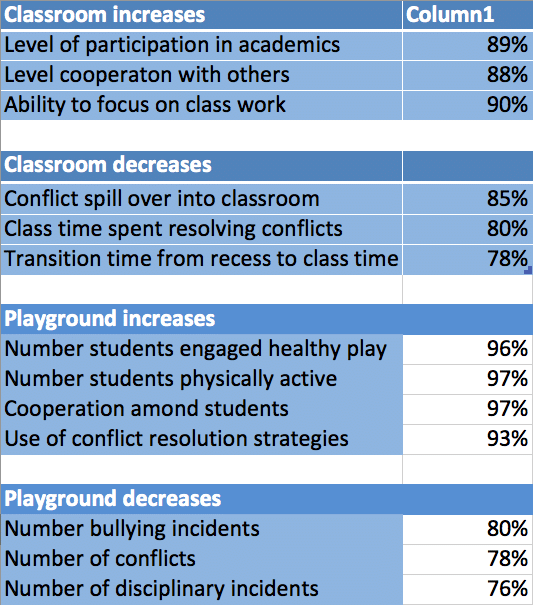
Playworks activities are designed to engage students in physical activity, foster social skills related to cooperation and conflict resolution, improve students’ ability to focus on classwork, decrease behavioral problems and improve school climate.

Every recess ends with an organized closing.

“The kids get back in line, they let all the steam out, and they walk back into the classroom in an orderly fashion. So the teachers earn back a time with tushes in the seats. The teacher is not solving bullying issues, so they’re getting increased learning opportunities, and the teachers are getting to teach more,” said McConnell. Over the course of the school year, according to Playworks’ data, the teacher gains 18 hours in instructional time.

[content_box box_type=”normal”]

Playworks services

Compiled by Lynn Sygiel, editor, Charitable Advisors

pw-sidebarPlayworks is changing school culture with safe, fun, and healthy play at school every day. Only elementary schools and its staffs are eligible for Playworks.
In the Indianapolis-area this school year, 5,300 students are receiving direct service through the Coach and TeamUp program.

Here’s an overview of Playworks programs:

Playworks Coach: fulltime recess and in-classroom game coach, based at the school.

Indianapolis area schools

  • School 44, Global Prep Academy
  • School 61, Clarence Farrington Elementary School
  • School 69, Kindezi Academy
  • School 107, Lew Wallace Elementary School
  • Irvington Community Elementary, charter school

Playworks TeamUp: partners with a group of elementary schools and provides an on-site coordinator to teach, model and empower a sustainable recess program.

Washington Township: Greenbriar, Fox Hill, Nora and Crooked Creek elementary schools.

Junior Coaches: A leadership program for fourth- or fifth-grades at Coach schools. After teachers and administrators identify potential candidates, these elementary students develop skills to take on added responsibility for leading recess. To set them a part on the playground, they wear purple shirts.

Playworks Pro: provides professional training and ongoing development to school staff, paraprofessionals and after-school care providers to create and maintain a great recess and play environment throughout the school year. Indianapolis worked with the Indiana State Department of Health to identify regions needing pro-training in schools, districts or youth-serving organizations. In the Warsaw area, multiple elementary schools from several districts came together for pro-training.

Training: provides specific training for youth-serving organizations’ staffs. Last year, Playworks trained the summer program staff for Nicholas Park, and Big Car’s staff were trained to understand crowd management and attention getters.

A 348-page game guide is available for schools, youth groups and church youth groups.

Corporate Playworks: Play Days is a fun and active team-building, volunteer and community engagement experience to get employees out of the office and onto the playground, serving kids and schools.

2016 survey results

In Indianapolis administrators, teachers and school support staff completed surveys. Of the 84 Indianapolis-area respondents, 88 percent wanted Playworks to return next school year.

Here is the compilation:

screen-shot-2016-11-28-at-10-07-34-pm

[/content_box]


According to Hertko, last year IU Health offered Playworks as one of its options for five IPS schools and three parks. School 69 opted to have Playworks and positive messaging painted on the school’s wall. That day, the principal reported there were no discipline problems, not even little things.

The program has real, measurable data to prove its effect. Mathematica Policy Research and Stanford University found that a Playworks recess can transform school climate, paving the way for less bullying and more focus on learning.

“You can go to a number of nonprofits here in Indianapolis that are doing good work, and you can hear a story of transformation, and it is just as touching and just as important,” said Hertko.

“I think what is different about Playworks is they have metrics in place that also measure that. There are students who are stepping up to be leaders who weren’t, and when the program is measured among teachers and administrators and students, they’re actually moving the dial on these issues. And that, I think, is really important,” said Hertko.

Junior coaches add a unique dimension to the program. These are fourth- or fifth-graders who are identified by teachers and administrators as potential playground leaders. On the playground, they are the ones in the purple shirts. Their end goal: to lead recess.

“It’s our leadership program and a core component. We take fourth- and fifth-graders who are leaders in their schools, but they’re not necessarily your student council presidents. They have reputations, and they need additional assistance. The role is an added responsibility and requires trust. So it’s a big deal and a paradigm shifter for a lot of kids,” said McConnell.

McConnell has a desire to measure what happens to junior coaches when they leave elementary school where they stand out.

“They’re at an interesting phase, they could go either way academically, either way socially. What happens when they go to seventh and eighth grade? What does that look like? We have anecdotal information that they stay the track because they’ve had the experience, but we don’t know enough to definitely say. That’s an area to explore,” she said.

McConnell said the key skills that kids develop are empathy and inclusion.

“I think they learn to relate to each other and because of the variety of activities it allows kids to interact with each other without barriers, without boundaries. They have more empathy for each other when they go back into the classroom,” said McConnell. “The inclusion part is you’re more likely to play with people you don’t know or people you don’t like, if you all want to play kickball.

“It softens the hard edge that comes with variations in language, academic abilities and athletic abilities. They learn to work together and play together, which is a natural expression of empathy, right?” McConnell continued. “They relate to each other differently, and so that transfers over to the educational environment, the actual academic environment.”

For parents, it’s about safe play. McConnell and Hall know the challenges for Playworks students – the majority receive free- and-reduced lunch and live in high-crime neighborhoods. Walking to the neighborhood park may not be an option.

“What we recognize is that there are amazing parks in this community, but the walk to the park from a kid’s house may not be safe. Recess is, in fact, where kids tend to play and be safe. And that safe factor translates into the home. So that’s a benefit to the family. Kids want to go to school, and they’re safe. So that’s a pretty important platform,” McConnell said.

They have learned from parents and the general community that safe play slowly radiates.

McConnell said there are junior coaches who actually teach roshambo to their neighbors as a way of resolving conflict. “They might say, ‘We’re going to play tag and then we’re going to solve it this way.’”

Nationally Playworks announced its intention to dramatically expand both the current number of students enrolled in programs, as well as reach hundreds of thousands of children through free resources and training for schools. Over the next four years, the AIM program, backed by $26 million in new funding, will reach 3.5 million kids in 7,000 elementary schools.

Locally, the Indianapolis staff wants to grow direct service, but also have more opportunities to reach pockets of vulnerable children in rural and urban areas like Muncie, Anderson and Terre Haute.

One model is to work with school districts and offering a combination of training and online resources. While they cannot direct serve every region of the state, they can positively impact school districts by reaching adults.

The good news is that all of this is in the final vetting stages. This is a way to reach a critical mass at the grassroots level, and then, according to McConnell, the organization can launch a policy discussion.

“It’s what informed Rhode Island’s decision, and that’s what changes the landscape. So we recognize that offering the program to anyone who really and truly is interested and supporting him or her through the process, changes the discussion. What does it really mean to educate a child? What does it really mean to fight obesity? Let’s look at it through what builds a healthier community and what builds a healthy child,” she said.

Hertko offers everyone an invitation: Come to a school that has Playworks and observe the playground and the classroom.

“I think that Playworks teaches how to get students’ attention, how to get them focused and also teaches students to do it themselves. It’s helping the kids, it’s helping the teachers, administration to make those schools healthier environments for students to learn and grow.”

YouthBuild Indy offers hands-on education

By Feature, Programming

By Lynn Sygiel, editor, Charitable Advisors

The refrain is a familiar one, and young people hear it all the time: “Study hard, go to college, get a good job.” For many students, it’s great advice. In a competitive marketplace, a good education is vital.

Rodney Bussell, program director at YouthBuild Indy, is all for studying hard and getting a good job. But going to college? Bussell says it’s not for everyone.

“Somehow, somewhere, you need to get certified in something,” said Bussell, who has a background in youth work and has been in charge of YouthBuild Indy since 2015. “If you’re better at using your hands, let’s get you in an apprenticeship program. If you’re not that classroom person who will sit in the class for the next four or five years all day long and write papers, if that’s not you, it’s OK. It’s not a bad thing.”

At YouthBuild Indy, a nonprofit on the city’s Eastside near 25th Street and Keystone Avenue, low-income young people receive construction and trades training while working to earn a High School Equivalency Diploma. The program began in Harlem in New York City in 1978, and a decade later, its founder took it national.

yb_20160519_142831 The Marion County program, around for eight years, is open to the county’s high school dropouts ages 18 to 24 who are drug-free. It is managed by EmployIndy, funded by the U.S. Department of Labor, and has had more than 350 young adults complete the program.

Chantell Ledezma, 22; Tyler Keno, 22; Britney Cooper, 25, are currently enrolled in the program, and Armani Edmond, 19, who finished in the spring, is now a staff member. These four enrolled to earn their equivalency diploma and construction training, but it has provided them with much more than that.

“Yes, it is about the education, but staff care about your feelings, too. That’s why I like coming here. It’s not just the money or the education, I just feel like they help with a lot,” said Keno, who has been with the program for three months.

For Cooper, the program is her chance to make a change and have a better life.

“My goals are to build myself, have a career and look into the future. We all motivate each other every day. It’s the place to come to,” she said. Cooper dropped out of school at 18 to take care of her daughter.

Bussell said the program provides stability and a sense of family for these young adults.

“You create trust for them. A lot of them don’t have a family structure that a lot of us may have grown up in. So a lot of times, we build trust, let them see that we’re there for them and they haven’t seen before. They’re kind of in that traumatic lifestyle.

“We help them see the big picture and outline their goals and aspirations: How do you choose? Do you want to go to college? Do you want to do construction? Do you want to go into another field? How are we going to help you get there?”

YouthBuild Indy opened in 2008 at the John Hope Academy on 16th Street. It’s now on the third floor of 37 Place, a multigenerational community center in the Martindale-Brightwood neighborhood. Because of its location, the organization lacks some visibility. Potential students don’t just walk in the front door.

Part of Edmond’s job is to get the word out through social media, meetings with area school guidance counselors and billboards around the city. In the past, students found the program through fliers, the courts, referrals from other programs and word of mouth.

We’ve been trying to pump it up because the numbers are kind of lower than we’d like them to be. We really are trying to market it. A lot of people are trying to figure out what we do or say, ‘I never heard of you,’” said Bussell. “We’ve had some decent foot traffic, we still would like to have more. Armani does a great job of getting out in the community, doing a lot of fairs and trying to make people aware of the program.”

On Bussell’s wish list is a different location that would include a carpentry shop with classrooms. Both city officials and other businesses have reached out to offer projects for students, and having an onsite shop would allow students to work on these projects with staff supervision.

The program targets Marion County students because of the county’s high poverty and dropout rates and emphasizes certain ZIP codes.

Potential students have to show proof of low income — food stamps, Medicaid or a check stub, if they are working. Staff expects that students are drug free, but they are not regularly tested.

Even if a student meets all the criteria, he or she must be interviewed and invited to a two-week mental toughness boot camp. During this time, the student is not enrolled in the program, but both the staff and students are charged with determining if the program is the right fit. Students under consideration must arrive at 8:30 every morning sharp, wear a white shirt and khakis, and only after completing the boot camp, are asked to make a commitment.

“It’s basically like tryouts for a sports team or anything like that. It’s basically seeing who wants it bad enough,” said Edmond. “After completing that two-week process, they will have a class graduation. Right after that, they’ll come back up, and we’ll have a meeting to see who made the cut, who wanted it bad enough and who will be accepted into the program.”

Edmond also works with students, talking and helping them through every day. I’ve been through it, and just being that person they can relate to and give them tips and tell them to keep pushing forward up to their graduation point.”

Once enrolled, grant funds help provide students with gas cards or bus passes and a weekly attendance stipend. Students get $75 a week during an education week and $100 during a construction week.

Besides Bussell, the program has three case managers, a recruiter, three to four teachers and a construction manager. Troy Turner from Turner Construction teaches safety courses and manages the construction work and Marian University oversees the education portion.

Most students spend a week in the classroom and then rotate to a construction site or learn about basic Occupational Safety and Health Administration, engineering, electrical or construction certifications. Students also learn the expectations and responsibilities of the workplace through the JAG program, which also helps them work on resumes and take part in mock interviews.

With Turner’s guidance 73 percent of the students have completed their National Construction Certification, which is nationally recognized and issued by the National Center for Construction, Education and Research (NCCER). Often the construction work focuses on Indy’s abandoned houses. The Community Development Corporation purchases these homes and then contracts with Turner Construction, which guarantees that these will be training houses for YouthBuild.

Students just completed houses on Capitol and Graceland avenues and Oxford Street and now are working on Kenwood and Leland streets.

“Giving them NCCER, they have a basic fundamental foundation of what construction is, and it’s a good certification to have. Our students move ahead of the bunch. They come in to a job interview with a high school equivalency and NCCER. We have a young man who got a job right away. He said, ‘I got NCCER,’ and he walked out of a job fair with two jobs,” said Bussell.

Through partnerships with organizations such as IndyPendence Job Corps, Bussell is looking to grow the trade options to include CNA or IT training.

“We can expand on it, but the foundation is always going to be construction,” said Bussell.

Can students come back? “Once at YouthBuild, always at YouthBuild,” is a saying that is espoused by staff.

“When young people graduate, we don’t just cut them lose. We have a year follow-up. We’ll make sure they have jobs, and if not, we’ll try to get them back to find one. We celebrate 30 days, 60 days, 90 days job-holding accomplishments.”

YouthBuild partners with or holds occasional hiring fairs.

“I will contact some of my alumni and ask, ‘Are you working?’ If you are working and you are satisfied OK, if not, let’s get you in here,” Bussell said.

YouthBuild Indy places 68 percent of its participants in further education programs or employment and has an 81 percent diploma/certification rate.

Would Cooper, Keno, Ledezma and Edmond recommend the program to friends and family?

Ledezma says if they really want to go back to school, this is the place to be.

“If it was one of my friends, like my homeboys, I’d be like, ‘Bro, you trying to bury yourself. Like come up to the place where I’m at.’ This might be weird, but everyone wants the money, and I’d be like, ‘They pay you, too. Get you some money, get your education,’” said Keno.

Three Chicago nonprofit organizations to receive investments totaling nearly $3 million

By Feature, Programming

By Mary L. Datcher, senior staff writer, Chicago Defender

Chicago Beyond announced the winners of its first-ever innovation challenge and will present three nonprofits with investments that total nearly $3 million overall. Launched by Chicago Beyond in April, the GO Innovate challenge sought early-stage ideas that offer innovative programming in two areas: Supporting College Matriculation and Graduation; and Reengaging Youth in Work and School.

For each winning organization, Chicago Beyond is also funding a research partnership with the University of Chicago’s Urban Labs to evaluate the impact of each investment. Every investment recipient has worked with Chicago Beyond and Urban Labs to develop a unique research question that will allow detailed study of the program and better understanding of what works, in order to positively impact a greater number of young Chicagoans and increase the field of knowledge in these topic areas.

More than 200 organizations applied for the first innovation challenge. Applications were reviewed by the Chicago Beyond team and finalists were selected by two independent selection committees which were formed for each topic area.

“Our first innovation challenge brought out some of the best and most innovative ideas in programming to help our city’s youth succeed in school and in life,” Chicago Beyond Managing Director, Liz Dozier, said. “There is no shortage of passion for and commitment to the young people of Chicago. We are grateful for the opportunity to present these three organizations with investments to not only reach more young Chicagoans immediately, but to learn from and share our research outcomes in order to have a greater impact on the future of our youth nationwide.”

Read moreButton Text

STEM education: in-school and out-of-school working together

By Feature, Programming

By Lynn Sygiel, editor, Charitable Advisors

Paul Ainslie and Bob Abrams have followed similar career paths. Both have had lengthy careers in the corporate sector – Ainslie at automotive-supplier Delphi and Abrams at engine-maker Cummins and other small businesses.

But that’s not all they have in common. Both now work for nonprofit organizations and each is charged with advancing science, technology, engineering and math – or STEM, for short. Abrams is Indiana’s Afterschool Network STEM coordinator and Ainslie is the managing director of I-STEM based at Purdue University.

Abrams and Ainslie are working together, helping to marry in-school and out-of-school STEM efforts. Both see limitless opportunities to expand and build upon in-school learning through flexible and engaging out-of-school programming and by connecting programs to community resources.

“The extension is to connect in-school and out-of-school STEM teachers, so that there is consistency. If they’re going to do a lesson in physical science in the STEM science class, there may be an after-school program that would align to that,” said Ainslie.

In the 21st century, many have rallied around STEM education, citing students’ need for greater scientific and technological literacy to function in today’s society and economy. Corporate leaders have worried about where the next generation of workers will come from with too few students seeing these disciplines as springboards for their careers.

Abrams and Ainslie say there is plenty of is exemplary STEM curriculum, but typically, the after-school approach has been more ad hoc, and they want to change that.

“So we’re doing that connecting by saying, ‘Let’s extend the learning on this science STEM topic to the after-school space,’” said Ainslie.

“What we’re trying to do is say to schools and after-school programs, ‘OK, this is working well in school, what can you do with the out-of-school program?” said Abrams.

What the duo has found in their travels around the state are willing communities, but what’s lacking are models. Their strategy is simple: Find programs doing that and share them as demonstration sites.

So far they have identified two programs, although they believe there are more out there.

Warren Township and Columbus each have an elementary school that has repurposed a computer lab as a STEM lab, and has a dedicated STEM resource person. Much like art, music and physical education, students rotate throughout the school day. Both see the potential of repurposing the STEM labs for after-school programming and connecting the in-school and out-of-school teachers.

“In Warren, the school is Liberty Park Elementary. It’s a Project Lead the Way-based STEM center and PLW did the training for that instructor. That’s the model. If you go with a strong curriculum, then training is part of it, too. And that’s got to be a key thing,” said Ainslie.

In the Columbus school district, according to Abrams, there is one school right now with plans to expand to others. The school uses a California-based program called Iridescent, which is an initiative that incorporates the cooperation of scientists and engineering experts as mentors.

“So Cummins in Columbus sends people in to lead particular exercises, but there is a dedicated teacher in that school who has gone through the training and leads that program,” he said.

Corporations are interested in supporting these types of efforts.

Ainslie has been working with Eli Lilly and Company and its Science Coaches program, which has 85 professionals, working in classrooms, primarily K-8. He said there is interest from Rolls Royce, Roche and Cummins, too. It’s an opportunity to get STEM professionals into the classroom to provide expertise without an impact on school budgets.

“There are a number of corporate partners that are interested in helping out, but they see the recent landscape being random acts of STEM. They’re good individual activities, but sustainability is questionable. So if we can demonstrate a sustainable, self-generating structure that works, I think we have something that people will invest in,” said Abrams.

Both Abrams and Ainslie provide professional development for educators. While schools already have academic standards, the Indiana Afterschool Network has developed specialty standards in multiple areas, including STEM. Indiana’s 38 standards serve as a framework for after-school programs. An online strengths-based self-assessment tool, it helps K-12 after-school programs rate their performances.

“Indiana has actually been recognized as a leader in out-of-school standards, including the STEM standards. Indiana was the first to focus on specific topics, and the STEM standards have become sort of the standard for the country,” said Ainslie.

What both acknowledged, however, is that there is a lot of variability in the focus on STEM and the quality of the STEM programs.

Since 2013, the Indiana Afterschool Network (IAN) has been collecting data through self-reporting. In its online mapping database, 992 programs are now registered, and of those, 44 percent offered STEM programming. IAN estimates that the current database represents about a third of the programs statewide.

While both provide professional development, Abrams said after-school is challenging for multiple reasons, specifically staffing.

“It doesn’t pay much, there is high turnover, and it doesn’t have an accreditation process. So finding people who are interested, motivated, skillful and being able to retain them is a real challenge,” he said.

“It gets into how well-prepared are the educators who are running the STEM programs. Are they just doing ‘gee-whiz’ activities that they learned on YouTube or are they actually talking about learning, and checking for student understanding?” said Ainslie.

Having the materials is good, but educators need to be prepared to assess learning and still make it fun. It’s the difference between having just an experience and having a quality STEM experience. Both want students both in- and out-of-school programs to have full discussions about their STEM experiences, which includes explaining what they observed, discussing what they learned and how they might do it differently.

“That sort of full discussion that we try to encourage educators and teachers to have doesn’t always happen in after-school. Sometimes it’s making a volcano, ‘Wasn’t that cool? What do we do tomorrow?’ It’s not the complete quality science experience that we want kids to have,” said Ainslie.

Both realize, too, that time spent in after-school programs is short. Programs must make time for snacks, homework and physical activity.

And the number of Hoosiers enrolled in after-school is only 11 percent with the majority on the elementary school level.

So they have a plan.

Warren Township school district educators have been providing feedback and believe it is better to have focused, time-limited activities, like a space camp for three weeks.

“We feel if there are focused short-period activities, like a weeklong Makerspace programming and it’s publicized, it may introduce more families to after-school opportunities that they aren’t aware of,” said Abrams. “Makerspace staff will come to the site and parents can make sure their kids are there.

“If you schedule STEM every day from 4 p.m. to 5 p.m., half the people are gone by 4:45, except for a couple who stay until 6 p.m.,” said Abrams.

There are also programs such as IndianaFirst robotics, STEM Scouts and coding activities that are gaining momentum because they’re viewed more like camps.

For someone thinking about starting an after-school STEM program, Abrams and Ainslie have some advice. Find resources partners, schools and business that want to be partners. Define the skills and curriculum and how you will train teachers. Recognize what you’ve got to start with, what can you build on, so you don’t have to start from scratch. Find people who are interested, motivated and skillful.

“It’s a three-legged stool. I mean, it’s in-school, out-of-school and community partnerships,” said Ainslie.