Category

Fundraising

Need money? Feds have it

By Feature, Fundraising

By Lynn Sygiel, editor, Charitable Advisors |

Kathy Souchet-Downey is big on making lists. Lists that nonprofits can use.

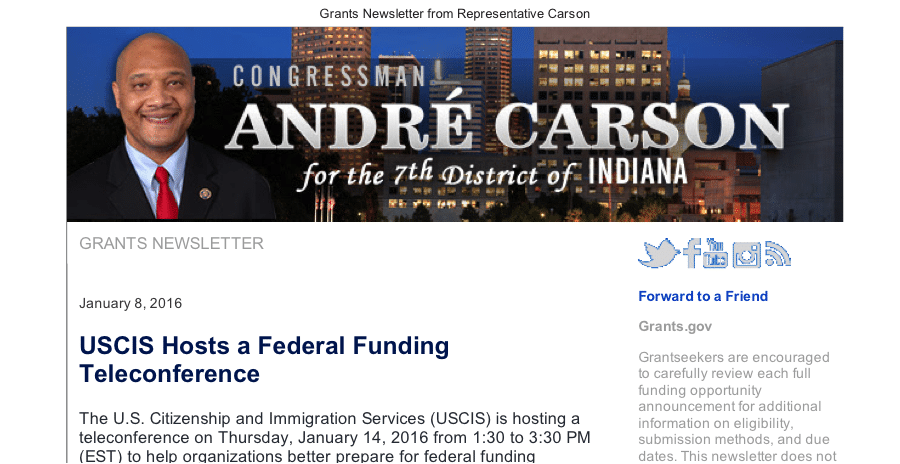
As a staff member of Congressman André Carson in Indianapolis, she regularly pulls together a list of recently released federal grants and emails it to organizations. All an organization has to do to receive it is email her at kathy.downey@mail.house.gov and request the publication.

But the grants’ list isn’t the only way Carson’s office supports applicants. He is willing to provide his support by writing a letter to accompany the nonprofit’s grant request. Souchet-Downey can also help field specific grant questions. With the Congressman’s support, over $7 million in federal grant money was secured for nonprofit and community organizations in his district last year.
carson

Kathy Hahn Keiner at Gleaners Food Bank of Indiana, Laura Feldman Miskin at College Mentors for Kids and Gregg Keesling at RecycleForce have first-hand experience applying for federal grants that had Carson’s and other Indiana Congress members’ support.

Since 2009, College Mentors for Kids has applied for five federal grants. In 2013, it was awarded a three-year $1.3 million grant for its work in five states. Feldman Miskin said the application itself created several opportunities.

“Most of my work my work at College Mentors for Kids is with corporations and foundations supporters, but this is a different ballgame,” said the director of corporate and foundation development.

“It created an opportunity to talk with our career staff about ways to improve the programs significantly, where programs could grow and for the staff to think about how the federal government could support this effort. It brought innovations to a new level,” she said.

Carson’s office also provided guidance on building relationships with members of Congress in the other states where College Mentors work.

These three local organizations haven’t applied for the same dollars, but rather from a variety of federal agencies.

For College Mentors the American Recovery and Reinvestment Act in 2009 provided its first funding, and later grants from the U.S. Department of Justice, specifically the Office of Juvenile Justice (OJJDP) was a fit. The organization has applied for five federal grants. OJJDP has identified mentoring as a strategy for preventing and intervening in juvenile delinquencies, and so it aligned with the organization’s mission.

Keesling, RecycleForce’s executive director, said his agency’s grants come from two federal agencies – the Department of Labor and Department of Health & Human Services’ subdivision, Community Economic Development (CED) Grant Fund. Since 2009, Keesling said RecycleForce has been awarded over $11 million in federal grants, including $2.1 million in the last six months, which is helping the organization add 40 jobs.

[content_box box_type=”normal”]

Grants: There are three common types of federal grants: formula, project and matching.

  • Formula grants are non-competitive and are distributed to state and local governments based on quantifiable variables. For example, X dollars goes to every student in the state. These grants are allocated for broad purposes such as highway programs, education funding and block grants. Please note that although formula grants are initially non-competitive, once funding is received by a federal agency or state and local government, these dollars may be available to eligible organizations through an application or request process.
  • Project grants fund specific projects and services addressing a specific policy need identified by Congress. Availability of this funding fluctuates year-to-year. Project grants are most often competitive and available to eligible organizations through an application or request process. Examples of project grants include Wetland Protection grants through the U. S. Environmental Protection Agency or Minority Business Development programs through the U.S. Small Business Administration.
  • Matching grants require that the recipient contribute something towards the project — normally cash services or facilities to match a percentage of the grant. These are used to encourage recipient to efficiently manage the program. Matching grants are most often competitive and available to eligible organizations through an application or request process.
[/content_box]

Writing these proposals, however, is not for the faint of heart. All three said the timeframe is condensed, giving them six weeks to two months from first learning about the grant to the final submission. All three recommended a dedicated internal staff person that keeps everyone on task.

And not all their asks have been successful. Keesling said RecycleForce applied four times before it got its first CED grant.

“You’ve got to understand the rules at the federal level, and then you’ve also got to understand how you adapted those rules to your needs at the local level,” said Keesling.

The system allows the organization to learn, if the grant is not approved.

“People historically chase the money, they fail, they get frustrated, they throw up their hands. It’s a process,” he said. “When you don’t get a grant, you can request feedback from the reviewers about what you did wrong.

Feldman Miskin and Keesling said it is important that this is not the first time your member of Congress has heard from you and that you have established relationships.

“Hey, you never heard of me, but will you write a letter of support? Here’s all the good work we are doing.”

While there is a learning curve to develop strong proposals, using the government’s online grant system also takes time to learn.

Hahn Keiner, Gleaners’ Chief Programs and Agency Relations Officer, was introduced to the federal grant application process this fall. With the closing of the Double 8 stores, Congressman Carson hosted a food insecurity roundtable that Hahn Keiner attended and piqued Gleaner’s proposal idea.

In April, Gleaners will learn if its proposal for a $100,000 Fresh Bucks Indy project will be funded. The pilot-project is modeled on the SNAP incentive program, which is used at Indianapolis area Farmers’ Markets and allows a user’s benefits go further by doubling purchasing power, up to $20, on Indiana-grown specialty crops.

If awarded, Gleaners will partner with Kroger at the 10th and Linwood streets’ store. That particular Kroger has a high SNAP usage. The project would not only expand the SNAP participants access to produce year-round, but partner with a national retail store.

“We are hoping to get the grant because we think it’s a viable project that could be replicated all over the country. We’re really excited about it. There is a lot of opportunity even if we don’t get it. The whole idea was it was successful at the Farmers’ Market, but test driving it at Kroger, and it could go farther than that, if it is successful,” said Hahn Keiner.

According to Keesling, Indiana is at the end of the line when it comes to federal grants.

“We don’t have a culture that understands how to do it. With the work of Congressman Carson’s office, we are starting to grow that. These are our tax dollars, and there is really no reason that they should go to New York or Oklahoma. We should think of the federal government as a partner.”

The three had some general advice for nonprofits that are considering a federal grant submission:

  1. Spend time on the specific federal agency’s website, issuing the request, to understand how it thinks about the world, the language used and how it identifies a problem. That will help determine, if your nonprofit is a good fit, and the project aligns with the organization’s mission and local community goals.
  2. Ask area nonprofits that have received federal grants for tips.
  3. Get comfortable with the government’s structured online grant application system (grant.gov). Carson’s office has a primer on learning to use the online application system.
  4. Identify an internal project manager to help meet the deadline and create a timetable to complete.
  5. Letters of support from members of Congress are a unique aspect of the process, so allow plenty of time to receive the required collaboration and support letters. The more support, the better it speaks to the project.
  6. Get started early on grant elements that will require materials from external sources, like project’s contractor bids and partner memorandums.
  7. Spend time on the budget. Ask: Is it allowable? Expendable? Reasonable? Does it support program objectives?
  8. Allot time to work on it in order to cross every “T” and dot every “I”. Keep your writing clear and clean. It’s not a time for creative writing.
  9. After you receive the grant, keep members of Congress updated. Form collaborative partner committees.

IRS nixes charitable donation substantiation rules

By Feature, Fundraising

By Diane Freda, reporter, Daily Tax Report Bloomberg BNA |

Jan. 7 — The IRS has withdrawn proposed rules that would have allowed charities to directly report donors’ contributions to the agency, saying it won’t implement an exception to the current “contemporaneous written acknowledgement” (CWA) requirement for substantiating contributions of $250 or more.

The Internal Revenue Service had been flooded with comment letters opposing the proposal released in September (180 DTR G-7, 9/17/15).

In withdrawing the rules (REG-138344-13) Jan. 7, the IRS cited the substantial number of public comments it has received questioning the need for donee reporting, and especially, the collection and maintenance of Social Security numbers for use on a new information return.

Button Text

State of the sector survey

By Feature, Fundraising

By Nonprofit Finance Fund, survey results |

NFF’s 2015 State of the Nonprofit Sector Survey focuses on the underlying causes of these dynamics by exploring the programmatic, financial, and operational issues facing nonprofits across the U.S. It launched the Survey in 2008, when economic crisis threatened the viability of many organizations.

Seven years later, results from 5,451 respondents show some indications of recovery, stabilization, and growth. Nonprofits are adding jobs, engaging in strategic conversations such as leadership succession planning, and looking to retain their workforce. Yet as they raise their sights from the focus on short-term crisis, many are confronting the troubling reality that current practices cannot sustain organizations in the long-term or meet the needs of the communities they serve now. Many organizations have stumbled out of crisis looking to make the necessary investments to secure their long-term future. And it is a hard road ahead. 

Key findings

Under-resourced communities are going without because nonprofits can’t meet demand. Americans — particularly those in low-income communities — are still struggling to secure jobs, affordable housing, and healthcare.

  • 76 percent of nonprofits reported an increase in demand for services — the 7th year that a majority have reported increases.
  • 52 percent couldn’t meet demand — the third year in a row that more than half of nonprofits couldn’t meet demand.
  • Of those who reported that they could not meet demand, 71 percent said that client needs go unmet when they can’t provide services.  

The 2015 NFF Survey Analyzer at survey.nff.org allows you to investigate questions that cut across sub-sectors, budget size, geography and other dimensions.

Button Text

Six trends that will set the pace for 2016’s philanthropy

By Feature, Fundraising

By Bruce DeBoskey, The DeBoskey Group, for The Denver Post |

With record levels of giving, new approaches to marshaling philanthropic assets for impact, and better approaches to philanthropic strategy, 2015 was a great year for philanthropy. This trend will continue in 2016.

Increasingly, leaders in businesses, foundations and families understand that philanthropy is more than the merely transactional act of writing checks to favorite nonprofits. Today, philanthropy is seen as a strategic investment that is transformational for both society and the donor.

In the coming year, expect to see: The increasing impact of women

Women continue to demonstrate innovation and leadership in the field of philanthropy — and with big impact. Women now control more than half of the private wealth in the United States.

Looking forward, women are expected to inherit 70 percent of the $41 trillion in inter-generational wealth transfer that will take place over the next 40 years. By 2025, women will comprise 60 percent of U.S. billionaires.

Button Text

Nonprofits assail IRS rule

By Feature, Fundraising

By Tim Devaney, staff writer, The Hill |

Nonprofit groups are assailing a proposed rule from the Internal Revenue Service, warning the regulations could dry up donations and leave them vulnerable to hacking.

The IRS is proposing new requirements for nonprofits to collect the Social Security numbers of their donors.

Currently, nonprofits send donors a form verifying their contributions, which they use for tax purposes. However, the IRS is proposing changes that would require these nonprofits to collect their donors’ SSNs to provide directly to the agency.

But this could put a bull’s-eye on nonprofits, critics say.

Button Text

Congress passes bill to make charitable IRA rollover, other tax incentives permanent

By Feature, Fundraising

By Sherri Welch, senior reporter, Crain’s Detroit Business |

The U.S. Congress has approved a bill that would make three charitable tax incentives permanent, according to Washington, D.C.-based Independent Sector, which called the move “a monumental victory on Capital Hill” in an open letter to its members.

Independent Sector and the nonprofit sector as a whole have been advocating to make the charitable incentives a permanent part of the tax code for a decade. During that time, the incentives have repeatedly expired before, in some cases, being retroactively renewed, confounding and frustrating donors and advisers alike.

Part of the Protecting Americans from Tax Hikes Act of 2015, the charitable tax incentives set to become permanent include:

  • the IRA charitable rollover, which allows donors age 70½ and older to give to charities up to $100,000 tax-free annually from their IRAs
  • enhanced deductions for gifts of excess food inventories and conservation easement provisions under which private owners promise not to develop land in exchange for the deduction while still retaining ownership of the land.

The act also includes provisions to make the child tax credit and the earned income tax credit permanent, according to Independent Sector.

Button Text

Zuckerberg’s pledge reflects a new era in philanthropy

By Feature, Fundraising

By David Crary, reporter, Associated Press |

The huge philanthropic pledge by Facebook CEO Mark Zuckerberg and his wife — totaling perhaps $45 billion — reflects the fast-paced emergence of a new Gilded Age of giving. The changes excite many in the charity world, but also raise questions about effectiveness, ethics and the impact on older charities that may not share in any windfall.

Foremost, there is applause for the new wave of philanthropists — led over the past five years by Bill Gates and Warren Buffett, and subsequently joined by Zuckerberg and scores of other billionaires in the United States and abroad.

The Giving Pledge, founded in 2010 by Gates and Buffet, now has 138 billionaire signatories from 15 countries who have pledged to give away more than half of their wealth. Many, including Zuckerberg, want to be personally engaged in the oversight and management of their pledged funds, and are finding nontraditional ways of leveraging them.

Amir Pasic, dean of Indiana University’s Lilly Family School of Philanthropy, drew parallels between these modern-day philanthropists and those from the earlier Gilded Age, roughly a century ago, when the Carnegie, Ford and Rockefeller families pioneered a new type of charitable foundation.

Button Text

Reliable online auction platforms geared toward nonprofit needs

By Feature, Fundraising

Laura S. Quinn, executive director Idealware for Tech Soup |

What tools can help you raise money and rally support for your cause through an online auction? We take a look at the software tools that are widely used in the nonprofit sector.

An online charity auction can be a good way to raise money, rally support for your cause, and hopefully, to have some fun. Like any special event, an online auction requires solid planning and a fair amount of staff time. What it won’t require, however, is substantial technical expertise. Several good online platforms will host and help you manage your online auction.

What should you be thinking about as you consider an online auction? What tools might work well? We asked a number of nonprofit professionals with experience in auctions for their software recommendations and condensed their advice here.

Button Text

Relay for Life events lead the way

By Feature, Fundraising

The American Cancer Society, which held nearly 5,000 Relay for Life events in 2014, raised $335 million during that time to lead the way in the annual Peer-to-Peer Fundraising Top 30 listing.

The charities on the list, compiled by the Peer-to-Peer Fundraising Forum, raised more than $1.6 million and featured more than 8.3 million participants.

The total revenue raised, however, is a 2.47 percent decline from 2013.

Second on the list is the American Heart Association’s Heart Walk, which raised $110 million, an increase of 4.92 percent.

Among the charities making a significant gain was the Alzheimer’s Association. It held 650 walks across the country and raised $67 million, an increase of 18.6 percent.

Button Text

In giving, who asks makes a difference

By Feature, Fundraising

By Carl Sygiel, special to Charitable Advisors |

Bob Karnak isn’t the type to back down from a challenge or a chance to get in a little exercise. The retired quality assurance consultant at Elanco recently made a trip from Indianapolis to Cleveland to visit family. For some, that would mean flying; for most, it would be a five-hour car trip. For Karnak, it was just an extra-long bicycle ride.

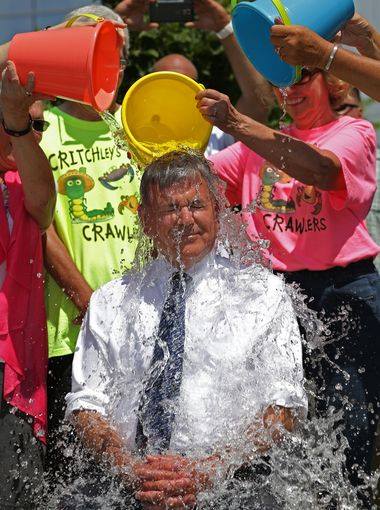
Dr. Robert Pascuzzi, a physician in the department of Neurology, kicks off the Ice Bucket Challenge at the I.U. Neuro Science Center in August. The ALS Certified Center is at the I.U. Neuro Science Center and where patients go to be diagnosed and evaluated using a multi-disciplinary approach for their ALS journey.

Dr. Robert Pascuzzi, a physician in the department of Neurology, kicks off the Ice Bucket Challenge at the I.U. Neuro Science Center in August. The ALS Certified Center is at the I.U. Neuro Science Center and where patients go to be diagnosed and evaluated using a multi-disciplinary approach for their ALS journey.

The 68-year-old Indianapolis man doesn’t make a habit out of going out for 300-mile spins, but it is in his fabric to stay active. Karnak averages about 3,000 miles a year on his bike, mostly for pleasure, but there’s often a deeper, more important goal.

Karnak’s two-wheeler isn’t just a vehicle to get from Point A to Point B. It’s a vehicle to raise money for charity – for causes that are important to him. Causes that can make the world a better place.

“Is altruism the right word?” Karnak asked. “It’s really doing something for somebody else. I’m healthy, my kids are healthy, my wife for the most part is healthy. I don’t have any life threatening diseases. I think it’s incumbent upon those who are healthy to help others.”

In many respects, Karnak, and others like him, are a charities’ best friends. They do the heavy lifting. They ask and the charity receives. In the nonprofit world, it’s called peer-to-peer fundraising, and while the concept has always been around in one form or another, it has grown to new heights over the past decade.

Over the years, Karnak has raised money locally through various biking events for charities such as Habitat for Humanity, the Multiple Sclerosis Society, the Juvenile Diabetes Research Foundation (JDRF) and most recently, the Leukemia and Lymphoma Society. The total is north of $160,000 and still rising.

Ways to get up, get involved

Looking for an event to participate in to raise money for a charity dear to you? There are many opportunities in Indiana, in the Midwest and nationally.

Most organizations have already held their 2015 events, but will be setting dates soon for 2016.

Here is a partial list:

AIDS
Indiana Aids Walk
www.indianaaidswalk.org

ALS (Lou Gehrig’s Disease)
Walk to Defeat ALS
Ice Bucket Challenge
webin.alsa.org

ALZHEIMER’S
Walk to End Alzheimer’s
www.alz.org/indiana
Longest Day
www.longest.day

BLOOD CANCER
Man/Woman of the Year
Light the Night Walk
Pennies for Patients
Team in Training
www.lls.org/indiana

BRAIN TUMOR
Head for the Cure 5K
www.braincure.org

BREAST CANCER
Komen Race for the Cure, April 16, 2016
www.komenindy.org

CHILDHOOD CANCER
Trek 100
www.trek100.org

COLON CANCER
Get Your Rear in Gear 5K
www.coloncancercoalition.org

CROHN’S AND COLITIS
Take Steps for Crohn’s and Colitis
www.ccfa.org
Spin 4 Crohn’s and Colitis Cures
www.spin4.org

CYSTIC FIBROSIS
Great Strides
www.fightcf.cff.org

DIABETES
Tour de Cure, June 4, 2016
http://main.diabetes.org/site/TR/TourdeCure/TourAdmin?fr_id=11068&pg=entry

HABITAT FOR HUMANITY
Cover Indiana Bike Tour
www.indyhabitat.org/cover-indiana

HEART DISEASE
Heart Walk
www.heartwalk.org

JUVENILE DIABETES
JDRF One Walk
JDRF Ride to Cure Diabetes
www.jdrf.org

LUNG CANCER
Beards for Hope (begins Nov. 1)
Free to Breathe run/walk
Walk your Socks Off
www.freetobreathe.org

LUPUS
Walk to End Lupus Now
www.lupus.org/indiana

MULTIPLE SCLEROSIS
Bike MS
www.nationalmssociety.org

PROSTATE CANCER
Movember Foundation
https://us.movember.com
www.1400miles.com

Karnak is persistent.

“If I’m out on a training ride, and somebody says, ‘Hey, what are you doing?’ and I get a chance to talk to them for more than five minutes, they are probably gonna get a letter from me asking for a donation,” Karnak said. “If you can bend someone’s ear, you’ll find everybody has a connection. Everybody. There’s not one person on this green earth anymore that doesn’t know someone who’s afflicted with something.”

Nonprofits rely on contributions to stay afloat, and under the peer-to-peer philosophy, rely on their supporters to play major roles. Who hasn’t been asked by your neighborhood Girl Scout or their parent to buy cookies? Or candy bars, wrapping paper, or poinsettias? We buy these things because someone we know asked us.

In today’s world, nonprofits that ignore the power of peer-to-peer fundraising do so at their own risk.

“It’s actually very simple in its core,” said Taylor Shanklin, the director of marketing and “peer-to-peer boss lady” at raisemore.com, a fundraising consulting firm in the Dallas-Fort Worth area. “It’s just people asking people to support them in what they are doing and support a cause they care about.”

In most cases, peer-to-peer fundraising revolves around an event: a run, a walk, a bike ride, a triathlon, a swim-a-thon. Participants sign up, agree to raise money and ask their friends and family to donate.

The Indiana chapter of the Leukemia and Lymphoma Society receives 88 percent of its funding through events such as its Man and Woman of the Year programs, its Light the Night walk and Team in Training, said Executive Director Amy Kwas. The challenging TNT program, where participants are trained to run marathons, compete in triathlons or 100-mile bike rides, was among the pioneers in this respect, having started in 1988.

“There’s the old adage – that people give to people, and that’s why it works in our case,” said Kwas. “Most people are affected directly, and it’s a way of showing support, perhaps for someone who’s going through treatment.”

Today, just about every nonprofit has gotten into the act. If you have a favorite charity, chances are there’s a specific event lined up to raise money for it. The figures may vary slightly, but there’s no doubt that the response rate from one donor asking another far exceeds that of traditional email or snail-mail solicitations from the charity itself.

Kimbia, a Texas-based fundraising consulting firm, estimates that 1 in 4 peer-to-peer emails will result in a donation, as compared to 1 in 1,250 appeals directly from a charity.

“In peer-to-peer, it’s a friend asking a friend,” said Shanklin. “I’m more inclined to give to my friend than some random organization. Peer-to-peer is always going to win in terms of (return on investment).”

Despite its effectiveness, not all charities have jumped on the bandwagon with both feet. In Indianapolis, Gleaners, which operates multiple local food banks, sends out solicitations frequently and still gets the majority – as much as 60 percent – of its donations from individuals. The charity has a donor database of more than 60,000, said Debbie Russell, the director of donor engagement.

“We’ve talked about it, but we’re not doing a lot in that regard,” said Russell, of peer-to-peer.

Gleaners did have a recent golf outing, however, that raised $7,500, and is putting in place a Building Hope initiative that is moving in the peer-to-peer direction, Russell said.

Gleaners is looking for key donors to become “ambassadors.” Russell said the ambassadors will spread the Gleaners’ message and bring others into the circle with the hope of creating a steady revenue stream.

For those charities wanting to enter the peer-to-peer world, there are no shortage of advisers. A simple Google search turns up page after page of companies marketing their services. Fundraising professionals can attend national conferences on the subject and there are numerous blogs devoted to the topic, mostly focused on the power of social media.

There are some red flags, however. According to the Peer-to-Peer Professional Forum, the top 30 peer-to-peer fundraising events in the country raised more than $1.6 billion in 2014, but that is a 2.47 percent decline from the previous year. The biggest player, the American Cancer Society’s ubiquitous Relay for Life program, brought in $335 million, but was down nearly 12 percent, or $45 million from 2013. The traditional Susan B. Komen Race for the Cure was down 10.78 percent, and its sister event, the Komen 3-Day walk, was down 38 percent or about $16 million.

Other events, such as LLS’ Team in Training program and the JDRF One Walk also took major hits.

Shanklin, of raisemore.com, thinks part of the decline is because the market is simply overcrowded.

“There are so many events now. Sometimes I feel that everybody is doing a walk,” Shanklin said. “I think that donors and participants are looking for something more interesting. Quite frankly, walks don’t bring in a lot of money, and they can be kind of boring. Although the walk thing is something everybody can do.”

Shanklin says charities must be more innovative, and many are, she said.

“Some organizations are trying different things, like animal shelters doing a dog walk,” she said.

The Alzheimer’s Association, which has a traditional walk that raised nearly $68 million across the country last year, has branched out with an event called the Longest Day. The initiative is on June 21, the summer solstice. On that day, participants pick an activity to take part in from sunrise to sunset, a reminder of the daily challenge facing those with Alzheimer’s.

“One of my friends had a daylong karaoke party,” Shanklin said. “They are doing a lot of do-it-yourself campaigns.”

Another popular event is the Movember movement where men grow mustaches in November and raise awareness (and money) for prostate cancer research.

“Movember is something that’s new. It’s fun, it’s quirky, it’s interesting. I think people are shifting their giving around because there are so many options out there,” Shanklin said.

The target for most charities is to catch lightning in a bottle similar to the ALS Ice Bucket Challenge that swept the nation a year ago. The ALS Association, which works to fight Lou Gehrig’s Disease, raised $115 million in 2014 after donations of just $23 million in 2013. In contrast, the movement has brought in barely a half million dollars in 2015.

“The Ice Bucket Challenge took off in the peer-to-peer world like nothing else,” Shanklin said. “I don’t know if we’ll ever see something like that again. It wasn’t even a fundraising campaign, just a way to raise awareness, but people got involved and interested, and it became a fun thing.”

“We broke the glass ceiling when it comes to awareness,” said Cindy Wise, executive director of the Indiana chapter of the ALS Associated. “Now if I mention “Ice Bucket Challenge,” everybody knows what I’m talking about.”

Shanklin doesn’t believe traditional fundraising is dead, but charities that continue to send out solicitations must be mindful of their audiences. While older donors may still like letters, younger people may prefer emails or to be contacted strictly through social media.

“Knowing the analytics of your audience is really important, and that’s something charities can really, really mess up,” Shanklin said. “When I feel they aren’t listening, and they bombard me – like if they send something to my 4-year-old son and me – I’m thinking, ‘If you are misusing your resources, I actually don’t want to give you my money. I might want to give it to someone else.’

“I want to see organizations do a better job of tailoring their communications,” Shanklin continued. “Nonprofits must look at generations and generational-giving trends and reports and how they are connecting to those generations.”

Knowing your audience carries over to the peer-to-peer world. Much attention has been focused on the innovative fundraising techniques of Charity: Water, which provides wells and drinking water for Third World countries. The 8-year-old nonprofit has become overwhelmingly popular with millennials and has drawn raves for its videos, vivid graphics, compelling stories, its social media presence and its revenue model in which 100 percent of all donations go to its programming. Charity: Water’s operating costs are paid for privately.

Charity: Water’s September campaign asked that people born in that month forgo any birthday gifts and ask friends to donate to the charity instead.

Even Charity: Water’s approach, however, goes back to the core of peer-to-peer fundraising. Friends asking friends. Neighbors asking neighbors.

Karnak, the bicycle veteran who has been raising funds this way for more than two decades, is a believer.

“I think a lot of people give because I’m coming out with a request and a valid reason,” he said. “And I make a case for it. I’m not doing it for myself. People are willing to give if you ask.”