Category

Fundraising

Three ways to engage millennial donors

By Feature, Fundraising

By Kathleen Kelly Janus for Stanford Social Innovation Review |

For many nonprofit organizations, getting young people to support their work seems an insurmountable challenge. Millennials are a mystery to them. As the stereotype goes, what is the use of involving the lazy, unemployed, social media-addicted generation, anyway? Even so, it’s widely understood that millennial engagement is vital to cultivating a pipeline of support for the years to come.

The good news is that engaging millennials does not have to be such mystery. In fact millennial supporters can become an organization’s most avid champions. At Spark, an organization I co-founded, which is now the largest network of millennial donors in the world, we’ve proven that while they may not have as much to give, collectively their impact can be powerful. In nearly 10 years, we have raised more than $1.5 million to support women’s issues, mostly in contributions of less than $100, and probably even more importantly, we have inspired a large group of young people to support gender equality issues who will likely continue to contribute to women’s organizations for decades.

Button Text

Funding innovative breast cancer treatment

By Feature, Fundraising

By Tom Jackman, reporter, The Washington Post |

The journey started in the gym at West Springfield High School in 2004. The rookie coach of the girls volleyball team wept as he told his players he was struggling not only with teaching the sport but also with his mother’s recent diagnosis of Stage 4 breast cancer, the deadliest stage. The girls were speechless, stunned by Rick Dunetz’s raw display of emotion.

But they rallied around the coach in an electrifying run to the district championship, galvanized by his mother’s first appearance at the title game. Dunetz was struck by how the players and the patient fed off each other: The team’s underdog winning streak, he said, seemingly inspired his mother to keep fighting cancer.

Button Text

Harnessing the power of the crowd

By Feature, Fundraising

By Patricia Campbell, content manager, The Guardian |

In the years since Barack Obama’s crowdfunded presidential campaign put this alternative form of fundraising on the map, crowdfunding has diversified dramatically. In the UK, digital innovation, particularly across social platforms and the financial tech (fintech) industry, has engendered a flourishing sharing economy, disrupting the natural ebb and flow of traditional finance streams. Peer-to-peer models are thriving, with the crowdfunding sector showing substantial growth.

Crowdfunding can neatly be described as the practice of financing a project or venture via small amounts of money from a large number of people. It’s most commonly understood as a means to fund grassroots businesses, with “backers” recouping financial rewards. But, driven by uncertain economic times, a new crop of donation-based crowdfunding sites for personal causes is booming.

Button Text

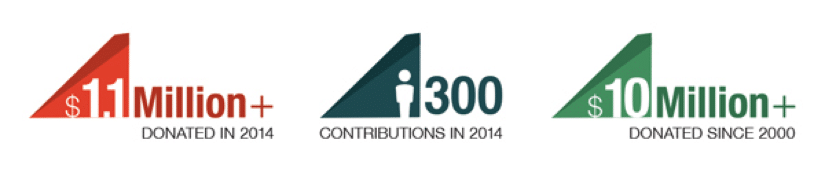
BKD Foundation’s 2014 charitable giving surpasses $10 million

By Fundraising, Sponsor Insight

The BKD Foundation is the firm’s charitable arm. The BKD Foundation is solely funded by BKD partners’ and employees’ monetary contributions. It aims to enrich the communities BDK serves through financial donations and volunteerism. The foundation supports not-for-profit organizations of all types and sizes, including employees serving in volunteer roles.

bkd-numbers

Supporting youth organizations

While the BKD Foundation provided support to a number of Indiana organizations, it made significant contributions to causes that serve the state’s youth. Junior Achievement of Central Indiana, The Villages, Big Brother Big Sisters of Northeast Indiana and Boys & Girls Club of Evansville are just a few of the organizations that benefited from foundation dollars. But the support went beyond monetary, numerous employees also regularly volunteered.

Outside of youth-specific charities, the Indianapolis and Bloomington BKD offices continued its five-year donation commitment to the Eskenazi Health Foundation for its violence intervention program and to the Community Foundation of Bloomington and Monroe County, a nonprofit that supports local charities.

Indiana BKD employees personally went above and beyond with charity efforts by donating both money and time — to Habitat for Humanity homebuilding efforts, the Salvation Army Toy Town toy drive, the March of Dime and many more.

Surrounding communities

The Fort Wayne and Merrillville offices sponsored The Carriage House Dancing with the Fort Wayne Stars event. Several BKDers also volunteered to tabulate votes and help with event-related activities throughout the year.

In Evansville, the team chose to support Community One, a local nonprofit dedicated to housing restoration and community development needs.

To learn more about the foundation’s support, browse the digital version of the 2014 foundation report.

Lack of money hampers expansion, study finds

By Feature, Fundraising

By Nicole Wallace, senior writer, The Chronicle of Philanthropy

Nonprofit organizations that want to spread their programs are having a hard time raising the money to expand, according to a new report.

The report is based on a survey of 436 nonprofit leaders, 325 of whom said their organizations were in the process of expanding. Yet only 24 percent of those groups have started fundraising campaigns to finance their planned growth, and those that have are raising an average of only 17 percent of what they say they need to carry out their expansion plans.

Button Text

The doer and the payer: A simple approach to scale

By Feature, Fundraising

By Kevin Starr and Laura Hattendorf, Mulago Foundation, Stanford Social Innovation Review

At the Mulago Foundation, we obsess on the notion of social impact that goes to scale. Since we’re usually willing to pay for lunch, people often come to talk about “going to scale” and “scaling up our work.” Most of the time, the word “growth” would better capture what they have in mind. Growth is a fine thing, but scale is what solves problems, and so scale is what we look for. When we talk about “going to scale,” this is what we mean:

You’ve got a proven model at big scale — the thing you do. Who’s going to replicate — do — it, and who is going to fund that replication?

Button Text

CFR what? It’s CFRE – Certified Fundraising Executive and you should consider it for yourself.

By Feature, Fundraising

Have you been a fundraising professional for 5 years or more? Are you proud of your career? Are you interested in attaining a professional certification that acknowledges you as a leader in fundraising with a wide breadth of knowledge?

Then consider preparing for the Certified Fund Raising Executive (CFRE) exam, the global standard for the fundraising profession. The CFRE exam is a generalist exam designed to test the knowledge and skills you use on the job on a daily basis. It is designed to test mastery of knowledge of best practices and how to apply them. Your AFP Cincinnati Chapter is here to help you prepare for the exam.

Join CFRE Chair and presenter Norah Mock, CFRE, along with other CFRE presenters, will walk you through AFP’s CFRE Review Course. This thorough session offers development professionals an opportunity to review the main components of a complete fundraising program. It is a two-day, intensive program the purpose of which is to provide an overview of skills, techniques, and program components based on fundraising experience at the five-year level.

When:  Thursday, September 17, 2015 (full day), Friday, September 18, 2015 (half day)

Time:  Thursday – 8:30 am – 4:30 pm, Friday – 8:00 am – 12:15 pm

Where:  Shriners Hospitals for Children Cincinnati
3229 Burnet Avenue
Cincinnati, Ohio  45229-3095

Parking:There is no charge for parking at Shriners Hospitals for Children – Cincinnati. You access our garage at the rear of the hospital by turning onto Albert Sabin Way – if going north on Burnet, turn left – if going south on Burnet, turn right.  You will then turn left into the first driveway, and left again into our garage.  When you come to the speaker, let them know you are here to meet with Vanessa
Mosley.  Park in any available space and take the elevator to the first floor and enter the lobby.

Cost:  Members – $390, Non-Members $490

Sign up today at www.afpcincinnati.afpnet.org

Association of Fundraising Professionals National Philanthropy Day 2015: Inspiring Change Awards Nominations Are Open

By Feature, Fundraising

To celebrate the generosity of our community, the Greater Cincinnati Chapter of the Association of Fundraising Professionals (AFP) will host its annual National Philanthropy Day (NPD) Luncheon on Thursday, November 12, 2015 at the Duke Energy Convention Center. This year’s Honorary Chair is Alecia Kintner, CEO, ArtsWave.

The following awards will be presented at NPD: Philanthropist of the Year; Volunteer of the Year; and Outstanding Youth in Philanthropy. In the spirit of NPD, we invite you to nominate individuals and organizations who are inspiring change for your non-profit organization. Nominations are due Wednesday, June 24, 2015.

For more information about NPD 2015 including sponsorships, and to download the nomination form, please visit www.afpcincinnat.org.

Don’t miss out on a great opportunity to join AFP….with a savings! Take advantage of this valuable coupon and join today!

The Greater Cincinnati Chapter OH3 will be offering a $50.00 discount to new members joining in the Professional or Associate member categories by June 30, 2015.

The discount applies to $50.00 off the international portion of the dues. Fill out the membership invitation as usual, but deduct $50.00 from the total and include this coupon with your payment. *Coupon must be included with payment.

To join online, go to www.afpnet.org and use Promo Code: OH30415

One coupon per new member. Expires June 30, 2015
Questions? Call the AFP Membership Department at (800) 666-3863.


Giving circles and the classroom

By Feature, Fundraising, Programming

Compiled by Lynn Sygiel, editor, Charitable Advisors |

Emily Denton is a teacher, an original Giving Sum member and board member. What she values most about her experience with the giving circle is the exposure to many exemplary nonprofits in Indianapolis. Those connections have made a different in her classroom.

After meeting with VSA Indiana staff on a site visit, she continued the connection. That connection led to her St. Thomas students volunteering for the Arts-for-All event that was held on the lawn of the governor’s residence, a short walk from school. Her students worked side-by-side with VAS teaching artists to support children with disabilities, and met the state’s first lady Karen Pence.

Based on her experiences, she saw the value in replicating what young professionals were doing with her eighth-grade English students. Four years ago, she used the activity as a motivating end-of-the-year project.  

Application in the classroom

“As a writing teacher, I wanted to create an end-of-year project that would engage students in a meaningful way — but also still require writing.

I told my students a little about Giving Sum and my involvement. The students were especially interested in the philanthropic aspect and were surprised that a relatively small group was able to give a $50,000 grant to an organization each year.

The students bought into this project right away, and I think that was in part due to me opening up about my involvement in Giving Sum and the projects that Giving Sum members had made possible.  They were especially interested in the playground we’d built for the children at Coburn Place.

Organizations did not apply; I gave the students a list of nonprofits in our city, explained the request for proposal process that many nonprofits use to fund their programs, and told them they were going to get to create an RFP for the organization of their choice.

Students selected an organization. They did some research individually, and then worked in groups to devise a plan for convincing the class that their nonprofit was most deserving of the grant money. Students spent a week of class time creating presentations with slides to address each requirement of the proposal request. I used a rubric that included all the elements required in the Giving Sum RPF form.

They presented to the class and each student was allowed to vote for one organization, but not his or her own, to receive the grant money.  To add to the real-world element of this project, the students were told that one group’s organization would be chosen to receive an actual $100 grant. I actually provided the $100 grant, not the students and made a one-time donation to our class winner — the American Red Cross of Greater Indianapolis.

Volunteering was not involved, although my hope was that through exposure to these organizations, the students would be inspired to get involved in some of the great services these organizations provide in our city.

Junior high is a great age to be exposed to philanthropic and service organizations. St. Thomas students are required to complete service hours throughout the school year. My hope was that the Giving Sum grant proposal model would expose my students to nonprofits in our city, create a little competition through the request process and provide a real-world writing situation.

It is also a great age to introduce service learning and giving circles.  Students this age have so much to gain by looking beyond themselves and learning about how many people in our own city are in need.  When my students reflect on their time serving others, they often mention how positive and capable the experience made them feel.”

The impact they have on others leaves an impression on them, and they learn more about their own passions through their service. So often teenagers feel that, even if they have great visions, they can’t create real change on their own. Introducing the giving circle model empowers students and demonstrates the larger impact individuals can when they pull their resources for a common goal.”
The impact of giving together

By Feature, Fundraising

By IU Lilly Family School of Philanthropy, research study report |

Giving circles are made up of individuals who pool their resources and then decide together where these resources should be distributed. They also include social, educational, and engagement aspects that seem to engage participants in their communities and increase their understanding of philanthropy and community issues.

This research report presents data from a study to understand the impacts of participating in giving circles on members’ philanthropic and civic behavior, knowledge, and attitudes. Philanthropy is defined here as giving money and other resources, including time, to aid individuals, causes, and organizations. Civic describes areas related to government’s roles and responsibilities, political and social values, and engagement in the community and political process. Beyond exploratory research to understand the overall giving circle landscape and motivations of members, and a number of case studies on specific types of giving circles, insufficient research has been done to understand giving circles’ impacts on members.

Button Text