Nonprofits: How to report collaborative activities

By Uncategorized

By Lauren Kreutzinger, manager, VonLehman CPA & Advisory Firm

A collaborative arrangement may be the simplest relationship between nonprofits for accounting purposes. These are typically contractual agreements in which two or more organizations are active participants in a joint activity.

One example would be a private school that’s jointly operated by two religious organizations. Another would be a nonprofit that provides free clothing and operates a shop at the local homeless shelter.

It is important to note that the financial reporting rules in these arrangements depend on the type of collaborative relationship entered into by the parties.

Reporting costs and revenues

In any collaborative arrangement, the nonprofit considered the “principal” for the arrangement should report costs incurred and revenues generated from transactions with third parties on a gross basis in their statement of activities.

Generally, the principal is the entity that has control of the goods or services provided in the transaction. But Generally Accepted Accounting Principles (GAAP) should be followed for each particular situation.

The nonprofits should present payments between participants according to their nature, following accounting guidance for the type of revenue or expense involved in the transaction. Participants in a collaborative arrangement also are required to make certain disclosures in their financial statement footnotes. For example, they must report the nature and purpose of the arrangement and each organization’s rights and obligations.

When two nonprofits form a new legal entity  

In some circumstances, two organizations may determine that the best route forward is to form a new legal entity. A merger takes place when the boards of directors of both nonprofits cede control to the newly formed entity. The historical values of the assets and liabilities of the organizations are combined, and the accounting policies of the original entities must be brought into conformity for the new entity.

If one nonprofit cedes control to the other

Another option is for the board of one organization to cede control of its operations to another entity. For example: One nonprofit allows the other nonprofit to appoint the majority of its board as part of its decision to engage in cooperative activities. In such a case, an acquisition takesplace, with the remaining organization considered the acquirer. The remaining entity must record the acquisition based on the current value of the acquired organization’s assets and liabilities.

If there’s an excess of current value over original cost to the organization being acquired, that amount is recorded as a contribution. If the value is lower, the difference is generally recorded as goodwill not as an expense. But, if the operations of the acquired organization are predominantly supported by contributions and returns on investments, the difference is recorded as a separate charge in the acquirer’s statement of activities.

Let’s say your nonprofit assumes control of another entity and GAAP requires you to consolidate financial statements with the other. You should account for your interest in the other nonprofit and the cooperative activity by applying an acquisition method described in GAAP.

If the shoe is on the other foot, and it’s your nonprofit that cedes control of its operations to another entity, that organization may need to consolidate your organization (including the cooperative activity) starting on the “acquisition” date. If your nonprofit will present its own separate financial statements, you must determine whether to establish a new basis for reporting assets and liabilities based on the other entity’s basis.

When the new legal entity houses a joint activity

In many cases, a new legal entity is formed only when the outcome is to house the cooperative activity instead of all activities of the organizations that are collaborating. This would be neither a merger nor an acquisition.

However, to determine the proper accounting treatment, it’s important to look at which, if any, collaborator has control over the activity.

Seek help

Reporting your collaborative activities with other organizations in your financial statements is an important responsibility. Your VonLehman advisor can help you understand the rules and how to comply with your specific reporting obligations.

Lauren Kreutzinger is a manager with VonLehman CPA & Advisory Firm. She specializes in providing auditing, review, compilation, and business advisory services for a wide range of nonprofit organizations. She serves on the firm’s Nonprofit/Government Service Group and has achieved the American Institute of CPAs’ Nonprofit Certification. She frequently contributes nonprofit industry related content for the firm’s website and newsletters and has also presented at various nonprofit educational seminars hosted by VonLehman and other industry leaders.

Interns share value of internships

By Uncategorized

By Pamela Clark, director of student services and admissions and Abby Rolland, communications project manager, Lilly Family School of Philanthropy

Who benefits from internships?

In the nonprofit sector, internships provide crucial, practical experiences for students preparing for careers in the field. At the Lilly Family School of Philanthropy, both undergraduate and graduate students in philanthropic studies complete at least one internship.

Tyrone Freeman, Ph.D., believes internships are a vital part of the undergraduate learning experience.

“They provide students with pre-professional opportunities in the workplace that expose them to careers and organizations of interest.

“Internships test students’ abilities, build their networks, and let them try out various professional roles and workplace cultures before they make their own career decisions,” said the director of undergraduate programs and assistant professor of philanthropic studies at the Lilly Family School of Philanthropy.

Students find that internships enhance and contribute to their experiences overall. Claire Ralston, a senior in the philanthropic studies program, wanted to intern at Shepherd Community Center. So, she reached out to chief development officer Steve DeBuhr in order to discuss creating an internship that not only gave Ralston firsthand experience of work in the sector, but also benefited the Center.

Ralston spent last summer refining the Center’s stewardship process, helping with events, and managing volunteers. Her internship gave her tangible skills to be transferred to a future career. “It was a well-rounded experience for me.”

Her supervisor, DeBuhr, noted the benefits to the nonprofit. Not only did she implement her book learning, but her work as become its standard operating procedure.

“Claire was able to implement what she’s learned at the school and combine it with an attention to detail and a desire to pursue excellence. Her work has become our standard operating procedure for our newly formulated stewardship program, and any on-going benefit to Shepherd attained by thanking or connecting to our donors will in no small means be attributed to her work,” said DeBuhr.

Kathi Badertscher, Ph.D., director of graduate programs and lecturer of philanthropic studies, added, “the internship course provides the culminating experiential learning opportunity for students to apply their graduate-level education in practice.

“Students work or volunteer in a wide range of nonprofit settings, from “voluntourism” to special event planning to capital campaign management, based on their interests. They gain experience in setting priorities and contending with some of the realities of philanthropic work such as human and financial resource constraints.

“Internships provide a crucial bridge between the classroom, real-world issues in philanthropy, and skill development in a professional setting,” Badertscher said.

Macy Jackson, another senior in the bachelor’s degree program, spent last fall with Gleaner’s Food Bank of Indiana working with their grants and foundations department. She read and analyzed past grant reports and gathered the information in one place in order for current staff to utilize the information for future grants. She also wrote grant proposals, a practical skill she knows will be useful when she looks for full-time work.

“I’ve been able to use what I’ve learned in class, such as knowing the best way to talk to donors and foundations, in my work. I enjoy working with organizations and figuring out how I can integrate what I’ve learned to help them.”

Savanah Strever, director of grants and foundation relations and Jackson’s supervisor at Gleaner’s, also shared her thoughts on the advantage of hosting an intern.

“Having Macy allowed us to tackle several projects that otherwise may have been put on the backburner. She helped create systems and tools that will improve efficiency, ultimately resulting in increased fundraising capacity for those in need,” Strever explained.

Students are not limited to internships in Indianapolis or their hometowns. M.A. alumna Kelly Mitchell, the current Treasurer of the State of Indiana, spent her internship at a nonprofit organization in Kathmandu, Nepal.

“Being on the front lines and seeing the powerful effects philanthropy can have impacted me a great deal,” she explained.

Current bachelor’s degree student Kelsey Harrington spent time in South Africa, learning that building relationships and sustaining long-term impact are important aspects of philanthropy.

Her experience helped her earn an internship at the George and Frances Ball Foundation last fall, which will evolve into a full-time role once she graduates. This is an additional side-effect of some internships that is not limited to Harrington.

Nationally, more than 40% of the total expected number of new hires from 2011-2012 were expected to come from a company’s internship program, according to the National Association of Colleges & Employers (NACE) 2012 Internship & Co-op Survey.

Nonprofits are no different. The opportunity to screen potential employees is one benefit for nonprofits who host internships. In addition, both the organization and the intern can determine if the pair fits together well.

JoAnna Ness, M.A. ’18, earned her current job as the Communications Director for the Steuben County Community Foundation after a summer internship there working in communications. “During my internship, we discovered it was a great fit on both ends, and the timing worked out perfectly.”


How can an intern benefit your nonprofit organization?

  • Address an organizational need.
  • Gain fresh, energetic, and knowledgeable “staff” at reduced cost.
  • Screen potential employees.
  • Increase interaction with the university and gain access to faculty expertise.
  • Contribute to professional growth of the student.

Erin Wuertz, B.A. ’18, has a passion for domestic violence victims. Volunteering at Coburn Place led to an internship in philanthropy, which then evolved into another internship there in events management. Since then, Wuertz first earned a full-time role as a mentor, and now coordinates the organization’s volunteers.

Finally, senior Natalie Laskowski spent last summer as an intern with the Future Farmers of America (FFA) Foundation on their development and donor services team. Laskowski worked with projects ranging from annual fund data analysis to endowment reporting to corporate sponsorship engagement. Her internship extended to the fall, and she then received the opportunity to begin full-time work as the Development Coordinator in the spring.

Her commitment to FFA and creativity in learning did not go unnoticed by FFA Foundation President Molly Ball.

“Natalie is awesome. She takes a project and looks at it from a different angle in order to find innovative ways to approach an issue,” Ball explained.

At least four graduating students in the bachelor’s and master’s degree programs this year alone will work full-time with organizations that previously hosted them as interns.

 “We’re grateful to the many nonprofit organizations that have partnered with us and our students in providing rich experiences that support academic objectives, and look forward to continuing current partnerships and establishing new ones with nonprofit organizations,” Badertscher said.

Interested in learning how you can benefit from having an intern? Contact Pamela Clark at pamelac@iupui.edu.  


Pamela Clark currently serves as the director of student services and admissions for the IU Lilly Family School of Philanthropy. She enjoys working with students and supporting them in achieving their academic goals. She earned a bachelor’s degree in elementary education from the University of Evansville and a master’s degree in adult education from Indiana University.

Abby Rolland serves as the communications project manager at the Lilly Family School of Philanthropy, and is also working towards a master’s degree in philanthropic studies. She holds a bachelor’s degree in history from Gettysburg College

Youth councils get kids involved in government

By Feature

By Lynn Sygiel, editor, Charitable Advisors

When you are in high school, you worry when the assistant principal calls you down to the office. Paige Kendall was no different. She was terrified when, as a freshman, her name was called over the PA. 

The reason for the visit, however, was anything but punitive. In fact, it was an honor. Greg Werner, the assistant principal at Southridge High School in Dubois County, had a proposal. Huntingburg Mayor Denny Spinner was interested in launching a youth council in the city, and he was looking for kids with leadership skills to help get the project off the ground. Werner wanted to know what Kendall and five other students thought of the mayor’s idea, and if they liked it, would they help recruit classmates?

Kendall, now a junior, obviously liked what she heard. In the three years since her angst-ridden trek to the assistant principal’s office, Kendall has not only helped recruit others, but she’s been an active member of the council which launched in 2017.  And for the past two years, she’s been president of the 12-member Mayor’s Youth Council, which launched in 2017. It draws its members from the only public high school in the corporation with a student body of 531.

Huntingburg isn’t the only Indiana community engaging young people in this way. A growing trend, voices of young people are being heard in 34 municipalities in Indiana. Aim, formerly called the Indiana Association of Cities and Towns, supports the effort, and now offers statewide programs through its Youth Councils Network.

“Over the years, we have learned from many mayors and town leaders that youth councils are a fantastic way to connect with students and ensure municipal policies and programs take into account the needs of citizens of all ages. They are also a wonderful pipeline to recruit talented young people into public service, by showing them firsthand how local government works and how it can be a positive influence on people’s lives,” said Aim’s CEO Matt Greller.

Huntingburg’s Kendall is also serving on Aim’s first Youth Councils Network state board and helped plan the annual Youth Summit that was held in February. For the past two years, the summit took place at Indiana University in Bloomington. This year nearly 200 young people attended the two-day event.

Another Aim program is its Youth Legislative Day, which took place in April. The event started at IUPUI and ended at the Statehouse. Part of the day’s schedule was to learn about the top issues being debated by Indiana lawmakers.

While each council’s number of youth representatives vary, as do the tasks they complete, the reason for their existence is similar. Communities from Fort Wayne to Loogootee/Shoals, Indianapolis to Princeton and Angola to Evansville increasingly are tapping into an effective way to allow young people to whom the long-term future belongs help plan for it.

So just what motivated Spinner to start a youth council in Huntingburg? It started with a simple question.

Mayor since 2011, his city earned a Stellar Community designation in 2014. This Indiana award began in 2011 and recognizes smaller communities, and now regions, that have collaborative plans for community and economic development and is annually given to two Indiana communities.

After Huntingburg received the award, someone asked the mayor if there was anything he would do differently. That question got him thinking, and he realized there was a gap.

“We did not have a lot of engagement from our youth,” he said. “So how do we fix that?”

It was at an Aim conference that he discovered a solution. While attending a session about mayor’s youth councils presented by several mayors and Jim Dittoe, he sought more information about how to get started. The NCAA had engaged Dittoe to develop a youth program, and he had also helped Frankfort’s mayor establish its youth council. Spinner realized a council could provide him ongoing input from his city’s youth. So, he, like Frankfort’s Chris McBarnes had done, invited Dittoe to submit a proposal.

“What Jim provided was that structure I was looking for. He had had experience with some other communities in forming the same type of organization. We followed his blueprint to get the first year together, and it provided to be very successful,” he said.

This week when Richmond launches its council, it will be the 21st municipality in Indiana that Dittoe has advised.

“I’ve had the terrific opportunity of working with young people who are very optimistic. They’re determined and they want to tackle the tough issues within a community,” said Dittoe.

“We want them involved now. Not just being told what to do, but coming up with ideas and solutions and the challenges of working with people in positions such as the mayor, such as the chamber of commerce. We want them directly involved so they learn by doing.”

And getting involved and learning is just what Kendall and Cameron Buschkoetter, a Southridge senior, have done. And the result has been to develop a passion for the community.


“We really want to focus on making Huntingburg the best it can possibly be and making us and other people come here, want to live here and make their life in Huntingburg,” said Kendall.

The council’s first project was to elicit more youth involvement in the “5-5-5,” a series of monthly 5K fun walk/runs that gives the community a chance to exercise with a group. Created by Mayor Spinner, they happen on the second Friday of the month from April through August at 5 p.m. Thus its 5-5-5 designation.

The mayor’s challenge to the youth council was more peer involvement. Starting with a survey, the youth council asked all the high school students what was missing. Their approach was through old-fashioned paper surveys distributed through the school’s homerooms. Then they tallied the responses. There were some surprises.

“There were a lot of people that said if (the runs) were more of a competition with teams, they would be more willing to do it. And honestly, we should have thought of that. Teenagers love competition,” said Kendall. The council created teams of four, and each month, the first entire team to cross the finish line won Holiday World & Splashin’ Safari Tickets. Over 100 students participated each month.

The youth have also named a new city road. One result of the Stellar designation was an overpass, which was approved as a city street. The youth council brainstormed names for it, and then submitted its choice, Progress Parkway. The City Council gave them a thumbs up. 

“They loved it, so we actually named the overpass in Huntingburg,” said Kendall.

With just over 6,000 people, the small southwestern community boasts the filming of a few movies, including “A League of Their Own.” And Buschkoetter, who has spent his junior and senior years on the council, said the city’s slogan “Like No Other” fits this close-knit community. He firmly believes that when he finishes at Purdue University, he will return. What he learned from this year’s project was patience.

This year the council was singularly focused on the My Community, My Vision program challenge. In its fifth year, young Hoosiers determine what their hometowns need to attract younger generations seeking vibrant living spaces. Each of the five communities selected were partnered with an IUPUI School of Public and Environmental Affairs’ graduate student. Huntingburg worked with Michael Hendrix. 

The youth council members worked to develop plans for a park in the community, and in April, presented their plans for a second basketball court and received $5,000 to implement a project. They also have presented their plans to the city’s Park Department, which provided them with cost estimates and have requested additional funds from the Dubois County Community Foundation.

Buschkoetter said it was a strenuous process that included meetings with a reviewer and creation of a PowerPoint to explain the project.

And while awards and accolades are certainly not the main reasons for these young people’s involvement, real dollar awards are making their projects reality.

At Aim’s recent summit, the Kendallville Youth Council won the excellence-in-youth-leadership award. The award honors a council that made lasting efforts to better its community and comes with $5,000 to support a community development project. The council opted to use the money on an alley improvement after learning about similar projects throughout the state. Communities like Frankfort and Angola have taken little-used alleys and turned them into gathering places for the community.

And adult politicians are benefitting, too. Mayor Spinner said the youth council meetings are the highlight of his month.

“They’re not afraid to tell me if they have a concern or what they think the community should be doing. Having the opportunity to have an open conversation with students in their high school is the most positive thing. It’s giving them an opportunity to learn more about the city, to learn more about how government works, to learn more about how to engage with other people and take a leadership role, they’re all positives,” he said.

“They can see that they can make a difference in a small community and they can have their voice heard, and they can have a real impact right here. And showing them the positive things that are going on gives them a feeling that this is a good community to be part of.”

The existence of youth councils has the potential to enhance civics understanding for many young people who are potential future leaders in the places they live.

That’s what happened in Frankfort. The mayor, Chris McBarnes, was elected at 23, and at the time was the youngest Indiana mayor. Early in his term, he contacted Dittoe about starting a youth council.

Now, Isac Chavez, a young man who was on that first Frankfort youth council, is graduating from college and returning to Frankfort, and he’s running for an at-large spot on the City Council (Election Day: Tuesday, May 7).

“It’s a terrific example of what can happen encouraging young people to become involved as leaders,” said Dittoe.

Not-for-profit News’ Sygiel wins SPJ award

By News

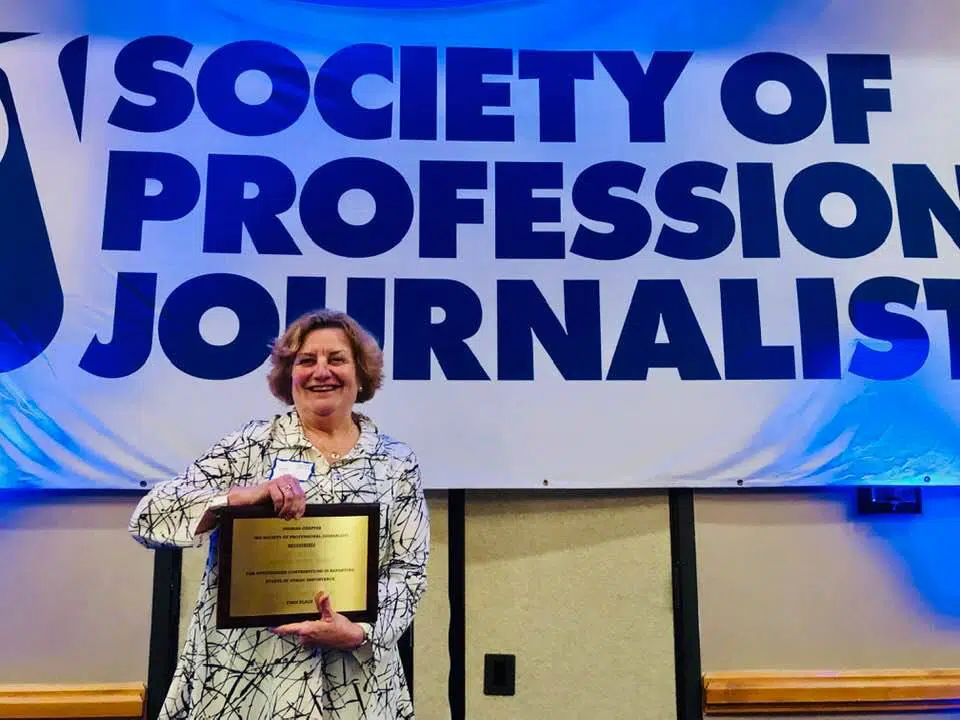
(photo credit: Freddi Stevens-Jacobi)

Charitable Advisors’ Not-for-profit News was among the organizations receiving first-place prizes Friday night at the 2018 Best in Indiana awards hosted by the Indiana chapter of the Society of Professional Journalists.

Editor/writer Lynn Sygiel was honored for her three-story series “Recent legislations’ impact on nonprofits,” which looked at how changes in tax laws and a long-heralded student-loan forgiveness government program affect nonprofits and their employees. The stories were submitted in the Best Non-Deadline Story or Series category.

A weekly e-publication which provides information about area nonprofits, the Not-for-profit News competed in the category for newspapers or publications with fewer than 30,000 subscribers.

“We are very excited for Lynn and the Not-for-profit News to be recognized for her excellent work,” said Bryan Orander, Charitable Advisors president.

Charitable Advisors is a social-purpose business that since 2000 has focused on strengthening the nonprofit sector by increasing communication among organizations, creating a one-stop jobs portal and offering consulting services that help boards build sustainability and bridge leadership transitions.

The entire list of winners can be found here. Proceeds from the Best in Indiana contest help fund the Indiana chapter’s college scholarship program. The two winners of $2,500 scholarships for the 2019-20 school year were Lydia Gerike of Indiana University and Emily Ketterer of Franklin College.

Here are links to the Not-for-profit News’ winning series:

Effective altruism applies science to giving

By Feature

By Lynn Sygiel, editor, Charitable Advisors

Diehard punk rock fans may know Peter Murphy as the former front man for the once-popular British goth band Bauhaus. Bauhaus broke up in the early 80s, but Murphy is currently back on stage with a 40th anniversary reunion tour.

Getting excited? Getting your ear plugs ready? Calm down. This story is not about that Peter Murphy. 

This Peter Murphy teaches philosophy at the University of Indianapolis. He’s a bit more genteel, but in many ways, beats a philanthropic drum as loud as his namesake rocker.

Murphy, who teaches a graduate course at U of I called “Poverty, Ethics and Effective Giving,” trumpets a philosophy known as “effective altruism,” or more simply EA.

As part of the class syllabus, students are introduced to the tenets of EA, and their final assignment is designed to apply what they’ve learned. Each year, Murphy secures funds from local donors, and as a group, students must reach a consensus about which organization or organizations will be the recipient of those funds.

“When they try to persuade one another that this is the organization we should give money to, they always set up rules. (One is) you have to give evidence, and the evidence that you give has to meet some kind of rigorous standards,” he said, which is an EA hallmark.

But for Murphy this isn’t just a course. Over the past 25 years, his philosophy students have studied Peter Singer and other scholars who have written about poverty ethics. Murphy was introduced to Singer’s 1972 paper “Fame, Affluence and Morality” as a college student, but his interest in the plight of the world’s poorest people was actually sparked earlier by his brother.

“When my brother went to college in the mid-1980s, he brought home a book that was quite popular at the time called “How the Other Half Dies: The real reasons for World Hunger” by Susan George. It was a best-selling book in the United States, and it was reporting on how roughly half the people in the world were dying of easily preventable causes,” said the Canadian-born Murphy.

Curiosity led him to continue to investigate EA, which has Singer’s ideas at its core. EA, a philosophy and social movement, started in 2011 at Britain’s Oxford University and uses evidence and reasoning to determine the most effective ways to benefit others. It differs from other philanthropic practices because of “its emphasis on quantitatively comparing charitable causes and interventions with the goal of maximizing certain human values.”

“I really see effective altruism as the convergence of people in philosophy who have been interested in ethics with social scientists who came in with randomized-controlled trials,” said Murphy. “The trials have brought out a lot of surprises at least in international giving. There are all sorts of things that have turned out to be absolutely ineffective that are very counter intuitive.”

Effective altruism has also provided a framework for Murphy and his wife, Dana Harrison, for personal donation decisions.

“When we met, we were almost kind of at extremes, and for both of us individually, our personal charitable giving was really important. When I first learned about effective altruism, it was really challenging, and I definitely had a defense response,” said Harrison, who, when she met her now husband, had just left her role as executive director of Dress for Success Indianapolis. He challenged her to think about her investments based on scientific data, not just emotion, in order to do the most good.

The couple encourages others to learn about EA’s framework when making charitable contributions, and they also think it’s important that Indiana’s nonprofits are aware of and keep track of the movement.

Cindy Collier couldn’t agree more.

For the past 15 years, she has been a consultant to corporations, government, foundations, nonprofits, and prior to that, worked for Health and Human Services at the national and state levels. She believes that the EA movement is helping to harness commitment, good work and people’s desire to make a difference.

“Instead of just trying hard, we’re going to succeed more often, and I think that’s the really wonderful aspect of the whole movement. It’s not just caring and trying, it’s taking the caring and the trying, and really making change,” said Collier. She has read “Doing Good Better” by William MacAskill, one of the co-founders of the EA movement, and has recommended it to friends.

“You want to feel good about helping people, but if the next year you come back and nothing has changed, that good doesn’t really feel so good when you haven’t really made a difference,” she said.

“We need to be more agile and try something different to get the results that we want whether it’s health, education, poverty reduction, no matter what the topic might be. If the needle’s not moving, we really need to think about investing in a different way to get different outcomes,” said Collier.

Harrison has often described the movement as “outcomes and evaluation on steroids.”

People who are EA followers believe in flexibility and open-mindedness, said Murphy, and are prepared to abandon a project if it isn’t working.

Local funders, too, have changed evaluations about programming to include data, but not yet to the level of executing randomized-controlled trials.

As a board member for Project Home Indy, Collier remembers the Women’s Fund asking for evidence that the group’s local model would work. As the first funder of a program for teen moms at risk of homelessness, it sent a due diligence committee to meet with staff.

“We have a lot of great foundations, and I have uniformly seen them ask those right questions, thinking about metrics. I have seen them ask what it’s going to be like after services, what’s the impact and what is being tracked. That really changes the culture,” she said.

Harrison thinks that at a minimum every nonprofit should research what models work before adding new programs in order to ascertain that its model hasn’t been disproven already in a dozen communities.

Which is why she was excited to recently learn about the work of the George and Frances Ball Foundation in Muncie. The foundation’s team just completed a study of 130 communities in the U.S. that have had cradle-to-career efforts. The team’s intention is to compare the components and identify what change happened. This is of special interest to Harrison as she serves as TeenWorks’ interim chief executive.

Daydreaming a bit, she wonders what could change if the foundation presents its findings to its nonprofit community and shares which models work and which don’t.

“How would nonprofit leaders react if the three things that worked they would never consider or the things that didn’t work were core to their programming? What is the impact of that and what is our readiness to hear those messages?”

Both Harrison and Collier believe applying EA’s model to areas like arts and culture would be difficult, and acknowledge that measuring poverty and education gains are easier than measuring enjoyment.

Small nonprofits don’t normally have researchers or statisticians on staff or empirically researched randomized-controlled trials.  However, they do see steps for nonprofits to take.

Collier has witnessed some funders asking: When we give you this money, what will be different?

“The nonprofit has got to be able to tell them, ‘Here’s what will change. Here’s the impact we can have.’  It’s thinking about the measurements and the expectations.’

“To me, the great part about this movement is not to make people cynical, but to make them more questioning,” said Collier, and she believes it will become a permanent way to determine what gets funded.

“When you are talking to donors, you are appealing to hearts or checkbooks to make an economic difference. But effective altruism is really about both. I think it’s a way to totally raise the bar about what we want to support.”

And while MIT and other social scientists are aware of EA, there has been limited application in the U.S. with most trials being done in developing countries.

One area, though, that Murphy and others have said is ripe for application is mass incarceration and sentencing. For people in prison or jail, it may be possible to lessen hardship in communities by cutting down the use of incarceration, and that is the leading conjecture of those in organizations that are based on EA principles.

“Do you get any additional deterrents by sending a person away for 10 years for cocaine rather than just 18 months or do they actually become a more hardened criminal if you send them away for 10 years? So, they’re trying to measure things like outcomes on families, employment rates and the economy in a local community. Oftentimes these young men if they can turn it around, they can be at their peak economic performance in terms of productivity and they can really be out there helping themselves and their communities thrive,” said Murphy.

He also believes there are good candidates in the community that meet EA’s principles and standards, making it a movement worth paying attention to.

What is effective altruism?

By Feature

Compiled by Lynn Sygiel, editor, Charitable Advisors

The effective altruism movement started with a simple question: Was there a way to apply data and reason to altruistic acts?

In 1993, two economists Michael Kremer and Rachel Glennerster traveled to Kenya for a vacation. Both had studied economics at the University of Oxford, met at Harvard and married. At the time, Kremer was an MIT professor and Glennerster worked for Treasury.

While overseas, they visited a friend who was working in Kenya and wondered if there was a way to scientifically test which good intentions are most effective. Kremer’s friend worked for a Dutch charity that was providing child sponsorships in Kenya. The group was trying to improve school attendance and test scores. But which of their efforts were making a difference — uniforms, adding teachers, flip chart or textbooks.

Kremer suggested they try a randomized controlled trial to determine what intervention was most effective. They would monitor and collect data from 14 schools of which half would be a control group. By collecting data in all the schools, they could see which fared better. The idea hadn’t been applied to development world. Testing each program one by one, Kremer found that there was no discernible improvement and these interventions had no effect on student outcomes.

Then a friend at the World Bank suggested deworming to cure parasitic infections in children with an annual pill. Kremer did an experiment to see whether it had an impact on education. What they learned was that the program worked to reduce absenteeism, a chronic problem at these schools. What was more impressive is that in a follow up 10 years later, children who had received the medicine worked an extra 3.4 hours per week and earned 20 percent more.

Kremer’s revolutionary approach gained a following and saw dozens of young economists running trials of development programs. By then, Glennerster had become executive director of the Poverty Action Lab at MIT and by 2007, the couple cofounded the nonprofit Deworm the World Initiative, which provides technical assistance to developing countries’ government to launch deworming programs.

And according to William MacAskill in his book, “Doing Good Better,” it is a way of thinking about how to make the biggest difference and uses evidence and careful reasoning to try to find an answer.

MacAskill helped develop the idea while he was a student at the University of Oxford and defines effective altruism as “using evidence and reason to figure out how to benefit others as much as possible, and taking action on that basis.”

Effective altruism, according to MacAskill has five key questions:

  1. How many people benefit, and by how much?
  2. Is this the most effective thing you can do?
  3. Is this area neglected?
  4. What would have happened otherwise?
  5. What are the chances of success, and how good would success be?

Initially, the movement was focused on individual-level charitable giving, and MacAskill also co-founded, Giving What We Can, with a fellow graduate student. The organization encourages individuals to give at least 10 percent of his or her income to the most cost-effective charities.

About the same time, two New York hedge fund analysts starting GiveWell, an organization that does in-depth research to determine which charities do the most good with every dollar. It compares for example how much good $1000 will do depending on which organization you give it to. GiveWell partnered with Cari Tuna and Dustin Moskovitz and started the Open Philanthropy Project.

In the process, the term effective altruism (EA) emerged as a community formed around these groups. Since 2013, EA has held conferences, run by the Centre for Effective Altruism at Oxford University. In 2015, the conference took place on Google’s campus in Mountain View, and in 2016 at the University of California, Berkeley.

Last fall, Vox Media launched Future Perfect, a new section to cover under covered issues. The twice weekly publication is inspired by the EA movement and is funded in partnership with The Rockefeller Foundation.

Blue & Co. – We are your biggest advocates.

By Sponsor Insight

By Annmarie Novotney, audit and accounting senior manager, Blue & Co.

Your organization exists for a reason. You have a mission to accomplish, and you’re driving hard every day to meet that challenge.

Nonprofit organizations face unique obstacles like identifying the best use of available resources, growing to support increased services and remaining financially viable while maintaining a strong focus on efficiency.

At Blue & Co., we understand the challenges you face, and work – not only as your service provider but also as your business partner – to help you navigate and overcome these challenges.

Our growing list of nonprofit clients (over 900 individual organizations) is proof of the abilities our experts demonstrate in areas that are relevant to you as a nonprofit organization. Some of our largest categories served include healthcare organizations, collegiate membership organizations, higher education entities, community foundations, social services groups, trade organizations and other membership organizations, and private and corporate foundations.

Our titles may include accountants and consultants, but we do much more than that. We are able to accurately identify day-to-day management issues and operational concerns, such as internal controls, segregation of duties, management effectiveness, and board development. We offer practical solutions that add value and help ensure you understand all aspects of compliance in your sector.   

It is our mission to support your mission. We want to stand with you as an invaluable resource to advance your services in the community. We believe in our nonprofit clients and are dedicated to helping them carry out their vision. Let us be a partner to you as you drive your organization to succeed.

Here is a brief overview of our top nonprofit services:

Annmarie Novotney is an audit and accounting senior manager at Blue & Co. Carmel’s office. She specializes in providing assurance and consulting services to nonprofit organizations and is active in the nonprofit community, recently completing a six-year term as treasurer for the Susan G. Komen Central Indiana Affiliate. She is a member of the Indiana CPA Society, the American Institute of Certified Public Accountants and Executive Women in Finance.

Employee Engagement: The driver of company culture

By Feature, Human Resources, Indianapolis, Leadership

By Julie Struble, Charitable Advisors

Research repeatedly confirms that employee engagement drives organizational success. We know it’s important,but have trouble with misunderstanding of expectations and turn-over.  

At last month’s HR peer group, Tony Dill, owner of HR Partnerships, discussed employee engagement with HR professionals at the HR peer group.  With several decades of both HR experience and working for nonprofits, he has the perfect blend to understand nonprofit HR challenges. During Dill’s one-hour presentation, he clarified what engagement is and isn’t and how to develop your leadership team. If you missed the session, here are some highlights of his presentation. 

When you hear the term ‘employee engagement’ what comes to mind? 

A common misperception is thinking your staff is satisfied, happy and motivated.  You’ve garnered from organization satisfaction surveys that your staff is pleased with the benefits offered and with the work environment. While those are important, they don’t measure the emotional commitment an employee has to the organization and its goals. In part that may explain why a seemingly happy team member jumps ship when a competitor’s offer comes along.

Employee engagement = Emotional commitment + discretionary effort

In contrast, Dill sees employee engagement defined by emotional commitment and discretionary effort.

Typically, emotional commitment is tied to people whom we are closest with — parents, spouse or our children. But according to theHarvard Business Review, workplace relationships are important to create a sense of purpose and ownership. Close work friendships boost employee satisfaction by 50 percent and companies with satisfied employees outperforming the competition by 20 percent.

It follows then if engaged employees have meaningful relationships at work, as a leader, you also need to invest in your staff and get to know them and invest in building relationships. This starts on day one. In fact, Dill recommends employee onboarding should last 6, 12, maybe even 18 months and includes socializing the employee into your culture.  Some examples of what this would look like:

  • Ongoing, regular meetings with the new hire at least every 30 days to help with defining performance standards and meeting company expectations.
  • Solicit monthly feedback about the employee’s experiences, what would help him or her and how the work experience could be better.
  • Have socializing activities during work hours with new hires and current staff.  A group lunch is an easy way to accomplish this.

The other component of engagement is discretionary effort.  This is when an employee perseveres beyond what is expected and goes the extra mile. For example, those employees who are willing to complete a project under a deadline versus asking for an extension.  Another way to look at discretionary effort is someone who looks for innovative ways to do things. Discretionary effort is motivated by a passion and is often linked to the mission or the well-being of team members, or both.

8 leadership traits

If your organization wants to foster engagement where does it begin?  Right at the top of the organizational chart. Organizations with a culture of engagement demonstrate eight characteristics in their teams. The leadership traits are: self-aware, authentic, humble, trust, innovation, vision, passion and confidence.

During Dill’s presentation, the audience elaborated on the top three characteristics; their ideas are worth sharing.

  • Self-aware leaders continue to develop themselves professionally and personally. 
  • Authentic leaders interact with their staff and get to know them as a person.
  • Humble leaders are servants. Putting others first.

The management team needs to take ownership of these leadership traits and demonstrate them first. Dill reassured that your staff does not need to exhibit all eight traits. Yet, often, they will pick them up from the “trickle-down” effect. Driving employee engagement and developing a company culture often happens in tandem. 

It all begins with trust

Dill explained, as leaders embody the eight leadership characteristics, they become more trust worthy and authentic.  In return, staff will feel comfortable to share. As staff gains trust, it builds a two-way commitment between the manager and employee. When an employee feels safe enough to open up and share, a feedback loop is created. Open communication allows the manager more opportunities to clarify what the employee needs to focus on and this in turn accelerates the organization’s productivity.

Dill offered advice to embrace this change in culture. First, help each team member, even the hired hand in the warehouse, understand how their contribution is linked to the organization’s strategic plan, and ultimately, its mission.  Additionally, but equally important, have a conversation about how staff’s goals play into the overall plan. In the nonprofit sector, this is where things get a bit dicey.

As a leader, you’ll probably learn your staff’s goals revolve around learning a new skill, getting a promotion and increasing compensation — things that while commonplace in the for-profit community, are often a luxury for many nonprofits.  If your organization is on a shoe-string budget, the attendees offered creative ways your organization can help its staff achieve their goals.  Such as, If the employee foots the bill for a training, he or she can be rewarded with extra PTO time. Bring in an expert in your industry for an employee lunch and offer a free lunch-and-learn. Create an internal training program.

Remember, engagement discussions are not one-time conversations.  Most people need to hear something eight times before they own it. Be creative and communicate your organization’s message in a variety of ways.

Julie Struble is the marketing and sponsorship director at Charitable Advisors.  With the company since 2002 and with five years as a HR generalist, one of her responsibilities is to coordinate educational opportunities for the CA’s affinity HR peer group, and secure speakers with expertise to discuss the challenges in the nonprofit HR department.


Don’t leave the employer out of the retirement plan equation

By Sponsor Insight

By Kevin Kidwell vice president national tax exempt sales, OneAmerica®

It’s well documented that Americans aren’t saving enough to fund their retirement. So the drumbeat in the industry has been to remind participants in employer-sponsored retirement plans of the importance to “defer, defer, defer” and set aside a portion of their take-home pay.

Meanwhile, companies that administer 401(k) and 403(b) plans have endeavored to provide clients with relatable uncomplicated guidance, make enrolling and plan access simple, and provide resources to keep everything on track. For example, some plans are designed for automatic investment in a target date fund so that some employee participants don’t have to lift a finger.

Broadly speaking, this evolution to making things easy has been borne out by studies in behavioral finance that have shown that these plan designs work.

While we all agree that saving for retirement is a good thing, there’s a financial commitment from the employer that should be acknowledged and also applauded. The retirement plan industry is focused on helping the participant put aside enough money; but just as important, is a focus on assisting the employers in creating the best structure for the organization’s financial goals.

No employer wants to experience hardship when it’s trying to do right by its employees in funding retirement contributions.  But some cookie-cutter approaches, which may seem easy in design and implementation, may not take into account the diverse needs of differently paid staff or worse yet, create cash flow issues that endanger the organizational mission.

The value in saving for retirement

The National Institute on Retirement Security[1] (NIRS) warned recently that American workers fortunate enough to have a retirement account offered through their employer still face a deep retirement savings shortfall.

Ultimately, the inability of older Americans to be self-sufficient after a lifetime of work will have negative impacts on the U.S. economy, government budgets and families, according to NIRS.

How retirement plans work

Contributions made by an employer to an employee’s retirement plan ─ whether the plan provides for elective deferrals or not – is regulated by the Internal Revenue Service (IRS),[2] and it’s those complex IRS rules that outline the guardrails for a tax-exempt retirement plan. (If you work for a nonprofit, that’s a common savings approach at your organization.)

The IRS allows an employee to defer his or her pay and allows the employer to also then make a tax-deferred contribution. The plans have strict rules in order to maintain their tax-deferred status. (The Employee Retirement Income Security Act requires several tests each year to prove a plan does not discriminate in favor of employees with higher incomes.[3] These rules don’t apply to government plans.)

While it’s not given, over time these contributions accumulate through the act of continuous employee/employer contributions and compounding.

A match, where the employer contributes an identical amount to what the participant invests, is not mandatory, but is the most common type of contribution.

I would argue that there are also other ways for employers to make contributions for the benefit of the entire company.

Here’s what could make a difference and is worth consideration:

  • Look at the usefulness of creating three separate retirement plan pools — one that matches automatically for everyone who opts into in the retirement plan, one that is reserved for specific groups of employees with high-demand jobs, and a third that’s targeted to profit-sharing based on performance.[4]
  • Consider a formula that factors in the Social Security Replacement Ratio. Not many people realize Social Security’s payout structure provides benefits progressively, so that people who earned the lowest wages at a company upon retirement receive a higher replacement rate than did the higher earners. As a result of this Social Security policy, the law allows employers to make contributions to offset the Social Security deficit for middle and higher income workers – compensating them for what Social Security is not going to pay out when they are eligible to draw it, in other words.
  • Consider unique retirement plans at companies or organizations with specialty occupations, such as the medical field, acknowledging that the retirement-saving needs of “late entrants” into the workforce (attorneys, physicians, accountants and other professionals of occupations that require years of schooling) are different than other members of staff. Adults who left their careers to raise their children missed out, so they could be eligible for unique retirement plan designs that helps them catch up.

Employers may also look at the possibility of contributing more to the retirement account during a great year for the organization’s bottom line, but also possibly contribute less in a down business year.

Ultimately, the retirement plan of any tax-exempt organization needs to mirror their mission. The plan should be of optimal plan design and be one where the employer isn’t painted into a corner by funding obligations.

We’ve found through our experience that there are all kind of things we can do that makes sense. But ultimately, if the system in place is not good for the employer, it won’t be good in the long term for their employees.

In Kevin Kidwell’s role as vice president of national tax-exempt sales, he works to provide ideas, knowledge, information – both technical and practical – in an effort to facilitate improved plan and participant outcomes. Since joining OneAmerica in 1988, Kevin has held various positions within the Retirement Services division. Beginning in 2000, his exclusive focus has been on healthcare and tax exempt organizations.

Indianapolis-based OneAmerica®, an organization that can trace its roots back to 1877, has been helping organizations with their tax-exempt retirement plans since 1964. We believe a retirement plan should do more than help someone retire – it can help organizations recruit, retain and reward employees.

What can we answer for you?

OneAmerica® is the marketing name for the companies of OneAmerica. Products issued and underwritten by American United Life Insurance Company® (AUL), a OneAmerica company. Administrative and recordkeeping services provided by McCready and Keene, Inc. or OneAmerica Retirement Services LLC, companies of OneAmerica which are not broker/dealers or investment advisors.

The views and opinions expressed in this material are solely those of the author and do not necessarily reflect the views and opinions of any of the companies of OneAmerica. Provided content is for overview and informational purposes only and is not intended and should not be relied upon as individualized tax, legal, fiduciary, or investment advice. Investing involves risk including potential loss of principal.


[1] https://www.businesswire.com/news/home/20190206005338/en/National-Institute-Retirement-Security-Testifies-House-Ways

[2] https://www.irs.gov/government-entities/federal-state-local-governments/employer-pick-up-contributions-to-benefit-plans

[3] https://www.plansponsor.com/401k-nondiscrimination-tests-explained/

[4] https://www.irs.gov/retirement-plans/plan-participant-employee/retirement-topics-vesting

Central Indiana Girl Scouts cookie campaign helps Kenyan kids

By Feature

By Lynn Sygiel, editor, Charitable Advisors

Editor’s note: Since this story was published, 900 Girl Scouts selected the Shoe that Grows as their reward, donating a total of 523 pairs to this Kenyan school and far surpassing the chapter’s 120 pair goal.

Samoas and shoes. What do they have in common? Very little, actually, but a group of ambitious and forward-thinking Girl Scouts in Central Indiana are out to change that.

Since early January, as they do every year, the Girl Scouts have been selling cookies. Lots of them. In Central Indiana, about 29,000 Scouts in 45 counties have been peddling their snacks and fulfilling our guilty pleasures. On average last year, each girl sold 184 boxes.

As the cookie season winds down, however, a first-of-its-kind project by the local council, the Girl Scouts of Central Indiana, is about to ramp up.

Traditionally, the girls and their troops earn group and individual rewards for being top cookie-sellers. By the end of this month, girls can select prizes, such as stuffed animals, sleeping bags, theme park tickets or trips with other scouts.

This year, however, the girls can earn shoes. Not pairs of splashy tennies or the latest Doc Martens. These shoes they earn aren’t for them, but for kids in Kenya.

Local Scouts will have the opportunity to forgo personal prizes and do something altruistic. Each Scout who sells at least 125 boxes may donate her “prize” to the cause. The reward for 125 boxes is equivalent to a half shoe to a Kenyan elementary student. As the number of boxes increases, so does the number of donated shoes.

These are, however, not ordinary shoes. These are Shoes that Grow, the brainchild of the nonprofit organization Because International. The shoes are adjustable and can accommodate five size changes. The shoes will be given to students at the Hope School, which is outside several small villages in northern Kenya. For kids in this African country, having shoes that fit — or even shoes at all — is not a given.

Ellen Winking, the vice president of membership and “cookie manager” at Girl Scouts of Central Indiana, heard about the program on a national news program and spent last summer conversing with local girls about this as a rewards option.

To help Girl Scouts understand how this unique footwear works, Winking used both an actual pair and a video to demonstrate. Both were supplied by Idaho-based Because International, which distributes simple, innovative products to help make daily life easier for people living in poverty.

The video shared the story of a 12-year-old girl in Haiti who could not attend school simply because she had no shoes. For local girls, it was an opportunity to learn that schooling could be denied for not having shoes.

Buoyed by the girls’ interest, Winking contacted Kenton Lee, founder of Because International, to discuss the possibility of offering the shoes as a reward, and the nonprofit staff agreed to give it a try.

“I was excited when they approached us with this idea, and we kind of brainstormed to see if it could fit. The partnership with the council is really unique, and I’m really looking forward to see what transpires. If it works, it definitely is something that I would encourage other similar groups to think about doing,” said Lee from his office in Nampa, Idaho.

This Central Indiana Girl Scout council’s goal for this year’s annual cookie program is to provide 120 pairs of shoes for students at a particular elementary school in Kenya. A part of the Girl Scouts’ training model is for each girl to self-identify a personal and troop goal for cookie sales.

“Adding the shoe is a slightly different twist because girls are forgoing a prize to do this good for others,” said Danielle Shockey, Central Indiana Girl Scouts’ CEO.

According to Lee, 400 kids attend the school in Kenya, but those are just the kids who have the ability to go to school. 

“There are even poorer kids, who live out in the rural areas surrounding the school. I would also like to give to local leaders extra pairs of shoes so as they identify more kids that don’t go to the school that they’d be able to help them by providing shoes if that’s a need that they have,” he said.

The Girl Scouts’ national office said while other troops have provided funds for causes like saving sea turtles, Central Indiana’s council is the first to offer this type of philanthropic reward option.

“I’m really excited about this opportunity with them,” said Lee. “This is a first. We’ve had other kids do more classic fundraising — lemonade stands, yard sales, mowing lawns or using their birthday — as fundraisers.”

Proper footwear, according to Lee, is a critical way of reducing the risk of injury, parasitic diseases and foot infections in Third World countries. For many, it is a necessary part of a school uniform. But, he knows, it doesn’t solve every problem.

“It is a very simple thing. But even a small thing, even something that doesn’t solve the entire situation, still makes a big difference,” he said. Lee estimates there are over 300 million children who do not have shoes, and countless more with shoes that do not fit. Sometimes they receive shoe donations, but children’s feet grow and they quickly outgrow donated shoes.

After attending Northwest Nazarene University, Lee thought he was destined to be a missionary. But since his religion requires a three-year commitment in the field, he traveled for a year, ultimately working in an orphanage in Kenya for six months in 2007 as a way to test his future path.

During a walk with children at the orphanage, he noticed one girl whose shoes didn’t fit, which sparked an idea that he jotted in his journal. Homesick, he returned to Idaho, but his idea percolated.

“It really was just kind of a random idea that popped into my head just based on the situation, based on the context,” Lee said. “You know the orphanage couldn’t afford to buy the kids any new shoes, and yet their feet were always growing. And then from that point, I had an idea for a growing shoe, but I had no idea how to make it happen. That’s what took the six years.”

First he tried and failed at designing a prototype. He tried to give the idea away, but after multiple rejections from shoe companies, he found a small shoe-design company in Portland, Oregon.

“They loved what we were trying to do and took us through about a yearlong design process. Then we made about 100 prototype pairs that my wife and I took back to Kenya and put in four different schools,” Lee said. “We had kids try them out for about a year, got some really good feedback, and then we made our first official batch of the Shoe that Grows. It was essentially just a hobby at that point. I had a few thousand pairs in my guest bedroom, and I tried to get them out to people I knew working with kids. It was just kind of a small part of my life at that point.”

Now, the shoe is in 100 countries, mainly near the equator including parts of Central America, through sub-Saharan Africa, East Africa, and a bit of Asia. Overall, the nonprofit has distributed almost 250,000 pairs in the last four years and has worked with over 1,500 partner groups or distribution partners to deliver those shoes.

To simplify distribution, the Because International has begun to identify factories closer to the need. Right now a Kenyan factory is working to produce a sample. If all goes according to plan in 2019, the shoes for the Kenyan school will be made at that factory in Mombasa and shipped to Nairobi. Haiti and Ethiopia also have manufacturing plants.

Lee said his organization doesn’t attach any strings to the shoes for either the recipients or the donors. Recipients are not required to send thank yous or Skype with the donors.

“Above all else what we want is for the local people — the leaders and the kids receiving the shoes — is for the shoes to be a benefit to them and be a valuable resource. But if the Girl Scouts want to make contact with the school and vice versa, we’re happy to make the connection.”

Besides sending shoes to Kenya, girls who select the shoe reward will receive a patch, which includes the Shoe that Grows logo, a heart designed from a footprint. For Girl Scouts earning patches and badges for successfully completing requirements is something of honor.

For the Girl Scouts, philanthropy certainly is not new. CEO Danielle Shockey, herself a Girl Scout alumna, said it’s embedded in everything the organization does.

“Philanthropy is really just part of our DNA, and the whole idea of making the world better place is our mission statement. I’ve never met a troop who doesn’t think about some kind of community service project,” and the cookie program provides troops with annual funds to be able to do this. At the younger levels, girls think about how to give back to the local community, and as they get older, they begin to think about the world around them.

According to a study at Arizona State University, altruistic children do grow up to be altruistic adults.

Since 2009, the Girl Scouts in Central Indiana have been involved in Operation: Cookie Drop. Customers are asked if they would like to purchase additional boxes to be distributed to soldiers stationed at military bases across Central Indiana, to military veterans and for the first time this year, to local first responders. Last year, the scouts delivered 96,000 boxes to Stout Field to military families.

“They are really glad to meet the girls and physically move the boxes together. We are purposefully making sure that they’re seeing the effort and the result. I think we do some very deliberate things, as much as it is a part of the things that they earn and their badges and the gold awards, we also want it to be intrinsic too,” said Shockey, who became CEO in January 2018.

Both Lee’s nonprofit, Because International, and Girl Scouts working to earn a Gold Award have a goal of solving societal problems.

In the case of Because International, they have expanded efforts and now have a mosquito net called Net Buddy for distribution in countries where malaria is a health concern. Lee, the founder, is also working with a colleague on a new program, the Pursuit Incubator, to help other entrepreneurs pursue ideas for products. The group’s efforts revolve around using small innovative products to fight poverty.

And as Girl Scouts stay with the organization and reach their teens, they have the option to earn a Gold Award, the organization’s highest award. Last year, locally about 30 girls achieved the Gold Award.

“To earn the Gold Award, a girl must find a community challenge where she thinks she can make a difference. So when we say it’s part of our DNA, girls are constantly thinking about the world around and how they can make it a better place and it manifests itself differently. Troops think about it, girls think about it and also if they want to have our highest award, they have to think about it in a very big way.”

Shockey shared the example of a Zionsville sophomore’s project. She saw the documentary about Holocaust survivor Eva Kor; and her message of forgiveness touched this 15-year-old teen.

“Soon after there was the school shooting in Noblesville and she thought my community really needs this message of forgiveness,” said Shockey. “And they needed to hear it directly from Kor.”

So working with her school superintendent, she planned two programs. At one, Kor would speak to middle- and high-school students, and offer a similar program in the evening at a local church. The proceeds from the 500 tickets sold were donated to Zionsville’s Lunch Angel Fund, a program that pays off student lunch deficits and provides needy students with extras they cannot afford.

The teen didn’t stop there, Shockey said, because she wanted a sustainable program.

“So she worked with WFYI to build education kits about the Holocaust. Now every history teacher in Zionsville has a Holocaust kit to use with future students,” said Shockey.

The leaders really walk the talk of girls leading the way, and so they will wait to see how successful and how popular it is before making additional plans and connections.

“Did girls make it part of their goals? I think at the end of this year, it will be pretty telling. Take Operation Cookie Drop that started over 10 years ago. It’s now 96,000 packages,” said Deana Potterf, the chief communications officer. Who could have imagined.