Domestic Violence Network: 20 years of fighting domestic violence

By Feature, Leadership

By Lynn Sygiel, editor, Charitable Advisors

Nonprofit networks vary in shape, size and mission. Some are satellites of national organizations and others establish connections and facilitate collaboration.

Ask Tracey Horth Krueger or Kelly McBride about the Domestic Violence Network (DVN) in Indianapolis, and they’ll tell you that after 20 years, it is still vibrant and relevant. That is in large part because of its ability to adapt and respond to community needs, according to Horth Krueger, the network’s first executive director, and McBride who has been in the position for the past 3½ years.

In reality, the network has been around since the 1980s, first as a grassroots movement. Regular monthly meetings were informal conversations that provided opportunities to collaborate and make connections. At those gatherings, direct service providers would discuss what they needed to support their work, but would then leave and return to clients and caseloads. There wasn’t an entity or staff support that would advance those initiatives between meetings.

“In 1997, the decision was made to try to secure funding to get a staff to really build the domestic violence network,” said Horth Krueger, who is now CEO of the Indiana Coalition to End Sexual Assault. “In my opinion, everything that is DVN now is built on what preceded it for the 10 years or 15 years prior to that. It is an extension of the work that that committed group of advocates has been doing in this city for years.”

DVN started with three employees and now brings numerous nonprofits to the table, including at least a half dozen area domestic violence shelters. One initial obstacle was overcoming nonprofits’ fear that such an entity, while worthwhile, would add to the competition for existing funding dollars. Organizations wanted to be set apart and be attractive to funders on their own.

“It was Mayor Peterson, a strong advocate for this work, who was able to say, ‘We’re a team, let’s keep our eye on the ball, we do much better when we’re working together.’ And then backed it up with having his deputy mayors in the meetings and involved. It was a great opportunity for DVN to really grow because we had support,” said Horth Krueger.

“What we were saying was, ‘Let’s come at this from a position of power. We’re going to be way more powerful if we’re working together than if we’re continuing to have the walls up,’” said Horth Krueger. “We were really shifting the conversation and saying that is an issue that cannot operate in isolation. We really need each other.”

While DVN’s mission has remained consistent – engage the community to end domestic violence through advocacy, education and collaboration – its delivery has not. Education and training have adapted to what’s happening in the community. DVN has always served in a coordination role.

“As we’re learning what national best practices are, we’re bringing those here, but at the same time we’re learning about what our city is doing. We’re merging those together, so that they fit everyone’s needs,” said McBride, who is a trained social worker.

While Horth Krueger is no longer involved in the day-to-day, she thinks the network also works because it focuses on the broader issues. As a former reporter/anchor at WRTV-6, she worked to bring visibility to the issue. First with the Safe Haven Campaign, which was designed to raise funds for additional transitional housing for victims of domestic violence. That campaign resulted in the opening of Coburn Place, a transitional housing and support service for domestic violence victims. The campaign, which is ongoing, was also designed to raise awareness about domestic abuse.

“That campaign did a phenomenal job at breaking through perception. It was just telling the stories of people that you might watch and think, ‘Whoa, it attacks all of us and our preconceived notions about others.’ So it’s really opening up all of us to be thinking about, ‘God, this really could be happening in my own family.’ And that’s powerful,” said Horth Krueger.

Staying focused on trends and identifying gaps in services gives the network the ability to look more strategically and more comprehensively at community needs and ultimately prevent domestic violence.

“DVN is not serving the needs of victims day in and day out, which is precious important work and needs to be the focus of nonprofit organizations. A community needs that other piece where an entity can be stepping back and looking more broadly,” said Horth Krueger.

That’s a role DVN has embraced since its beginning. In 2000, Peterson’s first year as mayor, he led more than 100 citizens in a roundtable discussion that prompted a call for a community action plan to end domestic violence. DVN took the lead, and the Family Violence Community-Wide Plan was issued in 2001.

Four years later, a second mayor’s roundtable identified new priorities for addressing domestic violence, including public awareness and education, economic justice, health and legal issues, prevention and targeted outreach to Hispanic populations. The second formal communitywide plan, Peace in our Homes: A Call to End Domestic Abuse in Central Indiana, was released in 2009. It was a catalyst to establish a coordinated community response.

In 2013, the Community-Wide Plan to End Domestic Violence 3.0 was released by DVN and used the Results Accountability framework. There was a focus on making a measureable improvement in the quality of life for entire communities.

Plans varied in duration from three to five years.

McBride said putting Band-Aids on things is not enough.

“We provide funds for emergency transportation, we have these great shelters to help victims, but how can we stop it in the first place. Domestic violence does not exist in a silo. Our domestic violence victims are coming in with mental health issues, addictions issues and everything else,” said McBride.

The newest community plan is focused on intersections and how poverty and domestic violence are intertwined and how crime and domestic violence are interconnected. It is designed to dive into the root causes of domestic violence, and change the issue in six months. The first — economics – resulted in a study of housing for domestic violence victims. Behind the scenes, a committee will continue the work for the duration of the plan.

“That is such an important conversation because it is all tied together. And if you can solve one or make headway on addressing one of these societal ills, it will have a positive impact on the rest. I see that as the very critical role that they are filling now and are leading it,” said Horth Krueger.

Marion County and the doughnut counties are the focus for the network, and participation is free. It represents people in the Greater Indianapolis area who serve domestic violence victims, and includes not only the shelters and the advocacy programs, but also law enforcement, the legal community and work in hospitals.

“It’s the full continuum and what needs to be in place to address the needs of victims and hold perpetrators accountable and prevent abuse. It’s the repository of all of this information about who’s doing what in the community and how,” said Horth Krueger.

DVN publishes two reports a year – “The State of Domestic Violence in Central Indiana,” a compilation self-reported by the nonprofits that serve the population and which provides a snapshot of the number of clients served. It’s designed to present an update on the state of domestic violence in Central Indiana based on similar reports compiled in 2014, 2013, 2011 and 2008.

The second report connects data from the IMPD, Julian Center and the Marion County prosecutors’ office to get a better understanding of what domestic violence looks like in the criminal justice system. The report hasn’t had consistent funding, but currently has government funding, and will put out preliminary statistics in the fall .

“That’s more of the arrests and the convictions. What does recidivism look like? Are we seeing domestic violence reported to the police in more spots within Marion County? That doesn’t mean it is happening more, it’s just reported more there. So then we’ve taken that data, and we share with our network and our partners and then we can help identify better prevention strategies or intervention strategies,” said McBride.

Most funding is local, but DVN holds a national grant in partnership with IMPD, the city, Julian Center and the prosecutors’ office. Called the Baker One Initiative, it is an IMPD-led policing initiative to identify high-risk offenders early in order to prevent homicide or serious assault. The original project, started in Mecklenberg County (Charlotte area), North Carolina, in 2002, has proven successful in preventing lesser crimes from escalating to seriously violent or fatal acts.

“Baker One Initiative’s initial data shows that it is working,” said McBride. “We’ve applied for several other federal grants in partnership with those folks as well, and we should find out about those in the next couple of months.”

While funding ebbs and flows, McBride said it is important that programs remain consistent. Recognizing that a service provider could lose funding for a program, for example, DVN assumed the responsibility for youth and employer education.

“There were people doing that, but their grants would ebb and flow. So if they lost a youth-prevention grant, then they would lose that program. So it wasn’t sustainable within the community,” said McBride.

“We’re not only educating our advocates but our community members. And we also educate high school and middle school students on how to identify and respond to teen-dating violence, what a healthy relationship looks like and what consent looks like,” said McBride. It’s been in place for three years this fall, and it has branched out to include a youth network once a month to engage peers in healthy relationships.

While the advocates’ network still meets the first Tuesday of the month, there are now trainings to provide ongoing support. In addition, DVN offers best practice trainings nine months of the year, and there is a monthly wait list. The remaining months DVN hosts a commemoration and holiday party, and a retreat to focus on self-care for direct service providers.

What’s next? In an ideal world, Horth Krueger sees the network working to make domestic violence unacceptable like Mothers Against Drunk Driving.

“The perpetrator is the one making them leave home, and so why are we putting it on the victim to relocate to a part of town they’ve never lived in, not that they have anything against that part of town, but they don’t know where the grocery is, they don’t know where the drugstore is, they don’t know the schools. So the movement has had to be aware of that and try to make those accommodations so they don’t feel completely removed from all they know.

“The housing issue is huge, but I think we need to think differently about the housing issue and maybe we don’t bring everybody to one building. We have scattered sites. We need to be out in these communities, we need to have partnerships with different organizations.”

[content_box box_type=”normal”]

Lessons learned

McBride and Horth Krueger have been immersed in the issue of domestic violence. And over the 20 years Domestic Violence Network in Central Indiana, they’ve learned a thing or two about how networks function.

They were willing to share some practical tips for nonprofit networks in order to stay relevant.

  1. Don’t become stagnant. Be flexible and adaptable and continue to pay attention to trends, issues and the needs of the community. The work is not black and white and has to be ever evolving.
  2. Relationships are key. Keep building and recognize that they can be ever changing.
  3. Do your homework. Find the influencers. Talk to people who’ve established networks or continuity. You’re never done. Talk to people who have been in your shoes.
  4. Don’t tie your efforts to a specific politician. If you tie the issue to an elected official, then you’re not thinking about sustainability. You want that support, and you want to be a priority to them, but you cannot become an office of because them.
  5. Listening is very, very important. It helps to have that skill set so that when you have multiple voices around a table, you can come to a consensus, and help people come to a consensus. You have to have the ability to listen and make sure that people feel heard and are heard. There are awesome ideas everywhere, and it’s important to elevate people’s ideas.
  6. Recognize that domestic violence intersects with almost every other social problem. With domestic violence affecting 1 in 3 women, and 1 in 7 men, you know someone who’s been touched by domestic violence. Keep asking: How can we pull together the community.
  7. Continue to work better and continue to communicate.
[/content_box]

The need for more basic philanthropy research

By Sponsor Insight

By Amir Pasic, Eugene R. Tempel Dean, Indiana University Lilly Family School of Philanthropy

Judging by the proliferation of research-inspired ventures, it may seem we’re in a golden age of philanthropic knowledge creation. But we are not focusing enough of our efforts on basic research.

Given the urgency of finding better ways to solve pressing social issues, it’s not surprising that the vast majority of research generated is applied research. Both the standard ways of doing philanthropy and the paradigm-bending (and busting) efforts to transform and disrupt conventional approaches come armed with research findings on what works, where there are strategic gaps in expectations and how some interventions are more effective than others.

This data-driven search for solutions is awesome and inspiring. Our current philanthropic research ecosystem is highly fragmented. Its inhabitants often belong to a variety of industries or professions whose connection to philanthropy is contingent on other interests and commitments. And today’s growing expectations of philanthropy are only likely to increase because of current political winds, and because total annual giving at $390 billion does not seem small compared to the nonmilitary portion of federal discretionary spending: $518 billion a year.

However, basic research also is needed to give more coherence to this burgeoning applied research engagement, and to give it a better chance at driving innovation. Shared fundamental questions unite applied and basic research. We just need to devote patience to pursuing basic questions, such as why do humans give? How does giving affect our social life? And how is giving connected to exchange relations in the market and to the power relations of authority?

A classic case for the value of basic research, The Usefulness of Useless Knowledge, was reissued this year by Princeton University Press. Written by the man who brought Albert Einstein to America, it argues that both deeper understanding and technological progress are best facilitated not by seeking immediately applicable solutions, but through “the unobstructed pursuit of useless knowledge.”

Such “useless knowledge” now resides in every smartphone built from “basic” discoveries that in their time did not have ready uses, ranging from electricity to relativity to quantum mechanics. In the social sciences and humanities, basic research leads to novel designs for our social institutions (think of social security and public health) and to the ways we form and express our identities and find meaning.

Alarm also is being raised about declining government investment in basic research, including by the president of MIT and the head of the Institute for Advanced Study, Einstein’s academic home. Realistically, philanthropy will fund only a small portion of flagging government support for basic science research. But even a campaign to fund basic science through philanthropy would benefit from better fundamental understanding of philanthropy.

We’re likely to see many more efforts to tap into philanthropy or to regulate the flow of financial resources into it. The decisions made would be improved by better understanding of what “it” is. Is philanthropy a tax dodge, the outsourcing of government, an agent of pluralism, or is it its own thing that reflects a fundamental feature of the human condition? It can be all of these things, but the last point merits more attention.

We often hear suggestions that the private sector or the government would do philanthropy’s work better. One can make that argument, but it is one that seeks not to improve or understand philanthropy, but to substitute it for something else.

This suggests that basic research on philanthropy is not going to succeed by walling it off from other disciplines and ways of approaching human nature and social interaction. But at the same time, if there is a basic puzzle to investigate that focuses on the how and why of human generosity, we cannot simply follow the practitioners and thinkers who consider philanthropy an offshoot of market behavior or authority relations that can be managed and understood better by using only these more established lenses.

There is a surge of applied research activity to draw upon.

Every association or forum for discussing the effectiveness of philanthropy is bringing its own research to the table. Just glance at the work of our established infrastructure organizations such as GuideStar, the Foundation Center, the Center for Effective Philanthropy and Independent Sector, not to mention the consultancies that advise foundations on big bets or generate interpretive strategic templates such as “collective impact.” They are generating ever more sophisticated and useful syntheses, deep dives, case studies, data tools and research reports.

The Gates-funded “Giving By All” initiative is fostering a range of applied research on interventions that might facilitate more donations by the public at large.

Even following the Stanford Social Innovation Review only begins to reveal the expanding universe of applied research and experimentation.

Our field is replete with excellent associations and consultants who serve as the McKinseys and Bains of the philanthropic world.

However, we are not so blessed with the equivalent of the multitude of excellent business schools in the world of commerce that build knowledge and allow us to discern among the flurry of urgent insights by providing rigor and the perspective of broader and longer context.

In the academic world, we have simply not kept up with the pace of innovation and experimentation that is being driven by research-savvy practitioners. We have not done an adequate job of building the connective sinews, as basic and applied research do not progress in isolation. They benefit from cross-pollination and creative tension between curiosity driven basic questions and applied discoveries.

As the first school of philanthropy, we have a role to play in pursuing the basic questions and engaging them with the repertoire of fundamental data generation and applied work for which we are already known.

But we are not alone. For example, The Human Generosity Lab is “the first large-scale transdisciplinary research project to investigate the interrelationship between biological and cultural influences on human generosity.”

And more broadly, there has been dramatic growth in the number of academic programs that teach about philanthropy. These are mostly found in schools of public affairs and public policy, where “nonprofit management” is a growing line of instructional business. But here too, more connective tissue needs to be grown to connect data-driven innovators on the one hand and scholars outside the professional school domain on the other.

Our understanding of philanthropy and our quest to make it more effective will benefit from embracing curiosity-driven research that seeks to understand what ties our disparate concerns together in the pursuit of basic questions about human generosity.


Amir Pasic, Ph.D., is the Eugene R. Tempel Dean of the Indiana University Lilly Family School of Philanthropy since 2015. Prior to joining IU Lilly Family School of Philanthropy, Dean Pasic was vice president of international operations at the Council for Advancement and Support of Education (CASE). Previously, he was associate dean for development and strategic planning at Johns Hopkins University School of Advanced International Studies (SAIS) and the executive director of the Foreign Policy Institute.

Use people strategy as your competitive advantage

By Sponsor Insight

By Mike Bensi, advisor, FirstPerson

I was flipping through some old school papers I’ve hung on to for far too long and found my notes from Michael Porter’s book, Competitive Advantage. If you haven’t heard of Michael Porter, here’s a great summary of him and the business ideas and strategies he’s shared over the years.

In this particular book, Porter said companies win over their competitors by being cheaper or by being different — being perceived by the customer as better or more relevant. There are no other ways.

While Porter was speaking to competition within business, we can apply this to the competition for talent we’re experiencing today. Companies have two ways to gain an advantage over other companies looking for the same talent: pay the most or be so different from other companies it’s easy to draw in and keep top talent.

Playing the numbers game is not sustainable, and applicants don’t rank this in the top criteria when looking for jobs. Companies must reflect on how their people strategy is better and different than other companies. To accomplish this, think like Porter and create a “value chain” within your employee lifecycle. This value chain should focus on five stages of your employee lifecycle as a series of activities which link together. With it, you’ll be better able to show talent how you stand out from the rest.

Button Text

Homeless resources in Indianapolis

By Feature, Programming

This week, Indianapolis Star reporter, Maureen Gilmer, wrote a story about seeking help for a homeless mom. The story referenced the Street Outreach Rapid Response Team, and other nonprofits that acted immediately to secure a spot for this family. To learn more about Indianapolis’ services, read her article.

Just like that, within three hours, a desperate young mom and her kids were rescued from an uncertain future. I was astounded at how quickly this family got the help they desperately needed, but at the same time, I know there are others who aren’t as lucky as Brown and her family.

These kinds of street rescues are what Street Outreach Rapid Response Team and Professional Blended Street Outreach are built to do. The rapid response team is actually a network of 67 people representing 22 organizations in the city — shelters, hospitals, mental health agencies, veterans’ groups, even animal welfare advocates.

“We’ve identified gaps in services available on the streets for people, and we’ve brought those folks together to help those most vulnerable,” said team coordinator Melissa Burgess.

When an email goes out to the group, “everybody jumps up and is ready to help if they’re able to,” she said.

Button Text

Fiscal Responsibility Primary Goal of Board

By Sponsor Insight

by Yvonne de Calonne & Michelle (Micki) Siner

Certainly, complying with self-dealing rules and following the letter of the bylaws are requirements of fiscal responsibility. But they may be just the minimum requirements.

Here are three ways for boards to further exercise their fiscal responsibility.

1. Assure the agency stays within its budget

Prepare a realistic budget. It is always appropriate to budget based upon educated estimates of the actual costs and revenues of intended services. But these estimates should not ignore the history of the budget item.

Neither history nor the estimate should stand as the lone criterion of a budget item. Justify the budget variances. At each board meeting, receive a report from staff on actual expenditures compared to budget. Significant variances – say, 10 percent or greater – should be explained.

A plan should be presented to bring the budgeted item back into line to accomplish the agency’s budget goals for the year. While it is important to correct unfavorable variances – spending too much –do not overlook under-spending. Money not spent as planned, such as advertising or program development costs, may result in revenues missing budget later in the period.

Adjust the budget when needed. Occasionally, the budgeted items may prove invalid. A program may not begin because of permitting or personnel issues. A major event may disrupt revenues or require overtime. When this happens, create a new budget for the remainder of the period with these events taken into consideration. The budget for unaffected line items remains unchanged. Then, once again, the agency is working with an achievable budget.

Button Text

Giving USA indicates growth in philanthropy across all nonprofit sectors

By Sponsor Insight

By Angela E. White, CFRE, senior consultant and CEO, Johnson, Grossnickle and Associates

Giving USA released its annual estimates of U.S. charitable giving in June for 2016, and the results show overall growth during a presidential-election year filled with national tumult and impending policy changes. Giving USA 2017: The Annual Report on Philanthropy reports that total giving in our nation reached $390.05 billion in 2016, an increase of 2.7 percent over 2015. This total is the highest since Giving USA began tracking this data 40 years ago.

Published by Giving USA Foundation, a public service initiative of The Giving Institute, Giving USA is the longest running and most comprehensive report of its kind in America. It is researched and created by the Indiana University Lilly Family School of Philanthropy.

Despite volatility in economic and political arenas in 2016, each of the nine major categories of charitable organizations realized growth in giving. This has happened only five other times during the past 40 years (1976-2016). The increase continues a positive growth trend, indicating that charitable giving has overcome losses from the 2008 recession, although growth has slowed and is considered moderate overall.

Giving by individuals showed strong growth — an increase of 3.9 percent (2.6 percent adjusted for inflation), continuing to be the largest source of charitable giving. Research indicates that this growth may be attributed to an increase in gifts from the general population rather than from mega-gifts — currently defined as gifts exceeding $200 million — as in recent years. This strong growth boosted total giving and offset the drop in bequests (-9 percent). Bequests are not predictable and frequently fluctuate from year to year and are not influenced by economic factors.

“In 2016, we saw somewhat of a democratization of philanthropy,” notes Patrick M. Rooney, Ph.D., associate dean for academic affairs and research at the Lilly Family School of Philanthropy. “The strong growth in individual giving may be less attributable to the largest of the large gifts, which were not as robust as we have seen in some prior years, suggesting that more of that growth in 2016 may have come from giving by donors among the general population compared to recent years.”

Organizations in the arts (6.4 percent), health (5.7 percent), the environment (7.2 percent), and international affairs (5.8 percent) experienced significant growth in giving. Growth in the arts may indicate the effect of assertive and innovative fundraising practices. And, research suggests growth in environment and international affairs could have been impacted by a new phenomenon borne of the contentious political climate: rage donations. These donations are a reactive reflex for some donors, given out of frustration in response to post-election policy changes.

Education, while still very strong, saw slower growth in 2016 (3.6 percent) than in recent years, which may be related to the drop in mega-gifts.

What does all this mean for future nonprofit fundraising? The recession is officially behind us with a seven-year growth trend, but new challenges lie ahead. Philanthropy trends show Americans continue to give generously even in uncertain times, though their giving priorities may shift a bit with the issues at hand.

For example, the predicted cuts in government support of specific programs could put pressure on philanthropic support of basic needs charities and other human services and public-society benefits organization.

It is important to remember that as the national economic climate changes, so can donors’ passions and giving patterns change. Different and innovative approaches to cultivate prospects and donors may be called for to increase giving and move your organization forward.

We encourage you to download a free copy of the Giving USA 2017 highlights or order your full copy of the report at givingusa.org.


Angela E. White, CFRE, has been instrumental in JGA’s success since 1996, when she joined the JGA team. In 2011, she became CEO of JGA, responsible for providing day-to-day leadership to the firm and guiding the JGA staff, while continuing to provide tailored consulting services directly to its clients. White has a high level of expertise in philanthropic consulting in healthcare, education, social services, arts and faith-based organizations. She also has considerable knowledge and experience in strategic planning and data analysis.

Here you grow again!

By Sponsor Insight

By Ann M. Merkel, Senior Vice President and Chief Market Development Officer, The National Bank of Indianapolis

Congratulations! As the leader of your nonprofit, you have successfully led your team in growing and fulfilling your organization’s mission. In fact, your organization is serving more people than you ever envisioned — or planned for!

As we know, with growth often comes challenge — specifically, how are you going to fund all of this growth? Maybe you secured a new, large contract or you’ve received a large multi-year grant? Or maybe you’ve outgrown your physical space?

Regardless, you may be faced with a new challenge — asking your bank for short- or long-term financing. Here are some steps for turning that challenge into a success.

  • Get to know your banker before you have a need. Communicate regularly and familiarize your banker with your organization’s ongoing funding sources. Share your strategic plan and communicate the steps for achieving your plan. This understanding will allow your banker to be your advocate when it comes to approving your loan request.
  • Be prepared to discuss your financial statements. You’re a skilled administrator and an enthusiastic visionary for your organization, but if you don’t have a strong understanding of your organization’s finances, include your controller, financially-savvy board member or your CPA in the conversations when you’re seeking a loan.
  • Confirm your financial statements are current and accurate. Most funders, including banks, prefer to rely on CPA-prepared reviewed or audited financial statements. Make sure your banker understands the nuances of nonprofit accounting, as well as how contracts or funding cycles affect your financial results.
  • Communicate a clear plan for how you intend to repay the loan. Create a financial statement forecast that addresses not only the impact on your organization of the new or expanded revenue source, but also the additional related expenses. Your banker needs to have a clear understanding of the additional cash flow that will be available to repay the loan.
  • Identify the asset(s) that you will use to collateralize the loan. If that asset is real-estate related, include the cost of “due diligence” items (appraisal, survey, title work, etc.) into your financial forecast.
  • Share the feasibility study, if your organization is engaging in a capital campaign to repay the loan. If this isn’t your first campaign, be prepared to discuss the size and success of previous campaigns.

The suggestions outlined above will not only be of benefit when times are good, but will also pay dividends should your organization experience a decrease or interruption in its annual revenue stream.

A solid banking relationship is especially critical when your organization faces an unexpected financial challenge. Communicating early and honestly with your banker will increase the likelihood that your bank will be willing to work with you during the challenging time. As a nonprofit administrator, you know very well that your donor relationships are built on mutual trust and take time to cultivate; and, the same can be said for your banking relationship, too!


In her role as Senior Vice President and Chief Market Development Officer for The National Bank of Indianapolis, Ms. Merkel is responsible for cultivating and maintaining high profile corporate, individual and community relationships.

Job descriptions: Are they really necessary?

By Sponsor Insight

By Jeremy York, HR Field Representative, the Synergy Companies

Most people are familiar with the term job description. It is the document that outlines items such as job responsibilities, experience, education, skills, etc. A dreaded document that most managers hate to prepare or fail to see the overall importance of having such a list. But what most managers do not understand is that a job description is an essential component of a successful people strategy.

First, job descriptions provide clarity and outline expectations. They help employees understand the fundamental framework for their job. Without job descriptions employees find themselves interpreting the job as they see fit, bogged down in a quagmire of tasks that may not be job-related or do not add value to the business strategy. Employees don’t have a clear focus on where they should spend their time or what tasks are the most important if it is not provided in a job description.

Second, job descriptions are a valuable tool in the recruitment process by specifically outlining job duties to applicants. They provide a road map in identifying qualified candidates so that you can hire the best talent. Applicants understand the core responsibilities of a role when they apply and therefore, understand what they’ll be expected to do once hired.

Third, job descriptions assist managers during performance reviews to accurately evaluate an employee’s ability to perform his or her job. Many managers struggle with performance reviews and see them as creating conflict. The job description can lessen the appearance of conflict by providing objectivity in assessing employee performance against the defined responsibilities of the job. Compare employee actions to job specifications and voila, an accurate assessment of performance.

Lastly, job descriptions help ensure legal compliance with regulations such as the Americans with Disabilities Act and the Fair Labor Standards Act. Employers often find themselves in situations where an employee asks for an accommodation based on a disability or argues that he or she is eligible for overtime pay. Job descriptions can serve as the first line of defense when questions arise regarding these situations.

Still not convinced that you need job descriptions? Having job descriptions can be the difference between winning or losing (paying hefty fines and/or penalties) employment related legal battles. This means that job descriptions could save you thousands, even millions of dollars in legal fees and settlements. Whether unemployment or unfair employment practices claims, job descriptions could be your best defense in giving yourself more leverage against such claims.


Jeremy York, SPHR, SHRM-SCP, is a Human Resources Field Representative for Synergy PEO Services. He provides strategic and generalist HR support to local nonprofit organization leaders and their staffs. York has over 15 years of human resources experience. He is the current director of certification for the Indiana State Council of the Society for Human Resource Management (SHRM) and serves on the IndySHRM board of directors as the past president.

Urban youth find power in the Constitution

By Feature

By Lynn Sygiel, editor, Charitable Advisors

Robert Walls is a problem solver. If you tell him you have tried everything and nothing seems to work, Walls sees it as a challenge to find something that will.

In 2006, Walls was asked to judge the national “We the People” competition in Washington, D.C. What surprised this Indianapolis resident and retired public school administrator was that among the 1,500 teens participating in the event, less than a half dozen were African-American.

Convinced that he could add diversity to the competition, his first step was to speak with Robert Leming, the director of the national Center for Civic Education, the organization that runs the competition.

During their conversation, Leming told Walls that the center had tried every idea it could think of to get urban school systems to adopt the Constitution-focused curriculum, and he was frustrated, too. But he welcomed new ideas and invited Walls to attend the group’s national state coordinators’ meeting.

Walls found the meeting disheartening, and that might have been discouraging for most people, but not in his case. While he learned that students couldn’t take part in the national event unless their school district had adopted the curriculum and a district teacher taught the course work, he thought that wasn’t an insurmountable hurdle.

[content_box box_type=”normal”]Since 1987, the national finals for the Center for Civic Education’s program have involved over 31,000 students. Each spring, upper elementary and secondary students participate in simulated congressional hearings with students testifying as the constitutional experts before panels of judges.[/content_box]

“In my opinion, the national competition was where the meat of the program really was. You got a chance to hear a whole lot of different opinions from all of the other states, and you got a chance to exchange ideas with teachers and administrators. I was frustrated that (urban kids) quite frankly had not been involved. There were some schools that adopted the program, but very few were teaching it to the point where they could get involved in the competition,” he said, citing the cost and the focus in urban schools on simply teaching the basics.

Undeterred, he forged ahead, and with the Center for Civic Education’s blessing, crafted a plan.

Walls began with his connection to Frontiers International, an African-American service organization founded in Columbus, Ohio, in 1936. His goal was to recruit schools to adopt the program, but he knew what could work immediately was to teach the program after school.


“But I said to the state coordinators, ‘If nothing else works, let us have our own competition,’” Walls said.

If you cannot join them, adapt.

At Walls’ recommendation, Frontiers International, which spreads its clubs into nine regions around the country, sponsored the first training. The Center for Civic Education agreed to the plan and pulled together a group of scholars to be trainers. In 2010, with 37 teachers from around Walls’ primarily Midwest region, the effort was begun. Educators spent five days at IUPUI, and upon completion, received a set of 30 books and teachers’ curriculum.

After that training, teachers could recruit from any school in their areas and teach the program after school. Later in 2010, the effort culminated with invitations to five (of 26) states — the top 110 students from around the country –to compete in the first Frontiers national competition in Birmingham, Ala, with the Center for Civic Education’s encouragement.

“Part of the reason we went to Birmingham is because it was recommended by Robert Leming, Wall said. “We could combine the study of the Constitution with the cultural experience of Birmingham. That’s our theme now. We try to combine the Constitution history and cultural history and see how they connect.”

In 2013, seeing the local potential, Darrin Orr, an Indianapolis businessman, helped Walls co-found a nonprofit organization, Winning Experiences. Orr is also the United Northeast Community Development Corporation president, which serves the Meadows area on the east side of Indianapolis.

One part of what launched locally is now the Northeast Corridor (NEC) We the People after-school team. As a nonprofit, it has expanded its offerings beyond the youth program to adults and has offered a Constitution 101 course in the Northeast Corridor and Fishers. It also has an ongoing book discussion group, an online civics program and offers kids scholarship accounts, service projects and advice on financial literacy.

Tinley Accelerated School freshman Desmond Mathews, 15, signed up in seventh grade for the We the People team and has stayed with the program for three years.

He would encourage others to join to learn things that the average person doesn’t know.

“Something I learned through this program is that there are laws that are unconstitutional. I used to think that every law was constitutional,” he said.

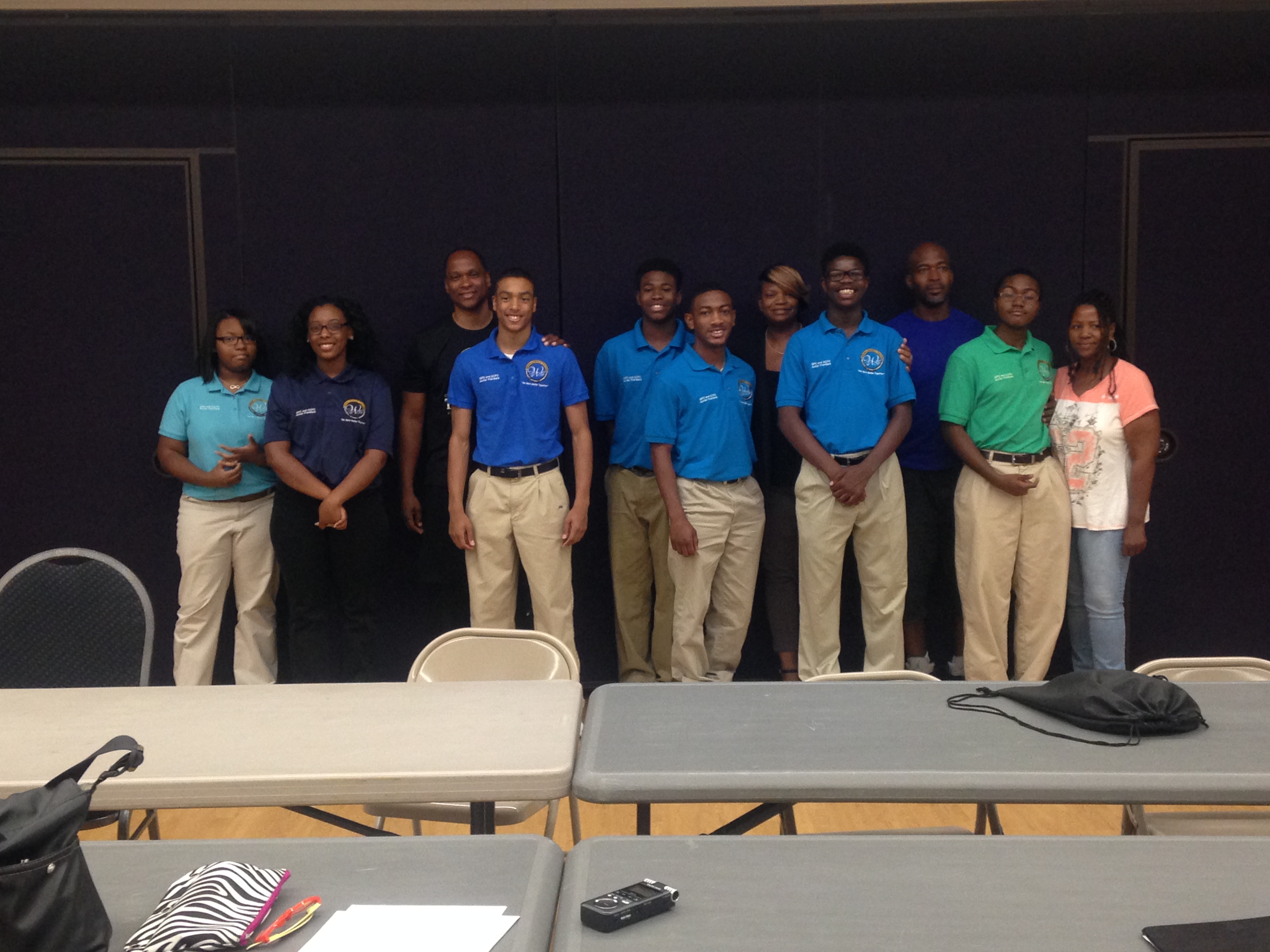
Nylicia King, 16, a sophomore at Broad Ripple High School, Mekiyah Boyd, 14, a freshman at Providence Cristo Rey, and Tinley Accelerated students Haylee Smith, 15, Dajour Finley, 15, Jamari Pollard, 15, and Bryce Orr, 16, joined Mathews on a Saturday at the Avondale Meadows YMCA to talk about what they’ve gained from the project.

“I’m just more informed about what’s happening because if I didn’t know about any of this, I would just be making assumptions on what’s happening, throwing guesses out to the wind and hoping that’s actually what the situation is. Now that I actually know what it is, I can gather my thoughts, and I’m able to back it up,” said Jamari, who also serves as the national Junior Frontiers representative. Before Jamari joined, he knew the Constitution was a thing, but he didn’t know anything about it.

“One thing that I found surprising is that when you get stopped by a policeman, you have the right to say, ‘Am I being detained or am I free to go?’ I didn’t know you could do that,” said Haylee.

Each of them talked with ease about the Constitution’s role in today’s headlines. Most high schools don’t offer a government course until junior year, but these kids have a head start.

“Before I started the group, I really didn’t too much care about politics and what was going on. But now, I’m more aware of what’s going on,” said DaJour.

And while studies have shown that programs focused on the Constitution improve students’ grades, Nylicia has seen it first hand.

“When I started, my grades weren’t bad, but they were like kind of slipping. I got my first D ever. And that was in social studies, and I didn’t ever imagine that I get a D in social studies because I love social studies. But since I’ve been in the program, it’s boosted me,” said the Broad Ripple High School sophomore.

For these students, it’s not just learning about the Constitution, but during their time in the program they are encouraged to graduate and consider post-secondary school.

Tasha Phelps, a Winning Experiences board member and marketing coordinator, frames it this way.

“Perhaps another way to think about our goal is the program that we have is civic education, but the return on student investment of time is college prep,” Phelps said.

In February, the team traveled to Virginia to a Historically Black Colleges and Universities (HBCU) festival.

It opened Haylee’s eyes to the possibilities.

“This program has provided me with a lot of college opportunities that I never would have had before. Like in February we went to a college fair in Virginia, there were 70 colleges there. They were giving out scholarships and accepting scholars on the spot. So when I become a senior, that could possibly be me getting accepted to a college,” he said.

It changed DaJour’s outlook.

“The program changed my perspective on college. I thought it was just another type of place to go, just to go to school, but it’s changed my perspective, and I can see that it’s way more than that. I didn’t know what an HBCU was, and now I know what that is,” he said.

In March, the team visited five HBCU schools: in the Midwest including Fisk, Meharry Medical College and Tennessee State in Tennessee, Central State in Ohio and Kentucky State.

Nylicia wants to be the first person in her family to graduate from college, and she knows she will need help along the way.

“The last college tour was Kentucky State, and they said if you wanted a better way to get college tuition paid for, there’s a representative from your state, and they can help you get that scholarship. I didn’t know, I thought you just went, I thought it was like a college scout that just came, I didn’t know there was a representative,” she said.

Right now the group is preparing for its competition in Philadelphia. Along with that experience in July, the students will stop in Washington to see the Smithsonian’s African American Museum, and after Philadelphia, travel to see the Statue of Liberty in New York.

Desmond, who is also a Winning Experiences youth board member, thinks more urban students should know about the opportunities.

“Something I want other people to know, I think this program should be way bigger than what it is now. It’s a great program that offers great opportunities that all teenagers, really anybody, should be exposed to.

“It’s not all work. People like my friends, I tell them about this program, they think, it’s all work, like we’re always studying the Constitution and we got to memorize the whole thing. We’re doing work, but it’s balanced,” he said.

Winning Experiences has a working board and volunteers who run the programs.

As a board member who enrolled in the adult program, Phelps realizes that the group is only a few years old, and its work is not typical, but she is buoyed by its power.

Phelps believes in this organization that began as an adaptation of an existing model and shows the power of teaching urban students and adults about the Constitution. And with a strong board now in place, she believes, like Desmond, that the organization will only gain momentum and increase its visibility around the country.

Improve fundraising performance with a development audit

By Sponsor Insight

By Andy Canada, senior consultant, Johnson, Grossnickle and Associates

A development audit is a great “barometer” to measure the capabilities of your development office and to establish goals and strategies for future success. This internal assessment is a rare opportunity to get a fresh perspective on a strong development program and can allow you to pause and take stock of how things are going and what resources may be needed to move forward and produce even better results. Development audits can also help solidify an organization’s philanthropic focus by ensuring board, staff and all areas of the organization are working together and embrace a unified culture of philanthropy. Often, organizations seek such an assessment of internal readiness in preparation for a new campaign or as a strategic planning process begins.

A development audit provides an opportunity for an objective overview of your internal development function, including current structure, systems and staffing. The audit process will provide practical advice to position your organization well for a campaign or whatever your next step may be. To be most effective, we believe, audits should include both a qualitative component — built from resource review and interviews with key staff and volunteers — and a quantitative analysis of recent fundraising data.

Here are some questions a development audit can help you answer about your development operation:

  • What is an appropriate level of expectation for the development office?
  • Are we performing to our full potential or are there ways to improve performance?
  • Are we performing to the level of other peer institutions?
  • What is our level of investment to raise funds?
  • Are we utilizing best practices?
  • How does our development performance align with our financial needs?
  • Do we have the appropriate staffing and structure to work with leadership in a cohesive and effective way?
  • How can we position the development office for further success in fundraising?
  • Is the current focus and direction of the development department aligned with the organization’s strategic priorities?
  • If our organization undertakes a new campaign or enhanced fundraising effort, is the current development operation set up to succeed?

View a development audit as an opportunity to move your mission forward. Learn more about using a development audit to help your organization set new goals and advance its development efforts by downloading our tip sheet.


Andy Canada, senior consultant, brings to JGA significant development experience focused in annual giving, planned giving, major gift development, and campaign development and implementation. Prior to joining JGA in 2010, he distinguished himself as development director with both the development teams at Indiana University Foundation and Purdue University, where he participated in significant transformative campaigns.